


Half a century of almost uninterrupted conservative rule in Japan will come to an end this week as Yukio Hatoyama’s Democratic Party of Japan (DPJ) takes power, facing huge pressure to revive the economy.
It is the first time since 1955 that the Liberal Democratic Party (LDP) has been voted out of government in the world’s No. 2 economy, and only their second stint ever in opposition.
Hatoyama — whose DPJ won a landslide general election victory two weeks ago with a promise of change — is set to be appointed prime minister by parliament on Wednesday. Experts say his honeymoon with voters may not last long.
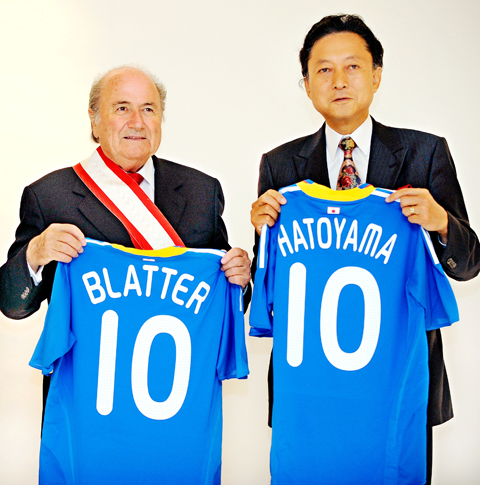
PHOTO: AFP
Opinion polls show the DPJ faces high expectations from voters eager to see an improvement in the ailing economy following the worst slump in decades, but pulling the country out of its long economic malaise will be no easy task.
While the recession may be over, officially at least, unemployment and homelessness are on the rise and the country faces major long-term challenges to cope with an ageing and shrinking population as well as soaring public debt.
“Drastic changes won’t come immediately. But the DPJ must show tangible changes that people can see and feel in order to stay in government,” said Tomoaki Iwai, a professor of politics at Tokyo’s Nihon University.
Hatoyama, 62, has laid out an ambitious agenda, promising to boost household income through financial assistance for families and farmers, free high school school education and an end to highway tolls — all without raising taxes.
He has delighted environmentalists but irked business leaders by pledging to cut Japan’s greenhouse gas emissions by ambitious 25 percent by 2020 from 1990 levels — if other major emitters commit to similarly aggressive goals.
On the diplomatic front, he has vowed to seek an “equal” alliance with the US and has already raised eyebrows in Washington with a spirited critique of US-led globalization and “unrestrained market fundamentalism.”
Hatoyama will make his debut on the world stage as prime minister later this month — addressing the UN General Assembly, meeting US President Barack Obama and taking part in a summit of leaders from the G20 nations. His foremost task during the trip is to confirm Japan’s alliance with the US, having called for a review of US military forces in Japan that provide security for the pacifist nation against the threat from North Korea.
The DPJ, which has long argued that Japan should not be part of “an American war,” has promised to end Japan’s naval refueling mission in the Indian Ocean in support of the NATO-led force in Afghanistan.
“It is only natural that policies change when the government changes,” said Jiro Yamaguchi, a politics professor at Hokkaido University. “Japan should have no reason to be bound by the US policies.”
The DPJ, which has struck a coalition deal with two smaller parties, says it will fund its spending pledges by cutting wasteful spending on public construction projects and a bloated bureaucracy.
The DPJ has never governed before and polls suggest that Japanese are wary about prospects for a change of power. The recent political earthquake was seen as more of a vote against the conservatives than a vote for the Democrats.
The LDP’s only previous stint in opposition lasted for about 10 months in 1993 and 1994, when a group of smaller parties formed a fragile coalition.
Hatoyama has yet to formally confirm his Cabinet line-up, but here are the front-runners for the key posts.
FINANCE MINISTER
Veteran politician Hirohisa Fujii, 77, has been named by the media as the top contender for the post he held briefly in the early 1990s, when he left the long-ruling conservatives to join a short-lived coalition government.
A law graduate of the University of Tokyo, he spent more than two decades with the finance ministry before turning his hand to politics, winning a seat in parliament for the first time in 1977 with the LDP.
He served as finance minister for about 10 months in 1993 and 1994 under prime ministers Morihiro Hosokawa and Tsutomu Hata.
Fujii has held various positions within the DPJ and is currently a senior adviser to the party. He is seen as a close ally of DPJ power broker Ichiro Ozawa, the party’s new secretary-general.
As Japan’s oldest finance minister since Masajuro Shiokawa — who took the job in 2001 at the age of 79 — Fujii would take on the challenge of steering the world’s No. 2 economy through its worst economic slump in decades.
FOREIGN MINISTER
Hatoyama has already said his foreign minister will be Katsuya Okada, a 56-year-old former DPJ leader and one-time trade ministry technocrat known for his deep policy knowledge and straight-laced “Mr Clean” image.
He is known for refusing all gifts, including flowers and chocolates, from supporters, and for usually avoiding alcohol.
Okada has said he sees the alliance with the US as the foundation of Japanese diplomacy but has also advocated reaching out to Asia more.
A law graduate from Tokyo University, Okada has also studied at Harvard Universtiy. He joined the trade ministry in 1976 and was first elected to parliament representing the LDP in 1990. He defected to an opposition party in 1993 which later joined forces with the DPJ. Okada was elected head of the DPJ in 2004 but was forced to step down following a massive defeat in the 2005 general election.
He is the second son of Takuya Okada, who turned his family business into one of Japan’s two biggest supermarket operators, Aeon.
STATE STRATEGY MINISTER
A cofounder of the DPJ, Naoto Kan, 62, is a grassroots activist turned political sharpshooter, known for his tough legislative debating skills. Nicknamed “irritable Kan” for his sometimes short temper, he has been tapped by Hatoyama for the newly created post of state strategy minister, which would give him oversight over all other ministries.
The job will make him a key actor in the DPJ goal of wresting back control over policy and budgets from the vast and powerful state bureaucracy.
Kan was first elected to the lower house in 1980 from the now defunct Social Democratic Federation and later switched parties before joining Hatoyama to launch the DPJ in 1996.
Kan is best known for his work as a health minister in the 1990s, when he pushed civil servants to disclose the ministry’s involvement in allowing the use of imported blood products tainted with HIV.
CHIEF CABINET SECRETARY
Hirofumi Hirano, 60, has been one of Hatoyama’s closest political allies, often standing immediately behind him at press conferences.
A former union official with Panasonic, Hirano would serve as the main spokesman for the prime minister and his Cabinet. After his stint as a union official, Hirano served as an aide to a socialist politician before winning his first lower house seat in 1996.
DPJ SECRETARY-GENERAL
A veteran backroom fixer and the architect of the DPJ’s election victory, Ichiro Ozawa, 67, has already been chosen as the party’s next secretary-general.
Although not a Cabinet minister, Ozawa is expected to play a key role in the party’s election strategy ahead of upper house elections next year.
Ozawa started his political career with the LDP at age 27 and later became its secretary-general, the No. 2 post. He broke with the LDP in 1993 after a factional feud, a move that launched him on a trajectory that would earn him the moniker “The Destroyer” for his record of forging and wrecking parties and alliances.
Ozawa would have been headed for the prime minister’s job himself but was forced to step down as party chief in May, tainted by a donations scandal in which his top aide was indicted. The DPJ’s seismic election victory has raised his clout, especially among the more than 100 rookie lawmakers who have been dubbed “Ozawa’s children” and who owe their political careers to the master strategist.

In the sweltering streets of Jakarta, buskers carry towering, hollow puppets and pass around a bucket for donations. Now, they fear becoming outlaws. City authorities said they would crack down on use of the sacred ondel-ondel puppets, which can stand as tall as a truck, and they are drafting legislation to remove what they view as a street nuisance. Performances featuring the puppets — originally used by Jakarta’s Betawi people to ward off evil spirits — would be allowed only at set events. The ban could leave many ondel-ondel buskers in Jakarta jobless. “I am confused and anxious. I fear getting raided or even

Kemal Ozdemir looked up at the bare peaks of Mount Cilo in Turkey’s Kurdish majority southeast. “There were glaciers 10 years ago,” he recalled under a cloudless sky. A mountain guide for 15 years, Ozdemir then turned toward the torrent carrying dozens of blocks of ice below a slope covered with grass and rocks — a sign of glacier loss being exacerbated by global warming. “You can see that there are quite a few pieces of glacier in the water right now ... the reason why the waterfalls flow lushly actually shows us how fast the ice is melting,” he said.

Eleven people, including a former minister, were arrested in Serbia on Friday over a train station disaster in which 16 people died. The concrete canopy of the newly renovated station in the northern city of Novi Sad collapsed on Nov. 1, 2024 in a disaster widely blamed on corruption and poor oversight. It sparked a wave of student-led protests and led to the resignation of then-Serbian prime minister Milos Vucevic and the fall of his government. The public prosecutor’s office in Novi Sad opened an investigation into the accident and deaths. In February, the public prosecutor’s office for organized crime opened another probe into

RISING RACISM: A Japanese group called on China to assure safety in the country, while the Chinese embassy in Tokyo urged action against a ‘surge in xenophobia’ A Japanese woman living in China was attacked and injured by a man in a subway station in Suzhou, China, Japanese media said, hours after two Chinese men were seriously injured in violence in Tokyo. The attacks on Thursday raised concern about xenophobic sentiment in China and Japan that have been blamed for assaults in both countries. It was the third attack involving Japanese living in China since last year. In the two previous cases in China, Chinese authorities have insisted they were isolated incidents. Japanese broadcaster NHK did not identify the woman injured in Suzhou by name, but, citing the Japanese


 RSS
RSS