


Mexican soldiers arrested a suspected drug gang leader linked to a 2006 border incursion by armed traffickers into Texas and the killing of an anti-crime activist in July, the army said late on Saturday.
The army said in a statement that soldiers acting on a tip about armed men detained Jose Rodolfo Escajeda in Nuevo Casas Grandes, Chihuahua State.
Escajeda and three other suspects detained with him on Friday allegedly worked for the Juarez cartel, named after the border city of Ciudad Juarez, across from El Paso, Texas. The suspects were riding in bullet-resistant vehicles.
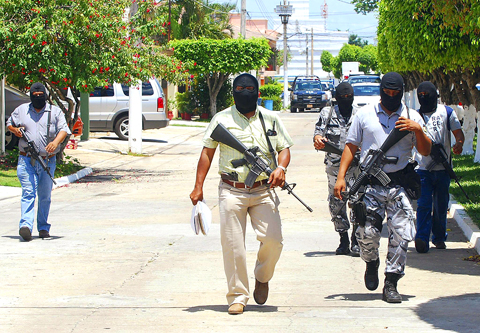
PHOTO: EPA
The army said Escajeda, who is wanted by the US Drug Enforcement Administration (DEA), and the other suspects were turned over to Mexican prosecutors. It did not say whether he would be extradited to face charges in the US.
A US federal grand jury indictment names Escajeda as “allegedly responsible for an incursion into the United States” as well as drug charges, the DEA said.
On Jan. 24, 2006, at least 10 men in Mexican military-style uniforms crossed the Rio Grande into the US on a marijuana-smuggling foray, leading to an armed confrontation with Texas law officers near Neely’s Crossing, Texas, about 80km east of El Paso.
State police tried to stop the three sport utility vehicles, which made a quick U-turn and headed south toward the border, a few kilometers away.
When the SUVs reached the Rio Grande, police saw the occupants of a green, Mexican army-style Humvee apparently waiting for the convoy.
Police stopped and watched as the vehicles began to cross the shallow river into Mexico. Both sides — the Americans and the smugglers — had their weapons drawn, though no shots were fired.
The Mexican army statement called Escajeda “a lieutenant and one of the main operators” of the Juarez cartel, and linked him to the border incursion.
It said Escajeda is also allegedly responsible for the killing of anti-crime activist Benjamin LeBaron and a neighbor near Nuevo Casas Grandes on July 7.
LeBaron — who held dual US and Mexican citizenship — had led protests in May demanding the release of his brother Eric, who was kidnapped and later released.
In related news, gunmen killed a state congressional candidate, his wife and their two sons at their home on Saturday in Tabasco State, southern Mexico.
Jose Francisco Fuentes Esperon, 43, was found dead along with his wife, 38, and two sons aged nine and 13, in Villahermosa, state Attorney General Rafael Gonzalez Lastra said.
Fuentes Esperon was a former university rector and was widely known in the state capital. The state government immediately offered to provide protection for any candidate who wanted it ahead of Oct. 18 elections.
Gonzalez Lastra said that Mexican President Felipe Calderon called Tabasco Governor Andres Granier “to express his support and stress his decision to help in investigating the case to the end.”

PRECARIOUS RELATIONS: Commentators in Saudi Arabia accuse the UAE of growing too bold, backing forces at odds with Saudi interests in various conflicts A Saudi Arabian media campaign targeting the United Arab Emirates (UAE) has deepened the Gulf’s worst row in years, stoking fears of a damaging fall-out in the financial heart of the Middle East. Fiery accusations of rights abuses and betrayal have circulated for weeks in state-run and social media after a brief conflict in Yemen, where Saudi airstrikes quelled an offensive by UAE-backed separatists. The United Arab Emirates is “investing in chaos and supporting secessionists” from Libya to Yemen and the Horn of Africa, Saudi Arabia’s al-Ekhbariya TV charged in a report this week. Such invective has been unheard of
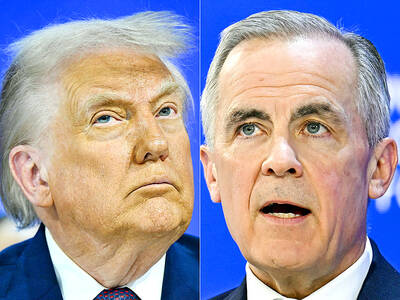
US President Donald Trump on Saturday warned Canada that if it concludes a trade deal with China, he would impose a 100 percent tariff on all goods coming over the border. Relations between the US and its northern neighbor have been rocky since Trump returned to the White House a year ago, with spats over trade and Canadian Prime Minister Mark Carney decrying a “rupture” in the US-led global order. During a visit to Beijing earlier this month, Carney hailed a “new strategic partnership” with China that resulted in a “preliminary, but landmark trade agreement” to reduce tariffs — but

Chinese President Xi Jinping’s (習近平) purge of his most senior general is driven by his effort to both secure “total control” of his military and root out corruption, US Ambassador to China David Perdue said told Bloomberg Television yesterday. The probe into Zhang Youxia (張又俠), Xi’s second-in-command, announced over the weekend, is a “major development,” Perdue said, citing the family connections the vice chair of China’s apex military commission has with Xi. Chinese authorities said Zhang was being investigated for suspected serious discipline and law violations, without disclosing further details. “I take him at his word that there’s a corruption effort under
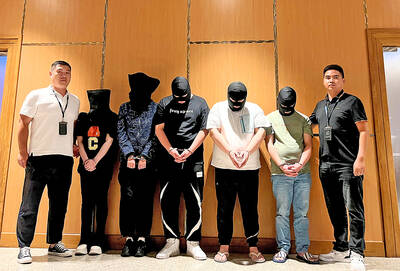
China executed 11 people linked to Myanmar criminal gangs, including “key members” of telecom scam operations, state media reported yesterday, as Beijing toughens its response to the sprawling, transnational industry. Fraud compounds where scammers lure Internet users into fake romantic relationships and cryptocurrency investments have flourished across Southeast Asia, including in Myanmar. Initially largely targeting Chinese speakers, the criminal groups behind the compounds have expanded operations into multiple languages to steal from victims around the world. Those conducting the scams are sometimes willing con artists, and other times trafficked foreign nationals forced to work. In the past few years, Beijing has stepped up cooperation


 RSS
RSS