


Nitrous oxide, the laughing gas used by dentists to pacify anxious patients, is putting stress on the environment and is now the biggest man-made destroyer of the ozone layer. N2O, a gas produced by using fertilizers and burning fuels, accounts for about 40 percent of ozone-destruction after the use of gases such as chlorofluorocarbons, or CFCs, was banned because of their harmful effects, said A.R. Ravishankara, a US National Oceanic and Atmospheric Administration chemist.
Laughing-gas emissions are rising by about 0.25 percent a year and may be responsible for up to 80 percent of human-caused ozone depletion by 2050, said the co-author of a study in the journal Science. Because N2O is also a greenhouse gas, reducing its output will result in a “win-win for both ozone and climate,” his team wrote.
“Nitrous oxide right now is more than twice as large as the next largest ozone-depleting gas,” Ravishankara said in an Aug. 25 telephone interview from Boulder, Colorado. “Nitrous oxide is also a greenhouse gas so if you were to reduce emissions because of the ozone layer issue, you’d also be helping the climate issue.”
The ozone layer, which protects humans from carcinogenic ultraviolet radiation, was depleted by man-made compounds such as halons and CFCs, whose use in aerosol cans and refrigerators was banned by the 1987 Montreal Protocol, an international treaty that didn’t regulate against N2O.
While overall emissions of ozone-depleting gases have gone down, meaning less damage will be done to Earth’s protective layer going forward, N2O emissions haven’t declined so now account for a bigger proportion of the total The researchers calculated the so-called ozone-depletion potential of N2O and found that while proportionally it is only one-sixtieth as damaging as a gas called CFC-11, because so much more nitrous oxide is emitted, it now accounts for more than twice as much ozone destruction.
While the sum total of gases regulated by the Montreal Protocol is still more damaging to the atmosphere than nitrous-oxide emissions, “things will change with time with CFCs declining and N2O growing,” Nobel Prize-winner Paul Crutzen, professor of atmospheric chemistry at the Max Planck Institute for Chemistry in Mainz, Germany, said in an e-mail. Crutzen, who wasn’t part of Friday’s study, shared the 1995 Nobel Prize for Chemistry for his research into ozone.
The ozone layer is found mainly in the stratosphere about 25km above Earth. Ozone depletion above the poles is caused by reactions of ozone, or O3 molecules, with chlorine or nitrogen oxides, triggered by a combination of low temperatures and sunlight.
Because temperatures are colder, Antarctica experiences more depletion than the Arctic and a “hole” forms annually. The ozone hole typically reaches a maximum extent in September or October and last year covered 27 million square kilometers, 2 million square kilometers more than in 2007, the World Meteorological Organization in Geneva said.
N2O is also produced by natural processes, when bacteria convert compounds containing nitrogen in rivers and forests into the gas, Ravishankara said. Anthropogenic or man-made sources include sewage treatment, fuel combustion and fertilizer.

Polish presidential candidates offered different visions of Poland and its relations with Ukraine in a televised debate ahead of next week’s run-off, which remains on a knife-edge. During a head-to-head debate lasting two hours, centrist Warsaw Mayor Rafal Trzaskowski, from Polish Prime Minister Donald Tusk’s governing pro-European coalition, faced the Eurosceptic historian Karol Nawrocki, backed by the right-wing populist Law and Justice party (PiS). The two candidates, who qualified for the second round after coming in the top two places in the first vote on Sunday last week, clashed over Poland’s relations with Ukraine, EU policy and the track records of their
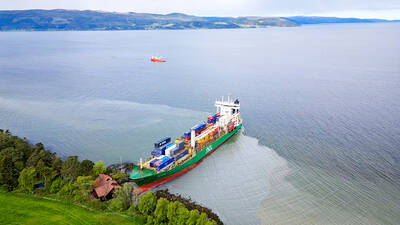
UNSCHEDULED VISIT: ‘It’s a very bulky new neighbor, but it will soon go away,’ said Johan Helberg of the 135m container ship that run aground near his house A man in Norway awoke early on Thursday to discover a huge container ship had run aground a stone’s throw from his fjord-side house — and he had slept through the commotion. For an as-yet unknown reason, the 135m NCL Salten sailed up onto shore just meters from Johan Helberg’s house in a fjord near Trondheim in central Norway. Helberg only discovered the unexpected visitor when a panicked neighbor who had rung his doorbell repeatedly to no avail gave up and called him on the phone. “The doorbell rang at a time of day when I don’t like to open,” Helberg told television

‘A THREAT’: Guyanese President Irfan Ali called on Venezuela to follow international court rulings over the region, whose border Guyana says was ratified back in 1899 Misael Zapara said he would vote in Venezuela’s first elections yesterday for the territory of Essequibo, despite living more than 100km away from the oil-rich Guyana-administered region. Both countries lay claim to Essequibo, which makes up two-thirds of Guyana’s territory and is home to 125,000 of its 800,000 citizens. Guyana has administered the region for decades. The centuries-old dispute has intensified since ExxonMobil discovered massive offshore oil deposits a decade ago, giving Guyana the largest crude oil reserves per capita in the world. Venezuela would elect a governor, eight National Assembly deputies and regional councilors in a newly created constituency for the 160,000
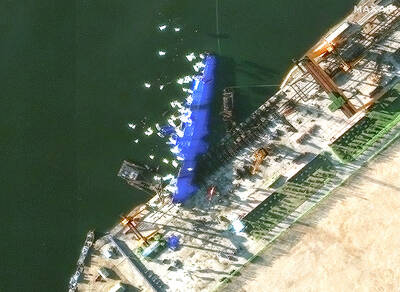
North Korea has detained another official over last week’s failed launch of a warship, which damaged the naval destroyer, state media reported yesterday. Pyongyang announced “a serious accident” at Wednesday last week’s launch ceremony, which crushed sections of the bottom of the new destroyer. North Korean leader Kim Jong-un called the mishap a “criminal act caused by absolute carelessness.” Ri Hyong-son, vice department director of the Munitions Industry Department of the Party Central Committee, was summoned and detained on Sunday, the Korean Central News Agency (KCNA) reported. He was “greatly responsible for the occurrence of the serious accident,” it said. Ri is the fourth person


 RSS
RSS