


The streets of Algiers are deserted following clashes between Chinese and Algerian traders, but the tension is palpable despite comments by Beijing’s envoy describing the unrest as an isolated incident.
“I thought I was going to die,” said Abdelkrim Salaouda, sitting on a chair in front of his shop selling household electrical goods in the city’s Bab Ezzouar quarter, 15km from the city center.
According to Salaouda, the clashes broke out over a dispute on Monday afternoon between a Chinese man and a young Algerian who was accused of having parked his car near his shop.
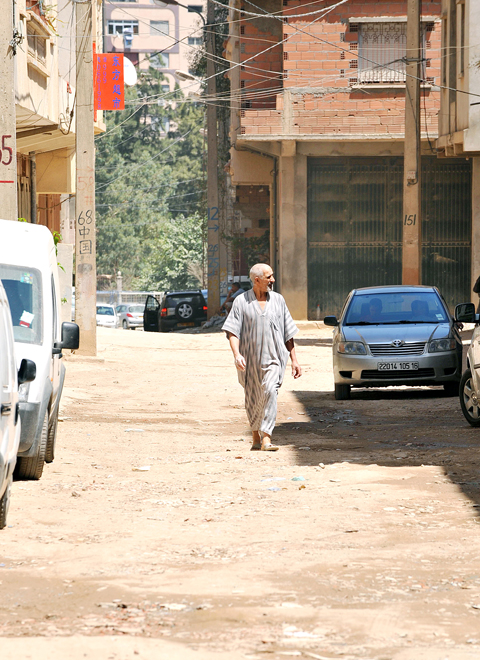
PHOTO: AFP
His brother came to his aid, but around 50 Chinese men, armed with swords, knives and iron bars then set upon the Algerian traders in support of their compatriot, residents said.
“I was going toward my neighbor’s shop when a group of Chinese attacked me and gave me a thrashing,” said Salaouda, whose head was still wrapped in a bandage.
“At the hospital I had to have seven stitches,” he said.
“The Chinese have taken advantage of the kindness of the Algerians. They were accepted despite their faults, today they are attacking us,” added one of Salaouda’s employees, Mounir.
“They drink alcohol in front of their shops and in full view of the Algerians and often parade about in shorts in the area. This sort of behavior is against our religion and our culture,” said Abdellah, another resident.
Since Monday police cars have been patrolling the area along with plainclothes officers.
Salaouda believes that the Chinese traders might now, however, be regretting their behavior after they suggested mediation in order to sort out their differences amicably.
“We don’t want them here any more. The only thing for them to do is to go back to China,” he said, surrounded by dozens of neighbors who nodded in agreement.
The residents had also signed a petition to the authorities calling for the Chinese to be asked to leave, he added.
The usually bustling area was deserted on Wednesday.
All the shops belonging to the Chinese traders were closed and none had appeared in public since the incidents, locals said.
“They are afraid of possible reprisals. On Monday evening young people from neighoring areas attacked four or five shops belonging to the Chinese,” said another man speaking on condition of anonymity.
The police had to intervene late in the evening, he said.
China’s embassy in Algiers on Wednesday played down the clashes as an isolated incident unrepresentative of normal relations.
“This isolated incident does not reflect the relations between Algerians and Chinese,” an embassy spokeswoman said, adding that China “had confidence in the Algerian police” to shed light on the violence.
Chinese traders have flooded the North African country, selling goods at cutthroat prices and sparking growing local resentment.

Through the noise of rushing papers and whirring belts at a print factory in Kyoto, two creators watch their photo essay come to life in broadsheet form — part of an effort to win new audiences in the age of artificial intelligence (AI). Despite the decline of the publishing industry, self-publication and handmade “zine” magazines are growing in popularity in Japan, reflecting the nation’s enduring love of paper in the digital era. While speaking to Agence France-Presse at the plant, his hands black with ink, one of the creators, Kazuma Obara, said: “I think [paper] is a medium that engages all five
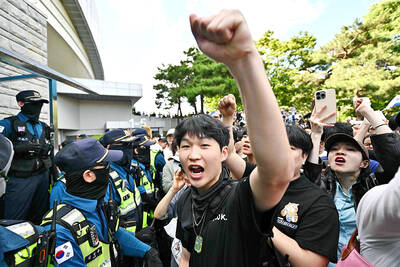
‘ABSURD MISTAKE’: The election commission said that there had been a failure to anticipate turnout after 14 polling stations ran short of ballot papers South Korean riot police yesterday cleared protesters from a Seoul polling station after a 35-hour blockade sparked by a shortage of ballot papers during local elections earlier this week. Wednesday’s election was the first nationwide vote since South Korean President Lee Jae-myung took office following the ouster of Yoon Suk-yeol over his short-lived martial law declaration. Lee’s ruling Democratic Party swept most races, but failed to flip the crucial Seoul mayoral seat. The South Korean National Election Commission apologized, blaming a failure to anticipate turnout after 14 polling stations in Seoul ran short of ballot papers. Some polling stations stayed open until 10pm to

Australian researchers have trained lab-grown brain cells on a silicon computer chip to play the 1990s shooter game Doom and said they are just scratching the surface of what the neurons could be capable of doing. It is the science-fiction work of biotech boffins at Cortical Labs, who researched and developed the technology that harnesses the workings of the brain’s networking system. Each so-called “biological computer” contains about 200,000 living human brain cells, grown from stem cells that were harvested from blood donations. Having mastered the simple computer game Pong, where a paddle is moved up and down to send a ball
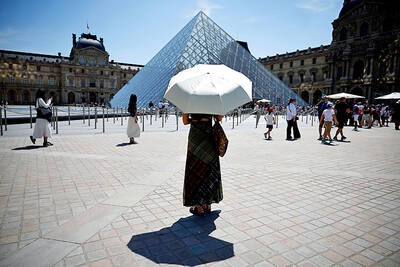
France experienced its hottest spring on record, the French weather service said on Tuesday, after an exceptional early heat wave that also broke highs for the season in England and Wales. Meteo-France said the average nationwide temperature over March to May was 13.8°C — about 1.7°C above the norm, and surpassing records set in 2011 and 2020. “The warmest spring since records began in 1900,” it said in a bulletin. All three months were warmer than average, but the onset of an “unprecedented heatwave” late last month pushed the mercury to highs typically seen at the height of the summer. “Our country had never


 RSS
RSS