


Human rights groups yesterday called for an international investigation into wartime abuses in Sri Lanka, saying the government lacks the political will to investigate the incidents on its own.
Rights groups accused the government of firing heavy weapons into civilian areas in the final months of the country’s quarter-century civil war, which ended last month.
The Tamil Tigers were accused of holding the civilians as human shields and shooting those who tried to flee. Both sides denied the allegations.
UN figures show that more than 7,000 civilians were killed in fighting this year before the war ended last month.
Sri Lankan President Mahinda Rajapaksa told UN Secretary-General Ban Ki-moon the government would look into abuse claims itself, but Human Rights Watch said Sri Lanka’s decision to shut down a presidential inquiry into earlier abuses proved it had little intention of pursuing justice.
That commission was investigating 16 cases, including the killing of 17 aid workers in eastern Sri Lanka in 2006. Though it had only completed seven of the cases, its mandate expired on Sunday and was not renewed.
“The decision to disband the presidential commission shows that President Rajapaksa has little intention of fulfilling his promise to Secretary-General Ban,” said Elaine Pearson, deputy Asia director at the New York-based rights group.
“It’s now up to concerned governments to step in and ensure that justice is done for the victims of abuses in Sri Lanka’s long war,” she said.
The group said that despite tens of thousands of cases of rights violations, including enforced disappearances and unlawful killings, there have only been a small number of prosecutions.
Government spokesmen did not respond to calls for comment.
Officials have previously brushed off calls for an international inquiry as a violation of Sri Lanka’s sovereignty.
Amnesty International, which also called for an international investigation, demanded that the defunct presidential commission’s reports be made public.
“Families of the victims and survivors need answers,” said Yolanda Foster, the London-based group’s Sri Lanka expert. “These people still have not received any justice from the Sri Lankan government, either through the judicial system or through this presidential investigation.”
Meanwhile, the New York-based Committee to Protect journalists said that at least 11 Sri Lankan reporters were forced to flee the country in the past year amid a government crackdown on dissent.
A total of 39 journalists across the globe were forced from their countries, but Sri Lanka had by far the highest number of fleeing reporters, the report said.

Kouri Richins, a Utah mother who published a children’s book about grief after the death of her husband is to serve a life sentence for his murder without the possibility of parole, a judge ruled on Wednesday. Richins was convicted in March of aggravated murder for lacing a cocktail given to her husband, Eric Richins, with five times the lethal dose of fentanyl at their home near Park City in 2022. A jury also found her guilty of four other felonies, including insurance fraud, forgery and attempted murder for trying to poison her husband weeks earlier on Feb. 14, 2022, with a
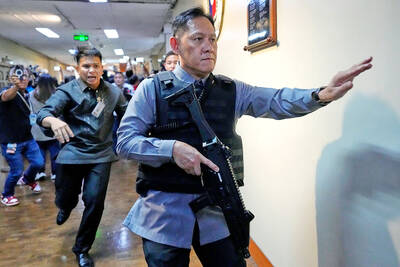
DELA ROSA CASE: The whereabouts of the senator, who is wanted by the ICC, was unclear, while President Marcos faces a political test over the senate situation Philippine authorities yesterday were seeking confirmation of reports that a top politician wanted by the International Criminal Court (ICC) had fled, a day after gunfire rang out at the Philippine Senate where he had taken refuge fearing his arrest. Senator Ronald “Bato” dela Rosa, the former national police chief and top enforcer of former Philippine president Rodrigo Duterte’s “war on drugs,” has been under Senate protection and is wanted for crimes against humanity, the same charges Duterte is accused of. “Several sources confirmed that the senator, Senator Bato, is no longer in the Senate premises, but we are still getting confirmation,” Presidential

HELP DENIED? The US Department of State said that the Cuban leadership refuses to allow the US to provide aid to Cubans, ‘who are in desperate need of assistance’ US Secretary of State Marco Rubio on Wednesday said that Cuba’s leadership must change, as Washington renewed an offer of US$100 million in aid if the communist nation agrees to cooperate. Cuba has been suffering severe economic tumult led by an energy shortage that plunged 65 percent of the country into darkness on Tuesday. Cuba’s leaders have blamed US sanctions, but Rubio, a Cuban American and critic of the government established by Fidel Castro, said the system was to blame, including corruption by the military. “It’s a broken, nonfunctional economy, and it’s impossible to change it. I wish it were different,” he told

Myanmar yesterday published a parliamentary bill proposing the death sentence for those who detain or violently coerce people into working in online scam centers. Internet fraud factories have flourished in Myanmar, part of Southeast Asia’s scam economy, targeting Internet users worldwide with romance and cryptocurrency investment cons. The multibillion-dollar black market attracts many willing employees, but repatriated foreigners have also reported being trafficked to sites in Myanmar and tortured by scam center operators. The draft legislation would allow capital punishment for “violence, torture, unlawful arrest and detention, or cruel treatment against another person for the purpose of forcing them to commit online scams.” The


 RSS
RSS