


Iran suffered a further bout of violence in the run-up to next week’s presidential elections when five people were killed and dozens more injured on Monday in an arson attack in the border town where 25 people died last week in a mosque bombing.
State media said the incident targeted the Mehr Financial and Credit institute in Zahedan, a largely Sunni Muslim town near the eastern border with Pakistan. Iran partially closed the border.
News of the latest violence coincided with reports of arrests over last Thursday’s suicide bombing of a Shiite mosque in Zahedan.
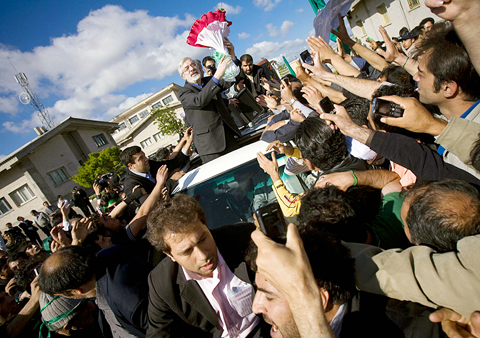
PHOTO: REUTERS
The suicide bombing and a small bomb found on an internal flight to Tehran over the weekend have been blamed on Iran’s foreign enemies by state media.
Iranian Supreme Leader Ayatollah Seyyed Ali Khamenei warned yesterday of an “enemies’ conspiracy ... trying to harm national unity,” the Irna news agency reported.
Analysts suspect that whoever is behind these incidents is being exploited by supporters of the hardline president, Mahmoud Ahmadinejad. He is being challenged in the June 12 vote by three other candidates, two of them reformers seeking improved relations with the West and blaming the incumbent for the country’s current isolation.
Ahmadinejad told a rally yesterday that if he was re-elected he would continue his tough talk.
“We are sorry that certain people inside the country have joined the Zionists in opposing those of us calling the Zionists liars, killers of children and murderers,” he said.
Brigadier General Ahmad Reza Radan, deputy commander of Iran’s security forces, said that “a number of individuals who intended to create insecurity” in Zahedan had been detained.
Zahedan is capital of the province of Sistan-Baluchestan, home to mostly Sunni ethnic Baluchis.
Three men convicted of involvement in the mosque bombing, the deadliest such incident in Iran since the eight-year war with Iraq, were publicly hanged on Saturday.
A Sunni opposition group named Jundullah, or “God’s soldiers,” which Iran says is part of al-Qaeda and backed by the US, claimed responsibility for the mosque bombing.
Manuchehr Mottaki, Iran’s foreign minister, said Jundullah was linked to “foreign forces” in Afghanistan.
Jundullah says it fights for the rights of Iran’s Sunnis and has claimed responsibility for a dozen terrorist attacks in Iran.
The recent incidents are reminiscent of a similar outbreak of violence days before Iran’s last presidential election in 2005, which brought Ahmadinejad to power.
Bombs then hit Tehran and the southwestern city of Ahvaz, which has a sizable Arab minority, killing eight people and wounding scores more.
Meanwhile, Israel warned that Iran could have enough fissile material for its first nuclear bomb by the end of this year.
Brigadier General Yossi Baidatz, head of the research division of Israel’s military intelligence, made the remarks to a foreign affairs committee of the Israeli parliament.
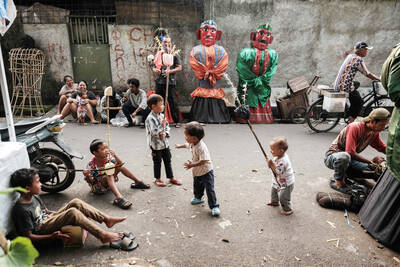
In the sweltering streets of Jakarta, buskers carry towering, hollow puppets and pass around a bucket for donations. Now, they fear becoming outlaws. City authorities said they would crack down on use of the sacred ondel-ondel puppets, which can stand as tall as a truck, and they are drafting legislation to remove what they view as a street nuisance. Performances featuring the puppets — originally used by Jakarta’s Betawi people to ward off evil spirits — would be allowed only at set events. The ban could leave many ondel-ondel buskers in Jakarta jobless. “I am confused and anxious. I fear getting raided or even
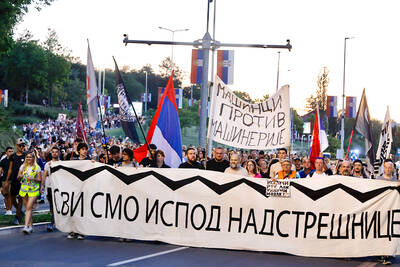
Eleven people, including a former minister, were arrested in Serbia on Friday over a train station disaster in which 16 people died. The concrete canopy of the newly renovated station in the northern city of Novi Sad collapsed on Nov. 1, 2024 in a disaster widely blamed on corruption and poor oversight. It sparked a wave of student-led protests and led to the resignation of then-Serbian prime minister Milos Vucevic and the fall of his government. The public prosecutor’s office in Novi Sad opened an investigation into the accident and deaths. In February, the public prosecutor’s office for organized crime opened another probe into
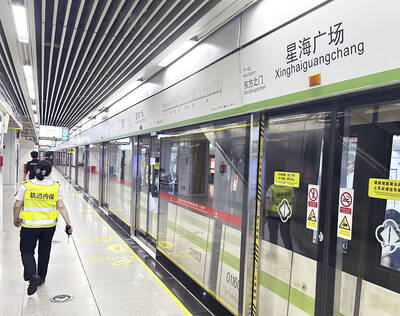
RISING RACISM: A Japanese group called on China to assure safety in the country, while the Chinese embassy in Tokyo urged action against a ‘surge in xenophobia’ A Japanese woman living in China was attacked and injured by a man in a subway station in Suzhou, China, Japanese media said, hours after two Chinese men were seriously injured in violence in Tokyo. The attacks on Thursday raised concern about xenophobic sentiment in China and Japan that have been blamed for assaults in both countries. It was the third attack involving Japanese living in China since last year. In the two previous cases in China, Chinese authorities have insisted they were isolated incidents. Japanese broadcaster NHK did not identify the woman injured in Suzhou by name, but, citing the Japanese
RESTRUCTURE: Myanmar’s military has ended emergency rule and announced plans for elections in December, but critics said the move aims to entrench junta control Myanmar’s military government announced on Thursday that it was ending the state of emergency declared after it seized power in 2021 and would restructure administrative bodies to prepare for the new election at the end of the year. However, the polls planned for an unspecified date in December face serious obstacles, including a civil war raging over most of the country and pledges by opponents of the military rule to derail the election because they believe it can be neither free nor fair. Under the restructuring, Myanmar’s junta chief Min Aung Hlaing is giving up two posts, but would stay at the


 RSS
RSS