


A shocking video depicting infanticide among Amazon tribes has revived a debate in Brazil about whether the practice should be criminalized, or respected as a traditional belief.
The debate was given new vigor by the emergence of the video, which was posted online by the Hakani Campaign, an organization opposed to the practice.
The live burial depicted in the Hakani video is one of several ways infanticide is practiced among indigenous tribes, who also differ in their reasons for the tradition.
In some cases, the children affected are born albino or with birth defects and are either buried alive or abandoned in the forest.
Other tribes believe that sets of twins represent the pairing of good and evil and will kill the baby they think represents the latter.
But the video has been attacked by supporters of indigenous rights, who claim it was illegally obtained by Christian missionaries.
A spokesperson for the National Foundation for Indians (FUNAI) said that evangelical missionaries filmed the video among the recently discovered Suruwaha tribe.
He accused the group of “interfering in the social interactions of people who have chosen to distance themselves from Western culture and preserve their traditions.”
In statements on its Web site, the Hakani organization rejects claims that the video was obtained illegally, but it does acknowledge that the footage was filmed by members of Youth with a Mission, an evangelical organization that calls on its associates “to know God and to make Him known.”
Survival International, a non-governmental organization that defends indigenous rights, cast doubt on whether the burial depicted in the controversial video is even real and has accused the filmmakers of inciting racial hatred against Indians.
The organization says the film, which has been viewed by more than 500,000 people on video-sharing Web site Youtube, is a clear attempt to put pressure on the Brazilian government to pass legislation banning infanticide.
Since 2007, a group of lawmakers has been attempting to adopt legislation that would prosecute individuals who know infanticide is going to happen but fail to report it to authorities.
FUNAI believes the issue is best debated by Indians, anthropologists, human rights organizations and the UN.
The practice of infanticide will eventually die out on its own, said Saulo Ferreira Feitosa, a professor of bioethics at Brasilia University and vice president of the Catholic Indigenous Missionary Committee.
“Of the 250 indigenous tribes in Brazil, we think this practice still exists in only 13,” he said.
“This type of problem will not be solved with punitive legislation. If that were the case we would not have a million underground abortions” in Brazil, where the procedure is illegal, he said.

ACTIONABLE ADVICE: The majority of chatbots tested provided guidance on weapons, tactics and target selections, with Perplexity and Meta AI deemed to be the least safe From school shootings to synagogue bombings, leading artificial intelligence (AI) chatbots helped researchers plot violent attacks, according to a study published on Wednesday that highlighted the technology’s potential for real-world harm. Researchers from the nonprofit watchdog Center for Countering Digital Hate and CNN posed as 13-year-old boys in the US and Ireland to test 10 chatbots, including ChatGPT, Google Gemini, Perplexity, Deepseek and Meta AI. Eight of the chatbots assisted the make-believe attackers in more than half the responses, providing advice on “locations to target” and “weapons to use” in an attack, the study said. The chatbots had become a “powerful accelerant for
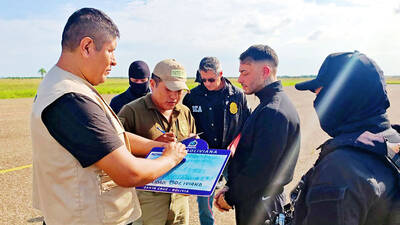
KINGPIN: Marset allegedly laundered the proceeds of his drug enterprise by purchasing and sponsoring professional soccer teams and even put himself in the starting lineups Notorious Latin American narco trafficker Sebastian Marset, who eluded police for years, was handed over to US authorities after his arrest on Friday in Bolivia. Marset, a Uruguayan national who was on the US most-wanted list, was passed to agents of the US Drug Enforcement Administration at Santa Cruz airport in Bolivia, then put on a US airplane, Bolivian state television showed. “The arrest and deportation were carried out pursuant to a court order issued by the US justice system,” Bolivian Minister of Government Marco Antonio Oviedo told reporters. The alleged kingpin was arrested in an upscale neighborhood of Santa
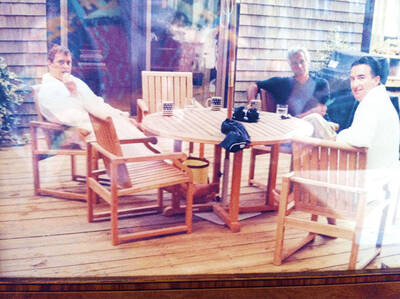
SCANDAL: Other images discovered earlier show Andrew bent over a female and lying across the laps of a number of women, while Mandelson is pictured in his underpants A photograph of former British prince Andrew and veteran politician Peter Mandelson sitting in bathrobes alongside late sex offender Jeffrey Epstein was unearthed on Friday in previously published documents. The image is believed to be the first known photograph of the two men with Epstein. They are currently engulfed in scandal in the UK over their ties to their mutual friend. The undated photograph, first reported by ITV News, shows King Charles III’s disgraced brother and former British ambassador to the US sitting barefoot outside on a wooden deck. They appear to have mugs with a US flag on them

Since the war in the Middle East began nearly two weeks ago, the telephone at Ron Hubbard’s bomb shelter company in Texas has not stopped ringing. Foreign and US clients are rushing to buy his bunkers, seeking refuge in case of air raids, nuclear fallout or apocalypse. With the US and Israel pounding Iran, and Tehran retaliating with strikes across the region, Hubbard has seen demand for his product soar, mostly from Gulf nation customers in Bahrain, Qatar, Kuwait and the United Arab Emirates. “You can imagine how many people are thinking: ‘I wish I had a bomb shelter,’” Hubbard, 63, said in


 RSS
RSS