


Police and protesters clashed in Georgia on Wednesday during a month-long opposition campaign to oust President Mikheil Saakashvili, stoking fears of unrest after a failed military mutiny.
Police accused protesters of trying to storm their base, while television pictures showed police and demonstrators trading blows with batons and sticks across a metal gate dividing them.
Police denied opposition accusations they fired rubber bullets as several hundred people converged on the base. Police said 22 protesters and six policemen were wounded. The opposition said several of its leaders were treated in hospital.
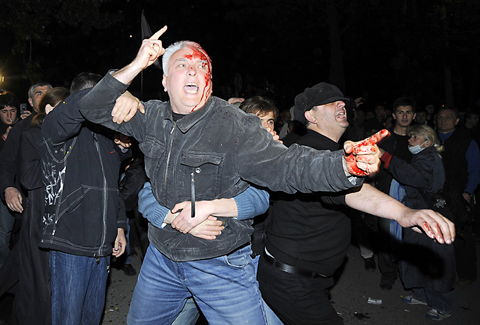
PHOTO: REUTERS
“This president has dug his own grave,” opposition leader and former Saakashvili ally Nino Burjanadze told supporters rallying outside parliament after the violence. “We’ll be standing and fighting until the very end.”
Georgia said it put down a brief, bloodless mutiny at a tank base on Tuesday and accused neighboring Russia of plotting a wider rebellion against Saakashvili nine months after a war between the former Soviet neighbors.
NATO began military exercises in Georgia on Wednesday which Russia had condemned as “muscle-flexing” on its southern border.
Georgia has been braced for unrest since the opposition began daily protests on April 9. The protesters have blocked streets in downtown Tbilisi and demanded Saakashvili quit over his record on democracy and last year’s war, when Russia crushed a Georgian assault on breakaway South Ossetia.
Several hundred people had surrounded the police base demanding the release of three opposition activists being held over the beating of a journalist on Tuesday. Masked riot police took position in the grounds.
The West has been watching for a possible repeat of a 2007 police crackdown against the last peaceful mass demonstrations against the 41-year-old president.
Deputy Interior Minister Eka Zguladze told Georgian radio that police had been attacked.
“The police received an order to protect the perimeter,” she said.
At a meeting of the 28 NATO states and their Georgian counterpart in Brussels on Wednesday, NATO called for dialogue between Georgia’s government and the opposition, for reforms to ensure freedom of media and assembly, and for the government to avoid violence against protests, a NATO spokeswoman said.

‘CROSSING THE LINE’: China’s embassy in Seoul criticized US Forces Korea Commander General Xavier Brunson, asking if his ‘hostile’ remarks were authorized by Washington South Korea and the US are in talks over recent public remarks by the commander of US Forces Korea, Seoul’s presidential office said yesterday, after the comments drew sharp criticism from China. In a recent podcast interview, US Forces Korea Commander General Xavier Brunson described South Korea as “the dagger in the heart of Asia” from China’s east coast, prompting the Chinese embassy in Seoul to say that he had “truly crossed the line.” The interview came amid growing speculation that Washington might seek to expand the role of US Forces Korea in countering the growing regional influence of China, a key

Through the noise of rushing papers and whirring belts at a print factory in Kyoto, two creators watch their photo essay come to life in broadsheet form — part of an effort to win new audiences in the age of artificial intelligence (AI). Despite the decline of the publishing industry, self-publication and handmade “zine” magazines are growing in popularity in Japan, reflecting the nation’s enduring love of paper in the digital era. While speaking to Agence France-Presse at the plant, his hands black with ink, one of the creators, Kazuma Obara, said: “I think [paper] is a medium that engages all five

Australian researchers have trained lab-grown brain cells on a silicon computer chip to play the 1990s shooter game Doom and said they are just scratching the surface of what the neurons could be capable of doing. It is the science-fiction work of biotech boffins at Cortical Labs, who researched and developed the technology that harnesses the workings of the brain’s networking system. Each so-called “biological computer” contains about 200,000 living human brain cells, grown from stem cells that were harvested from blood donations. Having mastered the simple computer game Pong, where a paddle is moved up and down to send a ball

France experienced its hottest spring on record, the French weather service said on Tuesday, after an exceptional early heat wave that also broke highs for the season in England and Wales. Meteo-France said the average nationwide temperature over March to May was 13.8°C — about 1.7°C above the norm, and surpassing records set in 2011 and 2020. “The warmest spring since records began in 1900,” it said in a bulletin. All three months were warmer than average, but the onset of an “unprecedented heatwave” late last month pushed the mercury to highs typically seen at the height of the summer. “Our country had never


 RSS
RSS