


Iraq summoned Iran’s ambassador to condemn Iranian shelling of villages in its northern Kurdistan region, the Iraqi government said on Tuesday, warning of “negative consequences” if attacks continued.
Iran shelled a Kurdish village in a remote area of northern Iraq’s largely autonomous Kurdistan region on Monday, causing damage to buildings but no casualties, border police said.
That followed Iranian shelling on Saturday of Kurdish rebel positions in another part of Iraqi Kurdistan. Helicopters were also used to fire from the Iranian side of the border.
The national media center said the Iraqi foreign ministry had “handed over an official condemnation letter to Iranian Ambassador Hassan Kazemi-Qomi for the shelling of the border villages inside Iraqi territory by Iranian forces.”
It said that Iraq’s office for neighboring state affairs had summoned the Iranian ambassador late on Monday to deliver the letter to him.
“The Iraqi Foreign Ministry demanded an immediate end to those violations which could lead to negative consequences for bilateral relations,” the media center said in a statement.
Villagers were wounded in the attacks, the statement said, in contrast to the border police who said no one was hurt in either attack.
Renewed shelling from Iran was reported on Tuesday.
Brigadier General Ahmed Gharib, a border guard official in the Kurdish city of Sulaimaniya, said the shelling took place in mountain areas. No one was hurt but one home was damaged.
Iranian forces often clash with guerrillas from the Party of Free Life of Kurdistan (PJAK), an offshoot of the Kurdistan Workers Party (PKK) which took up arms in 1984 for an ethnic homeland in southeast Turkey.
PJAK and PKK fighters are also present in Iraq.
“The Iraqi side understands Iran’s objectives to discipline its borders but that should not be done unilaterally,” the national media center statement said.
The two countries fought a war in the 1980s, but since the ouster of Sunni Arab Saddam Hussein as Iraqi president in 2003, relations between majority Shiite Muslim Iraq and Iran, another mainly Shiite nation, have improved.
In related news, a car bomb exploded yesterday at the entrance to a fruit and vegetable market in south Baghdad, killing 11 people and wounding about 30, police and hospital officials said.
The explosion, which occurred at about 7am at the Rasheed market in the city’s southern Dora area, follows a sharp rise in attacks in Iraq last month, raising concern that militants have regrouped after suffering sharp setbacks in fighting over the last two years.
Most of the recent bombings have taken place in Shiite areas, suggesting Sunni militants such as al-Qaeda in Iraq are responsible.
The Rasheed market is in a mainly Sunni area, but the farmers who bring their crops there are predominantly Shiites.

Australians were downloading virtual private networks (VPNs) in droves, while one of the world’s largest porn distributors said it was blocking users from its platforms as the country yesterday rolled out sweeping online age restriction. Australia in December became the first country to impose a nationwide ban on teenagers using social media. A separate law now requires artificial intelligence (AI)-powered chatbot services to keep certain content — including pornography, extreme violence and self-harm and eating disorder material — from minors or face fines of up to A$49.5 million (US$34.6 million). The country also joined Britain, France and dozens of US states requiring

Hungarian authorities temporarily detained seven Ukrainian citizens and seized two armored cars carrying tens of millions of euros in cash across Hungary on suspicion of money laundering, officials said on Friday. The Ukrainians were released on Friday, following their detention on Thursday, but Hungarian officials held onto the cash, prompting Ukraine to accuse Hungary’s Russia-friendly government of illegally seizing the money. “We will not tolerate this state banditism,” Ukrainian Minister of Foreign Affairs Andrii Sybiha said. The seven detained Ukrainians were employees of the Ukrainian state-owned Oschadbank, who were traveling in the two armored cars that were carrying the money between Austria and
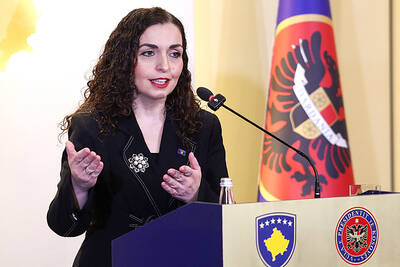
Kosovar President Vjosa Osmani on Friday after dissolving the Kosovar parliament said a snap election should be held as soon as possible to avoid another prolonged political crisis in the Balkan country at a time of global turmoil. Osmani said it is important for Kosovo to wrap up the upcoming election process and form functional institutions for political stability as the war rages in the Middle East. “Precisely because the geopolitical situation is that complex, it is important to finish this electoral process which is coming up,” she said. “It is very hard now to imagine what will happen next.” Kosovo, which declared

MORE BANS: Australia last year required sites to remove accounts held by under-16s, with a few countries pushing for similar action at an EU level and India considering its own ban Indonesia on Friday said it would ban social media access for children under 16, citing threats from online pornography, cyberbullying, online fraud and Internet addiction. “Accounts belonging to children under 16 on high-risk platforms will start to be deactivated, beginning with YouTube, TikTok, Facebook, Instagram, Threads, X, Bigo Live and Roblox,” Indonesian Minister of Communications and Digital Meutya Hafid said. “The government is stepping in so that parents no longer have to fight alone against the giants of the algorithm. Implementation will begin on March 28, 2026,” she said. The social media ban would be introduced in stages “until all platforms fulfill their


 RSS
RSS