


As power changed hands in Spain’s troubled Basque region yesterday, the confirmation of Patxi Lopez as the new regional prime minister was overshadowed by the threat of violence from the militant separatist group ETA.
Security was stepped up ahead of the parliamentary session that is due to elect Lopez prime minister after ETA announced it would make it a “priority” to target the region’s first government clearly defending its unity with Spain.
The recent arrest of ETA’s military leader foiled a car bombing planned for yesterday.
Graffiti threatening Lopez’s Socialist Party has appeared in Basque villages, and the names of some of Lopez’s future Cabinet members were not revealed early on for fear of attacks before they were supplied with bodyguards.
Yet even if ETA’s violence is expected to increase in the short run, there are also growing signs that its strategy of an armed struggle could be coming to the end of the road.
CHANGE OF POWER
Lopez will end the political domination of the moderate Basque Nationalist Party (PNV), which has currents favorable to independence and had governed the region of 2.2 million residents since it was given a wide autonomy three decades ago.
The PNV won the regional elections in March, but the Socialists’ unofficial alliance with the conservative People’s Party (PP) will allow Lopez to form a minority government that is seen as heralding a new era.
On the national level, Spanish Prime Minister Jose Luis Rodriguez Zapatero’s Socialists and the PP are at odds, but they joined forces to fight separatist potential in the Basque region.
During the 1939 to 1975 dictatorship of General Francisco Franco, many Basques saw ETA as defending Basque culture against Spanish oppression.
After Franco’s death, however, the self-government granted to the region made ETA’s shootings and bombings look increasingly unnecessary.
DISAPPROVAL
Even in radical separatist circles, 66 percent of the Basques disapprove of ETA’s violence, while only 2 percent back it unconditionally, according to a poll last year.
ETA’s shrinking support has run parallel with its military decline, with Spanish and French police constantly arresting members of the group.
ETA killed four people last year, down from dozens annually in its heyday in the 1980s.
ETA is listed as a terrorist organization by the EU and the US.
Political parties linked to ETA have been barred from elections, a factor which has led many radical separatists to question the group’s violent strategy.
Arnaldo Otegi, leader of ETA’s outlawed political wing Batasuna, is seeking to unite a part of the separatist parties, trade unions and organizations in an attempt to switch from military to political methods in the campaign for independence, the daily El Pais said.
Otegi, however, described such reports as seeking to divide the separatist left.
Even ETA itself is now thought to be divided between those seeing armed struggle as hopeless and hardliners hoping to violently pressure the government into negotiations.

FRAUD ALLEGED: The leader of an opposition alliance made allegations of electoral irregularities and called for a protest in Tirana as European leaders are to meet Albanian Prime Minister Edi Rama’s Socialist Party scored a large victory in parliamentary elections, securing him his fourth term, official results showed late on Tuesday. The Socialist Party won 52.1 percent of the vote on Sunday compared with 34.2 percent for an alliance of opposition parties led by his main rival Sali Berisha, according to results released by the Albanian Central Election Commission. Diaspora votes have yet to be counted, but according to initial results, Rama was also leading there. According to projections, the Socialist Party could have more lawmakers than in 2021 elections. At the time, it won 74 seats in the

EUROPEAN FUTURE? Albanian Prime Minister Edi Rama says only he could secure EU membership, but challenges remain in dealing with corruption and a brain drain Albanian Prime Minister Edi Rama seeks to win an unprecedented fourth term, pledging to finally take the country into the EU and turn it into a hot tourist destination with some help from the Trump family. The artist-turned-politician has been pitching Albania as a trendy coastal destination, which has helped to drive up tourism arrivals to a record 11 million last year. US President Donald Trump’s son-in-law, Jared Kushner, also joined in the rush, pledging to invest US$1.4 billion to turn a largely deserted island into a luxurious getaway. Rama is expected to win another term after yesterday’s vote. The vote would
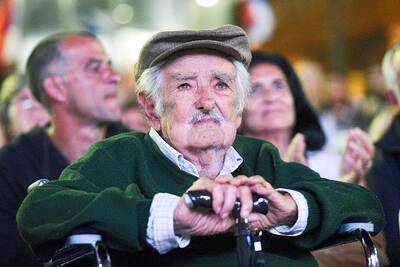
CANCER: Jose Mujica earned the moniker ‘world’s poorest president’ for giving away much of his salary and living a simple life on his farm, with his wife and dog Tributes poured in on Tuesday from across Latin America following the death of former Uruguayan president Jose “Pepe” Mujica, an ex-guerrilla fighter revered by the left for his humility and progressive politics. He was 89. Mujica, who spent a dozen years behind bars for revolutionary activity, lost his battle against cancer after announcing in January that the disease had spread and he would stop treatment. “With deep sorrow, we announce the passing of our comrade Pepe Mujica. President, activist, guide and leader. We will miss you greatly, old friend,” Uruguayan President Yamandu Orsi wrote on X. “Pepe, eternal,” a cyclist shouted out minutes later,
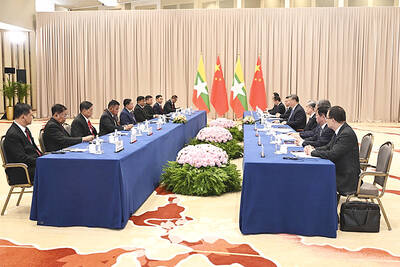
Myanmar’s junta chief met Chinese President Xi Jinping (習近平) for the first time since seizing power, state media reported yesterday, the highest-level meeting with a key ally for the internationally sanctioned military leader. Senior General Min Aung Hlaing led a military coup in 2021, overthrowing Myanmar’s brief experiment with democracy and plunging the nation into civil war. In the four years since, his armed forces have battled dozens of ethnic armed groups and rebel militias — some with close links to China — opposed to its rule. The conflict has seen Min Aung Hlaing draw condemnation from rights groups and pursued by the


 RSS
RSS