


Nepal’s prime minister resigned yesterday amid a power struggle over his firing of the army chief, saying he was stepping down to “save the peace process” that brought the Himalayan nation out of a bloody decade-long civil war.
Nepali Prime Minister Pushpa Kamal Dahal, a former Maoist guerrilla leader, made the announcement on TV yesterday afternoon, one day after his firing of the army chief was rejected by Nepali President Ram Baran Yadav — who officially leads the army — and which caused some of his key political allies to withdraw from the ruling coalition.
“The unconstitutional and undemocratic move by the president has pushed the country toward a serious political crisis. The president has no power to act alone without prior approval of the Cabinet on such matters,” Dahal said in his resignation speech. “It is a fatal attack on the infant democracy.”
Nepal’s Maoists fought a bloody, 10-year war against the government before joining the political mainstream in 2006, and then winning the most votes during elections last year that helped bring an end to the Himalayan country’s centuries-old monarchy.
But despite the Maoists’ rise to power, many of their former fighters remain restricted to UN-monitored barracks under a peace accord.
Dahal wanted the guerrillas freed and integrated into the military, as prescribed under a UN-brokered peace agreement. But the army chief resisted those efforts and sparred repeatedly with the government.
Dahal said yesterday he decided to step down “to create a conducive environment and save the peace process.”
After Dahal dismissed Katawal, the Maoist’s main coalition partner, the Communist Party of Nepal (United Marxist Leninist), and other key coalition members withdrew from the government.
Dahal’s Communist Party of Nepal (Maoist) has the most members in the national assembly but does not hold a majority and needs the support of smaller parties to stay in control of the government.
Immediately following the prime minister’s announcement, authorities announced a ban on protests in key parts of Kathmandu, including areas around the president’s residence and office. Police in riot gear were deployed across the city.
Security forces had already been on alert, anticipating street clashes.
Earlier yesterday, thousands of Maoist supporters rallied in Kathmandu to show support for the government and denounce the president’s action. Elsewhere in the city, supporters of the main opposition, the Nepali Congress party, blocked traffic with burning tires, chanting slogans against the government and the Maoists.
There were no reports of any clashes between the two sides, but Home Ministry official Navin Ghimire said security forces were preparing to deal with unrest.

Republican US lawmakers on Friday criticized US President Joe Biden’s administration after sanctioned Chinese telecoms equipment giant Huawei unveiled a laptop this week powered by an Intel artificial intelligence (AI) chip. The US placed Huawei on a trade restriction list in 2019 for contravening Iran sanctions, part of a broader effort to hobble Beijing’s technological advances. Placement on the list means the company’s suppliers have to seek a special, difficult-to-obtain license before shipping to it. One such license, issued by then-US president Donald Trump’s administration, has allowed Intel to ship central processors to Huawei for use in laptops since 2020. China hardliners

Conjoined twins Lori and George Schappell, who pursued separate careers, interests and relationships during lives that defied medical expectations, died this month in Pennsylvania, funeral home officials said. They were 62. The twins, listed by Guinness World Records as the oldest living conjoined twins, died on April 7 at the Hospital of the University of Pennsylvania, obituaries posted by Leibensperger Funeral Homes of Hamburg said. The cause of death was not detailed. “When we were born, the doctors didn’t think we’d make 30, but we proved them wrong,” Lori said in an interview when they turned 50, the Philadelphia Inquirer reported. The
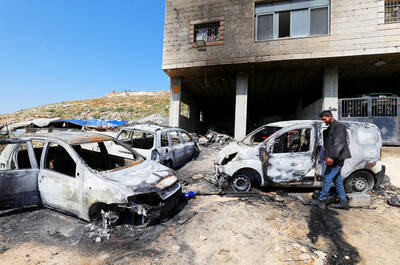
RAMPAGE: A Palestinian man was left dead after dozens of Israeli settlers searching for a missing 14-year-old boy stormed a village in the Israeli-occupied West Bank US President Joe Biden on Friday said he expected Iran to attack Israel “sooner, rather than later” and warned Tehran not to proceed. Asked by reporters about his message to Iran, Biden simply said: “Don’t,” underscoring Washington’s commitment to defend Israel. “We are devoted to the defense of Israel. We will support Israel. We will help defend Israel and Iran will not succeed,” he said. Biden said he would not divulge secure information, but said his expectation was that an attack could come “sooner, rather than later.” Israel braced on Friday for an attack by Iran or its proxies as warnings grew of

IN PURSUIT: Israel’s defense minister said the revenge attacks by Israeli settlers would make it difficult for security forces to find those responsible for the 14-year-old’s death Israeli Prime Minister Benjamin Netanyahu on Saturday condemned the “heinous murder” of an Israeli teenager in the occupied West Bank as attacks on Palestinian villages intensified following news of his death. After Benjamin Achimeir, 14, was reported missing near Ramallah on Friday, hundreds of Jewish settlers backed by Israeli forces raided nearby Palestinian villages, torching vehicles and homes, leaving at least one villager dead and dozens wounded. The attacks escalated in several villages on Saturday after Achimeir’s body was found near the Malachi Hashalom outpost. Agence France-Presse correspondents saw smoke rising from burned houses and fields. Mayor Amin Abu Alyah, of the


 RSS
RSS