


Bolivia launched an investigation on Friday into a suspected militant group that police said was plotting to kill Bolivian President Evo Morales, but the opposition slammed the probe as an “international show.”
Three suspected mercenaries were killed in a shootout on Thursday in the anti-Morales stronghold of Santa Cruz after police moved to arrest a gang that officials said traveled from Ireland or Croatia to kill leading public figures in the Andean nation.
“The investigative work is now in the hands of prosecutors. I hope they do their work quickly so we can have clear and concrete information” about who was behind the conspiracy, police chief Victor Hugo Escobar told state TV.
Interpol has offered to help Bolivia with the investigation. But opposition Senate chief Oscar Ortiz said investigators “should aim to find the truth, instead of helping the president stage an international show.”
Ortiz attacked Morales for “playing the victim” and said the country’s first indigenous leader was trying to disparage the eastern city of Santa Cruz because he lacked support there.
Morales has accused right-wing politicians and business leaders in Santa Cruz of organizing violent protests there last year to try to destabilize his government.
On Thursday, he said the rightist opposition wanted to “riddle us with bullets,” referring to himself and the vice president.
Government officials said the suspected conspirators had also targeted Santa Cruz Governor Ruben Costas, a fierce Morales’ critic.
They said the men were likely behind a dynamite attack on the residence of Roman Catholic Cardinal Julio Terrazas earlier this week. The cardinal was not home at the time.
“The terrorist group had a strategy and part of the strategy was to attack the cardinal ... and [take] other actions, not only against the president or vice president, but other authorities as well,” Bolivian Deputy Interior Minister Marcos Farfan told the Erbol radio network.
Farfan said the suspected plotters tried to blow up a navy boat on which Morales met with Cabinet ministers two weeks ago and aimed to trigger “a spiral of violence” in Bolivia.
The head of the Organization of American States, Jose Miguel Insulza, condemned the suspected assassination plot on Friday after meeting with the Bolivian foreign minister in Trinidad and Tobago, where Morales was attending the Summit of the Americas.
Confusion lingered over the nationalities of the three men killed. State news agency ABI reported that one of them was a Bolivian-Hungarian, Eduardo Rozsa Flores, who fought in separatist movements in the former Yugoslavia.
ABI said the other two men who died in the gunfight hailed from Ireland and Romania, although Bolivian authorities initially said two of the men had been Hungarian.
Police arrested two others in the Santa Cruz raid, whom local media identified as a Bolivian and a Hungarian. Authorities said police confiscated sniper rifles, high-caliber guns and other explosives from a nearby building.
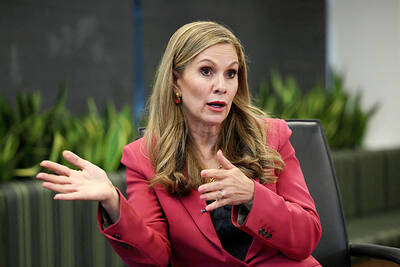
Australians were downloading virtual private networks (VPNs) in droves, while one of the world’s largest porn distributors said it was blocking users from its platforms as the country yesterday rolled out sweeping online age restriction. Australia in December became the first country to impose a nationwide ban on teenagers using social media. A separate law now requires artificial intelligence (AI)-powered chatbot services to keep certain content — including pornography, extreme violence and self-harm and eating disorder material — from minors or face fines of up to A$49.5 million (US$34.6 million). The country also joined Britain, France and dozens of US states requiring
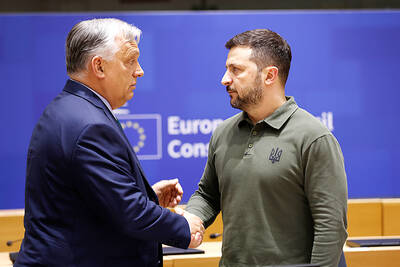
Hungarian authorities temporarily detained seven Ukrainian citizens and seized two armored cars carrying tens of millions of euros in cash across Hungary on suspicion of money laundering, officials said on Friday. The Ukrainians were released on Friday, following their detention on Thursday, but Hungarian officials held onto the cash, prompting Ukraine to accuse Hungary’s Russia-friendly government of illegally seizing the money. “We will not tolerate this state banditism,” Ukrainian Minister of Foreign Affairs Andrii Sybiha said. The seven detained Ukrainians were employees of the Ukrainian state-owned Oschadbank, who were traveling in the two armored cars that were carrying the money between Austria and
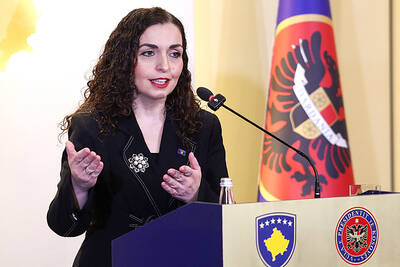
Kosovar President Vjosa Osmani on Friday after dissolving the Kosovar parliament said a snap election should be held as soon as possible to avoid another prolonged political crisis in the Balkan country at a time of global turmoil. Osmani said it is important for Kosovo to wrap up the upcoming election process and form functional institutions for political stability as the war rages in the Middle East. “Precisely because the geopolitical situation is that complex, it is important to finish this electoral process which is coming up,” she said. “It is very hard now to imagine what will happen next.” Kosovo, which declared

MORE BANS: Australia last year required sites to remove accounts held by under-16s, with a few countries pushing for similar action at an EU level and India considering its own ban Indonesia on Friday said it would ban social media access for children under 16, citing threats from online pornography, cyberbullying, online fraud and Internet addiction. “Accounts belonging to children under 16 on high-risk platforms will start to be deactivated, beginning with YouTube, TikTok, Facebook, Instagram, Threads, X, Bigo Live and Roblox,” Indonesian Minister of Communications and Digital Meutya Hafid said. “The government is stepping in so that parents no longer have to fight alone against the giants of the algorithm. Implementation will begin on March 28, 2026,” she said. The social media ban would be introduced in stages “until all platforms fulfill their


 RSS
RSS