


At least 20 people were killed and nearly 300 injured on Wednesday when a hospital in the last area of Sri Lanka held by the Tamil Tigers was shelled in what one doctor described as the worst day of bloodshed since the start of the military campaign.
The doctor, Thangamutha Sathiyamorthy, blamed the Sri Lankan army for firing shells that landed next to two health facilities in Putumattalan, on the northern end of the tiny strip of the Sri Lankan coastline where tens of thousands of civilians are trapped by the fighting. The military strenuously denied the allegation.
Sathiyamorthy said 22 people, including an 18-month-old child and a medical worker, were killed and 283 injured in the attack, which started soon after dawn yesterday. He described how he found dead and wounded civilians on the site of the first blasts, which occurred as about 500 people lined up beside a mother and baby clinic to receive milk powder and food rations.
“We were ready to distribute at 7:30am, there were 500 people waiting, then suddenly shells fell,” he said. Half an hour later he went back to assess the damage. “I saw there were bloodstains on the road, I saw there were slippers and sandals.”
He said he saw five bodies still lying on the ground.
“One was about a one-and-a-half-year-old child, another was a 30-year-old lady — she had four children — another one a 60-year-old man, he died while he was sleeping, and another lady died at home ... These were the bodies I found,” he said.
The 39-year-old doctor, the regional director of Kilinochchi health service, said more people were killed and injured in two subsequent attacks. In the final attack, at about 11am, one member of the hospital staff was killed and another seriously injured.
“Everyone clearly knows it has come from the Sri Lankan army side ... all shells come from their direction,” he said.
The International Committee of the Red Cross said one of its aid workers was killed in shelling in the region yesterday, but it was not immediately clear if it was the same incident. International media are not permitted to enter the no-fire zone to verify claims. The Sri Lankan military said it was aware that there had been a number of explosions yesterday morning, shortly after it broadcast a final offer for the rebels to surrender.
But military spokesman Brigadier Udaya Nanayakkara categorically denied that Sri Lankan forces were responsible for the shelling. He said troops had reported hearing explosions from within the zone but suggested they may have been Tamil Tiger mortar fire. He said no artillery had been used by government forces for weeks.
Since stepping up the military campaign since the start of the year the Sri Lankan armed forces have driven the last remnants of the once-powerful Liberation Tigers of Tamil Eelam (LTTE) into a narrow strip of land estimated to be no larger than 20km2. Estimates of the number of civilians trapped alongside them vary, with the UN putting the figure at about 100,000 and Sri Lankan authorities claiming it is no more than 40,000.
Yesterday Sathiyamorthy said conditions inside the no-fire zone were now desperate, with 13 people dead from starvation and 69 percent of children below the age of five showing signs of malnutrition.
“Of course the food supply is inadequate ... Every day they expect some solution because everybody was asked to go to the no-fire zone, but actually the people reached this area and unfortunately the government is shelling this area,” he said. “It is a real disaster. We didn’t expect this amount of disaster.”
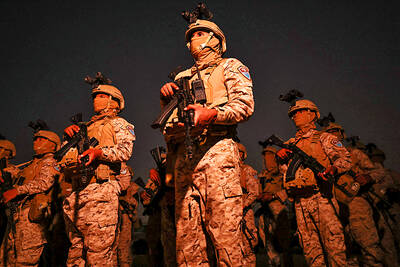
PRECARIOUS RELATIONS: Commentators in Saudi Arabia accuse the UAE of growing too bold, backing forces at odds with Saudi interests in various conflicts A Saudi Arabian media campaign targeting the United Arab Emirates (UAE) has deepened the Gulf’s worst row in years, stoking fears of a damaging fall-out in the financial heart of the Middle East. Fiery accusations of rights abuses and betrayal have circulated for weeks in state-run and social media after a brief conflict in Yemen, where Saudi airstrikes quelled an offensive by UAE-backed separatists. The United Arab Emirates is “investing in chaos and supporting secessionists” from Libya to Yemen and the Horn of Africa, Saudi Arabia’s al-Ekhbariya TV charged in a report this week. Such invective has been unheard of

US President Donald Trump on Saturday warned Canada that if it concludes a trade deal with China, he would impose a 100 percent tariff on all goods coming over the border. Relations between the US and its northern neighbor have been rocky since Trump returned to the White House a year ago, with spats over trade and Canadian Prime Minister Mark Carney decrying a “rupture” in the US-led global order. During a visit to Beijing earlier this month, Carney hailed a “new strategic partnership” with China that resulted in a “preliminary, but landmark trade agreement” to reduce tariffs — but

Chinese President Xi Jinping’s (習近平) purge of his most senior general is driven by his effort to both secure “total control” of his military and root out corruption, US Ambassador to China David Perdue said told Bloomberg Television yesterday. The probe into Zhang Youxia (張又俠), Xi’s second-in-command, announced over the weekend, is a “major development,” Perdue said, citing the family connections the vice chair of China’s apex military commission has with Xi. Chinese authorities said Zhang was being investigated for suspected serious discipline and law violations, without disclosing further details. “I take him at his word that there’s a corruption effort under
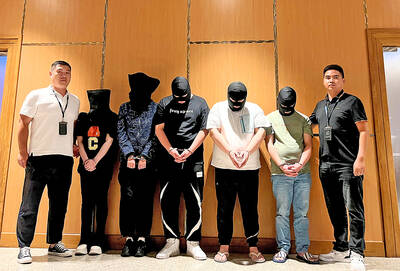
China executed 11 people linked to Myanmar criminal gangs, including “key members” of telecom scam operations, state media reported yesterday, as Beijing toughens its response to the sprawling, transnational industry. Fraud compounds where scammers lure Internet users into fake romantic relationships and cryptocurrency investments have flourished across Southeast Asia, including in Myanmar. Initially largely targeting Chinese speakers, the criminal groups behind the compounds have expanded operations into multiple languages to steal from victims around the world. Those conducting the scams are sometimes willing con artists, and other times trafficked foreign nationals forced to work. In the past few years, Beijing has stepped up cooperation


 RSS
RSS