


A purported top figure in Mexico’s Sinaloa drug cartel was in police custody on Thursday as authorities extended a cross-border crackdown on the gang that has included the arrest of 755 of its members in the US.
Vicente “El Vicentillo” Zambada was arrested before dawn on Wednesday at a home in an elite Mexico City neighborhood, said General Luis Arturo Oliver, the Mexican Defense Department’s deputy chief of operations.
The capture demonstrates that Mexico is breaking down crime gangs, Mexican President Felipe Calderon said in a Thursday night speech. He described Zambada’s father, Ismael “El Mayo” Zambada as “perhaps the most important leader of cartels in Mexico.”
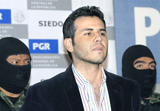
PHOTO: EPA
The younger Zambada assumed major new powers in the Sinaloa cartel last year, with control over logistics and the authority to order assassinations of government authorities and rivals, General Oliver said.
“This significantly affects the organization’s ability to operate and distribute drugs,” said Ricardo Cabrera, who runs the terrorism and drug trafficking unit in Mexico’s federal Attorney General’s office.
Last month, US President Barack Obama’s administration announced that investigators had arrested 755 Sinaloa cartel members in cities and towns across the US.
The US is seeking Zambada’s extradition under a 2003 trafficking indictment, but he will have to face charges in Mexico before the request can be considered.
The Sinaloa cartel is alleged to have bribed top Mexican security officials including former drug czar Noe Ramirez, who is accused of accepting US$450,000 to tip off cartel leaders to police operations.
Ramirez has denied the charges.
Police and military personnel had been closely watching the exclusive Lomas del Pedregal neighborhood where Zambada was arrested after receiving complaints about armed men in cars, Oliver said.
They surprised Zambada and five bodyguards and arrested them without a shot, seizing three AR-15 semiautomatic assault rifles, three pistols, three cars and several thousand dollars in cash.
Paraded in front of reporters on Thursday in a black blazer and dark bluejeans, the 33-year-old stared straight ahead, stone-faced. His clean-cut look was a sharp contrast from a US Treasury Department photo released in 2007 that showed him in a mustache and cowboy hat.
His family has long been tied to drug trafficking. Zambada’s uncle, Jesus “The King” Zambada, was arrested last year in Mexico City and accused of helping smuggle cocaine and methamphetamines through the capital’s airport.
The other two known Sinaloa cartel leaders at large are Joaquin Guzman Loera, known more commonly as “El Chapo” Guzman, and Ignacio Coronel Villarreal, or “Nacho Coronel.”
Mexican officials issued a US$5 million reward for Guzman after he escaped from a prison in 2001 hidden in a laundry truck. Forbes magazine recently ranked Guzman at No. 701 on its list of the world’s richest people, with an estimated US$1 billion fortune.
A US indictment accuses both Vicente and Ismael Zambada of using planes, boats, trucks and cars to move nearly US$50 million worth of cocaine from Colombia to New York, New Jersey, Chicago and California between August 2001 and June 2002.
Vicente Zambada apparently rose through cartel ranks after supervising the unloading of cocaine from ships off the Mexican coast and verifying quantities coming from Colombia, the indictment said.

Gaza is rapidly running out of its limited fuel supply and stocks of food staples might become tight, officials said, after Israel blocked the entry of fuel and goods into the war-shattered territory, citing fighting with Iran. The Israeli military closed all Gaza border crossings on Saturday after announcing airstrikes on Iran carried out jointly with the US. Israeli authorities late on Monday night said that they would reopen the Kerem Shalom crossing from Israel to Gaza yesterday, for “gradual entry of humanitarian aid” into the strip, without saying how much. Israeli authorities previously said the crossings could not be operated safely during
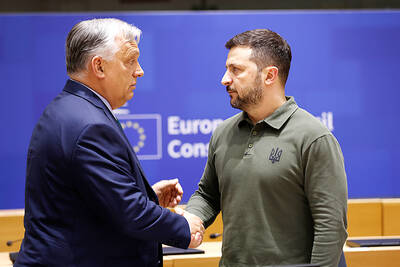
Hungarian authorities temporarily detained seven Ukrainian citizens and seized two armored cars carrying tens of millions of euros in cash across Hungary on suspicion of money laundering, officials said on Friday. The Ukrainians were released on Friday, following their detention on Thursday, but Hungarian officials held onto the cash, prompting Ukraine to accuse Hungary’s Russia-friendly government of illegally seizing the money. “We will not tolerate this state banditism,” Ukrainian Minister of Foreign Affairs Andrii Sybiha said. The seven detained Ukrainians were employees of the Ukrainian state-owned Oschadbank, who were traveling in the two armored cars that were carrying the money between Austria and
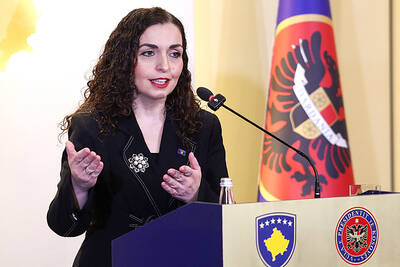
Kosovar President Vjosa Osmani on Friday after dissolving the Kosovar parliament said a snap election should be held as soon as possible to avoid another prolonged political crisis in the Balkan country at a time of global turmoil. Osmani said it is important for Kosovo to wrap up the upcoming election process and form functional institutions for political stability as the war rages in the Middle East. “Precisely because the geopolitical situation is that complex, it is important to finish this electoral process which is coming up,” she said. “It is very hard now to imagine what will happen next.” Kosovo, which declared

MORE BANS: Australia last year required sites to remove accounts held by under-16s, with a few countries pushing for similar action at an EU level and India considering its own ban Indonesia on Friday said it would ban social media access for children under 16, citing threats from online pornography, cyberbullying, online fraud and Internet addiction. “Accounts belonging to children under 16 on high-risk platforms will start to be deactivated, beginning with YouTube, TikTok, Facebook, Instagram, Threads, X, Bigo Live and Roblox,” Indonesian Minister of Communications and Digital Meutya Hafid said. “The government is stepping in so that parents no longer have to fight alone against the giants of the algorithm. Implementation will begin on March 28, 2026,” she said. The social media ban would be introduced in stages “until all platforms fulfill their


 RSS
RSS