


Drug cultivation is expected to fall slightly in Afghanistan this year as lower opium prices and higher wheat prices encourage some farmers to switch crops, the UN said yesterday.
Afghanistan is locked in a vicious circle where drug production helps fund Taliban militants and increases official corruption, both of which limit government control of many areas, which in turn allows more opium poppy to be grown.
Last year, Afghanistan produced more than 90 percent of the world’s supply of opium, a thick paste from poppy that is then processed to make highly addictive heroin and smuggled abroad.
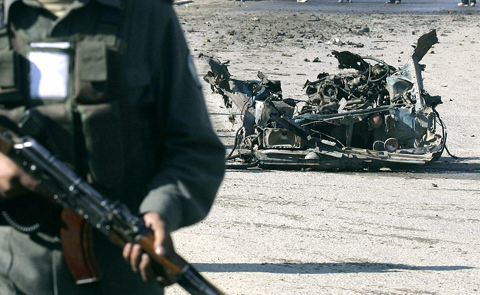
PHOTO: AP
The number of opium-free provinces could rise from 18 out of 34 Afghan provinces last year, to 22 this year if there is effective crop eradication, the UN Office on Drugs and Crime said in its annual winter assessment report.
But almost all opium production in Afghanistan, some 98 percent, is concentrated in seven southern and southwestern provinces, and more than half of all production is in just one province, Helmand, where mainly British troops are struggling to contain an entrenched Taliban insurgency.
The international community has poured millions of dollars into counter-narcotics efforts in Afghanistan since 2002, but drug production rose dramatically till last year.
Last year’s slight drop may have been largely because of bad weather and if production also falls this year, it will also be down to external factors: a 25 percent fall in opium prices because of a market glut and higher world wheat prices.
Taxes on farmers and traffickers netted the Taliban some US$470 million last year, the UN has said, but NATO forces in Afghanistan are not permitted to engage in crop eradication.
NATO is discussing how to implement a decision made at a ministers’ summit last October authorizing direct attacks on the drugs trade, an alliance spokesman said.
The alliance’s top commander, US General John Craddock, has issued guidance to his generals saying all drug traffickers could be attacked, whether or not evidence connected them to the Taliban insurgency, Germany’s Der Spiegel magazine said last week, quoting a leaked classified document.
But the commander of the NATO-led force in Afghanistan, US General David McKiernan did not want to follow the guidance, Der Spiegel said, fearing the move would seriously undermine NATO attempts to reduce civilian casualties.
Meanwhile, the NATO force in Afghanistan said yesterday that three civilians — two children and a tribal leader — had been killed in incidents in which its troops opened fire, including after coming under attack by Taliban.
The issue of civilian casualties from operations against insurgents is one of the most controversial aspects of the foreign military presence in Afghanistan, angering the public and government of Afghan President Hamid Karzai.
The children were killed on Saturday when troops from the International Security Assistance Force (ISAF) fought Taliban militants who had attacked from a compound in Helmand, the ISAF said.
A search of the compound after the fighting had ended revealed several “killed insurgents” lying alongside rocket-propelled grenade launchers and ammunition cases, it said.
“Unfortunately, two children were killed and three local Afghan adults were injured during the incident,” it said.
The wounded were evacuated to hospitals.
The clash took place in the southern province’s Nad Ali District, a region that sees regular violence because of the large number of insurgents there.
Troops shot two more Afghans the same day in the eastern province of Paktia, also hit hard by the insurgency, when the vehicle they were in came too close to a convoy despite warnings to stay away, a separate ISAF statement said.
One, a tribal elder, died later of his wounds, it said.
Scores of Afghan civilians have died in such incidents, with troops not allowing ordinary people to approach their bases or convoys for fear of suicide attacks.
Foreign troops were attacked in Kabul yesterday by a suicide bomber in a vehicle.
Two Afghans and a foreign soldier were wounded, Afghan officials said.
Karzai has demanded that US and NATO forces do more to stop civilian deaths during their operations against militants.
There are about 70,000 foreign forces, mainly from NATO, in Afghanistan battling the Taliban insurgency.
Up to 30,000 more US soldiers are expected over the year to stem a growing wave of violence that has spurred Washington to shift focus to Afghanistan after concentrating on the conflict in Iraq.

‘CROSSING THE LINE’: China’s embassy in Seoul criticized US Forces Korea Commander General Xavier Brunson, asking if his ‘hostile’ remarks were authorized by Washington South Korea and the US are in talks over recent public remarks by the commander of US Forces Korea, Seoul’s presidential office said yesterday, after the comments drew sharp criticism from China. In a recent podcast interview, US Forces Korea Commander General Xavier Brunson described South Korea as “the dagger in the heart of Asia” from China’s east coast, prompting the Chinese embassy in Seoul to say that he had “truly crossed the line.” The interview came amid growing speculation that Washington might seek to expand the role of US Forces Korea in countering the growing regional influence of China, a key

Through the noise of rushing papers and whirring belts at a print factory in Kyoto, two creators watch their photo essay come to life in broadsheet form — part of an effort to win new audiences in the age of artificial intelligence (AI). Despite the decline of the publishing industry, self-publication and handmade “zine” magazines are growing in popularity in Japan, reflecting the nation’s enduring love of paper in the digital era. While speaking to Agence France-Presse at the plant, his hands black with ink, one of the creators, Kazuma Obara, said: “I think [paper] is a medium that engages all five

Australian researchers have trained lab-grown brain cells on a silicon computer chip to play the 1990s shooter game Doom and said they are just scratching the surface of what the neurons could be capable of doing. It is the science-fiction work of biotech boffins at Cortical Labs, who researched and developed the technology that harnesses the workings of the brain’s networking system. Each so-called “biological computer” contains about 200,000 living human brain cells, grown from stem cells that were harvested from blood donations. Having mastered the simple computer game Pong, where a paddle is moved up and down to send a ball

France experienced its hottest spring on record, the French weather service said on Tuesday, after an exceptional early heat wave that also broke highs for the season in England and Wales. Meteo-France said the average nationwide temperature over March to May was 13.8°C — about 1.7°C above the norm, and surpassing records set in 2011 and 2020. “The warmest spring since records began in 1900,” it said in a bulletin. All three months were warmer than average, but the onset of an “unprecedented heatwave” late last month pushed the mercury to highs typically seen at the height of the summer. “Our country had never


 RSS
RSS