


Ukraine’s gas company Naftogaz said yesterday that Russia’s Gazprom cut natural gas supplies to Europe by about two-thirds, raising the stakes in a spiraling dispute between the two neighbors that bodes ill for European consumers.
Naftogaz spokesman Valentyn Zemlyansky said Gazprom sent only 92 million cubic meters of gas for European consumers yesterday, down from 221 on Monday or about 300 during previous days.
“That is all they are sending, in several hours Europe will feel it,” Zemlyansky said.
Gazprom officials could not be immediately reached for comment and the drop in supplies could not be immediately confirmed. Gazprom said late on Monday that it will cut the amount of gas it ships to Europe through Ukraine by 65.3 million cubic meters. Gazprom said it was cutting gas supplies by the amount it accuses Ukraine of having stolen when it ran through its pipelines.
Kiev denies the accusations saying Russia is to blame for the disruption because it is refusing to ship extra gas used to make the delivery.
The statement is bad news for European consumers.
Some European countries are already experiencing supply problems after Russia cut off supplies to its neighbor on Jan. 1 over pricing disagreements and outstanding debt. Hungary, Romania and Bulgaria say that supplies from pipelines through Ukraine remained down, in Romania’s case by 30 percent.
The reductions come as a EU commission was to meet with senior Ukrainian officials yesterday to discuss the crisis.
Russia’s reductions appear aimed at putting pressure on Ukraine, which has turned down several offers on prices and transit fees by Gazprom. Ukraine has enough gas reserves to last for weeks without Russian gas.
During a similar dispute between Ukraine and Russia in 2006, several West European countries saw their gas supplies drop by 30 percent or more. This time Gazprom’s customers were better prepared, having built up substantial reserves.
While the previous gas cutoff was seen as punishment for Ukraine’s pro-Western policies, this time Gazprom is insisting it is a commercial dispute. Both countries are seeking to prove they are a reliable energy partner for the EU.
“As of 3:30am supplies ... to Bulgaria as well as the transit to Turkey, Greece and Macedonia have been suspended,” Bulgaria’s Economy Ministry said in a statement. “We are in a crisis situation.”
There was no immediate confirmation from Turkey, Greece or Macedonia of a halt in supplies. Turkey has an alternative route for importing Russian gas, under the Black Sea.
South-east Europe and the Balkans receive their Russian gas from a pipeline which passes from Ukraine via Bulgaria, so officials in Sofia are likely to be the first to see signs of a cut-off.
In Kiev, Ukrainian state energy Naftogaz firm said Russia had cut gas supply via Ukraine to Europe to about a third of its normal flow.
“This means that in a few hours Europe will face a problem with gas supplies,” said a Naftogaz spokesman.
Gazprom said it had no choice but to reduce supplies to Europe via Ukraine because Kiev was siphoning off gas intended for transit. It said it would boost supplies through other routes to compensate.
A delegation from the EU was to meet Ukrainian officials in Kiev yesterday, and fact-finding talks were also planned for the same day between EU officials and Gazprom, though the venue had not yet been confirmed.
European Commission President Jose Manuel Barroso said on Monday he had appealed to Putin and Ukrainian Prime Minister Yulia Tymoshenko not to let their dispute affect Europe’s gas supplies.
“I hope that the matter will be resolved, as the reality is that if it is not then it may create problems for European countries who are not responsible for the situation,” he said.
Russia has clashed repeatedly with Ukraine’s pro-Western leaders over their ambition to join the NATO alliance. Gazprom denies any political motive in the row and says it is purely about Kiev’s refusal to pay a fair price for its gas.

Crowds in Bangladesh are flocking to snap photographs with an unlikely social media star — an albino buffalo with flowing blond hair nicknamed “Donald Trump” that is due to be sacrificed within days. Owner Zia Uddin Mridha, 38, said his brother named the 700kg bull over its flowing helmet of hair resembling the signature look of the US president. “My younger brother picked this name because of the buffalo’s extraordinary hair,” he said at his farm in Narayanganj, just outside the capital, Dhaka. Mridha said that a constant stream of curious visitors — social media fans, onlookers and children — have come throughout
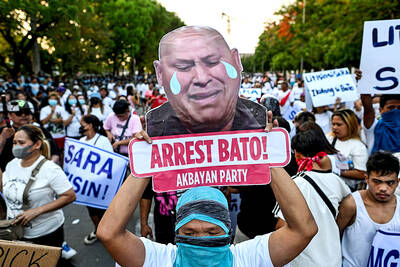
The Philippines said it has asked the country’s Supreme Court to allow it to arrest former Philippine president Rodrigo Duterte’s chief drug war enforcer to stand trial in an international tribunal. The International Criminal Court (ICC) last week unsealed an arrest warrant against Philippine Senator Ronald dela Rosa, accusing him along with Duterte and other “coperpetrators” of the “crime against humanity of murder.” Dela Rosa briefly sought refuge in the Philippine Senate last week while asking the Philippine Supreme Court to stop an ongoing attempt by government agents to arrest him. “By his own conduct, he has placed himself outside the protection of

It began as a satirical online project. Now millions of young people in India are flocking to it as an outlet for their frustration. A parody political party called the Cockroach Janta Party, with the insect as its symbol, has exploded across India’s social media by turning absurdist humor into protest. Memes and short videos mocking corruption, joblessness and political dysfunction have flooded social media sites, where millions of users are embracing the cockroach — known for its ability to survive harsh conditions — as a tongue-in-cheek symbol of endurance. The online movement’s rise has been unusually rapid. The Cockroach Janta Party (CJP)

The researchers in Ireland looked at their computer screen, marveling at a medieval book tracked down in a Roman library. They flipped through its digitized pages and found their sought-after treasure: the oldest surviving English poem. “We were extremely surprised. We were speechless. We couldn’t believe our eyes when we first saw that,” said Elisabetta Magnanti, a visiting research fellow at Trinity College Dublin’s school of English. The poem was also within the main body of Latin text, she said, calling it “extraordinary.” Composed in Old English by a Northumbrian agricultural worker in the 7th century, Caedmon’s Hymn appears within some copies of


 RSS
RSS