


An eight-year old Saudi Arabian girl who was married off by her father to a 58-year-old man has been told she cannot divorce her husband until she reaches puberty.
Lawyer Abdu Jtili said the divorce petition was filed by the unnamed girl’s divorced mother in August after the marriage contract was signed by her father and the groom.
“The judge has dismissed the plea because she [the mother] does not have the right to file, and ordered that the plea should be filed by the girl herself when she reaches puberty,” lawyer Abdullah Jtili told Agence France-Presse.
The case was handled by a court in Qasim Province, north of the Saudi capital Riyadh. The girl does not know she is married, said Jtili, adding that he will appeal.
In many child marriages, girls are given away to older men in return for dowries or following the custom by which a father promises his daughters and sons to marriage while still children. But the issue is complicated by different interpretations of Shariah law and a lack of legal certainty.
“There is confusion in Saudi Arabia over the fundamental question of what constitutes adulthood,” said Clarisa Bencomo of Human Rights Watch. “There is also vast judicial discretion.”
The case appears to fit a pattern of divorced fathers using their children to take revenge against their ex-wives. Mothers usually only have custody while the children are young.
Relatives said the marriage had not been consummated and that the girl was still living with her mother. They said that the father had set a verbal condition by which the marriage was not to be consummated until the girl turns 18 — although it was unclear how this could be enforced.
The father agreed to marry off his daughter for a dowry of 30,000 riyals (US$7,100) as he was facing financial problems.
Bencomo dismissed the idea that the girl would be able to file for divorce once she reached puberty since there was no standard definition of this.
In addition, Saudi judges often insist that even adult women speak to them through a male guardian or lawyer.
No figures are available for the number of arranged marriages involving pre-adolescents in Saudi Arabia, where the strictly conservative Wahhabi version of Sunni Islam holds sway and polygamy is common. But human rights groups say they are aware of many such cases.
Clerics including Sheikh Abdul-Aziz Al-Sheikh, the kingdom’s grand mufti, have denounced child marriage. But it is still prevalent in conservative areas. The Shura council has defined adulthood as starting at age 18, but objections prevented the decision from being ratified.

Australians were downloading virtual private networks (VPNs) in droves, while one of the world’s largest porn distributors said it was blocking users from its platforms as the country yesterday rolled out sweeping online age restriction. Australia in December became the first country to impose a nationwide ban on teenagers using social media. A separate law now requires artificial intelligence (AI)-powered chatbot services to keep certain content — including pornography, extreme violence and self-harm and eating disorder material — from minors or face fines of up to A$49.5 million (US$34.6 million). The country also joined Britain, France and dozens of US states requiring

Hungarian authorities temporarily detained seven Ukrainian citizens and seized two armored cars carrying tens of millions of euros in cash across Hungary on suspicion of money laundering, officials said on Friday. The Ukrainians were released on Friday, following their detention on Thursday, but Hungarian officials held onto the cash, prompting Ukraine to accuse Hungary’s Russia-friendly government of illegally seizing the money. “We will not tolerate this state banditism,” Ukrainian Minister of Foreign Affairs Andrii Sybiha said. The seven detained Ukrainians were employees of the Ukrainian state-owned Oschadbank, who were traveling in the two armored cars that were carrying the money between Austria and
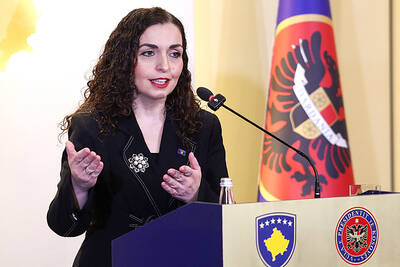
Kosovar President Vjosa Osmani on Friday after dissolving the Kosovar parliament said a snap election should be held as soon as possible to avoid another prolonged political crisis in the Balkan country at a time of global turmoil. Osmani said it is important for Kosovo to wrap up the upcoming election process and form functional institutions for political stability as the war rages in the Middle East. “Precisely because the geopolitical situation is that complex, it is important to finish this electoral process which is coming up,” she said. “It is very hard now to imagine what will happen next.” Kosovo, which declared

MORE BANS: Australia last year required sites to remove accounts held by under-16s, with a few countries pushing for similar action at an EU level and India considering its own ban Indonesia on Friday said it would ban social media access for children under 16, citing threats from online pornography, cyberbullying, online fraud and Internet addiction. “Accounts belonging to children under 16 on high-risk platforms will start to be deactivated, beginning with YouTube, TikTok, Facebook, Instagram, Threads, X, Bigo Live and Roblox,” Indonesian Minister of Communications and Digital Meutya Hafid said. “The government is stepping in so that parents no longer have to fight alone against the giants of the algorithm. Implementation will begin on March 28, 2026,” she said. The social media ban would be introduced in stages “until all platforms fulfill their


 RSS
RSS