


Suspected Taliban militants in northwest Pakistan opened fire on an oil tanker used to supply fuel to foreign forces in Afghanistan, killing three people, local officials said yesterday.
Two drivers and one assistant were killed in the incident late on Friday in the Khyber tribal district, located on the main supply route into Afghanistan, where NATO and US forces are battling a Taliban insurgency, the officials said.
Local administration official Rahat Gul blamed the attack — the latest in a series of increasingly sophisticated strikes on NATO and US supply vehicles — on Taliban militants. The empty tanker was burned in the incident.
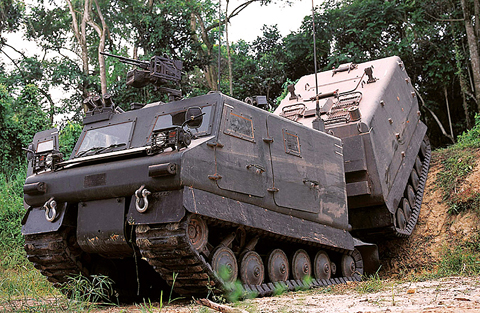
PHOTO: AP
In the same tribal district, a bomb exploded near a NATO supply convoy but the blast did not cause any damage or casualties, a security official said.
“The bomb was meant to target the convoy, but luckily, no damage was done,” the official said.
Militants have staged spectacular attacks in recent weeks on NATO supply depots outside the northwestern Pakistani city of Peshawar, torching hundreds of vehicles and containers destined for foreign troops in Afghanistan.
The NATO and US-led forces in Afghanistan are hugely dependent on Pakistan for their supplies and equipment, as about 80 percent of the gear is transported through the country.
Meanwhile, three Danish soldiers serving with NATO were killed and one injured on Friday when their vehicle was hit by an explosion in southern Helmand Province, the Danish military said.
“Three Danish soldiers ... in the Danish battalion were killed and one was injured on Friday afternoon when their armored vehicle drove over a roadside bomb or mine,” the military said in a statement.
The blast occurred near the town of Gereshk.
The injured soldier was transported to a field hospital at Camp Bastion for treatment, the military said.
The deaths bring to 21 the number of Danish troops killed in the country since Copenhagen deployed soldiers there as part of NATO’s International Security Assistance Force in 2001 — one of the highest per-capita death tolls among coalition forces.
Denmark has some 700 troops in Afghanistan, most of whom are stationed in Helmand Province under British command.
‘NAZIS’
In London, British Defence Secretary John Hutton compared the Taliban and al-Qaeda to the Nazis and said Western forces faced a long fight to defeat insurgents in Afghanistan, in an interview yesterday.
Hutton told the Times newspaper that troops in the violence-scarred country were defending British values in the same way they did in World War II.
“We know that we must tackle the threat at source, it is not just going to go away,” he said.
“It is a struggle against fanatics that may not challenge our borders but challenges our way of life in the same way the Nazis did,” he said.
After Prime Minister Gordon Brown confirmed on Thursday that most British forces would pull out of Iraq by the end of July, Hutton said British soldiers would be in Afghanistan for the long haul.
“We will stay there as long as is necessary to secure all of our objectives — it’s going to be years,” the minister said.
His words hinted at the UK’s willingness to add troops to its existing 8,000-strong contingent in Afghanistan, where fighting against a resurgent Taliban has cost the lives of 134 British servicemen.
“The key thing now is not that the Taliban or al-Qaeda can defeat us in Afghanistan, their tactic is to outlast us,” Hutton said.
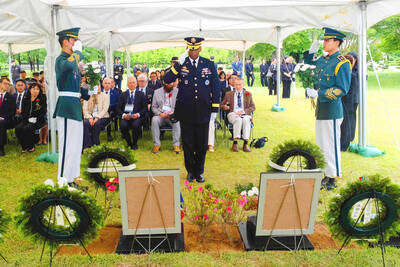
‘CROSSING THE LINE’: China’s embassy in Seoul criticized US Forces Korea Commander General Xavier Brunson, asking if his ‘hostile’ remarks were authorized by Washington South Korea and the US are in talks over recent public remarks by the commander of US Forces Korea, Seoul’s presidential office said yesterday, after the comments drew sharp criticism from China. In a recent podcast interview, US Forces Korea Commander General Xavier Brunson described South Korea as “the dagger in the heart of Asia” from China’s east coast, prompting the Chinese embassy in Seoul to say that he had “truly crossed the line.” The interview came amid growing speculation that Washington might seek to expand the role of US Forces Korea in countering the growing regional influence of China, a key

Through the noise of rushing papers and whirring belts at a print factory in Kyoto, two creators watch their photo essay come to life in broadsheet form — part of an effort to win new audiences in the age of artificial intelligence (AI). Despite the decline of the publishing industry, self-publication and handmade “zine” magazines are growing in popularity in Japan, reflecting the nation’s enduring love of paper in the digital era. While speaking to Agence France-Presse at the plant, his hands black with ink, one of the creators, Kazuma Obara, said: “I think [paper] is a medium that engages all five

Australian researchers have trained lab-grown brain cells on a silicon computer chip to play the 1990s shooter game Doom and said they are just scratching the surface of what the neurons could be capable of doing. It is the science-fiction work of biotech boffins at Cortical Labs, who researched and developed the technology that harnesses the workings of the brain’s networking system. Each so-called “biological computer” contains about 200,000 living human brain cells, grown from stem cells that were harvested from blood donations. Having mastered the simple computer game Pong, where a paddle is moved up and down to send a ball

France experienced its hottest spring on record, the French weather service said on Tuesday, after an exceptional early heat wave that also broke highs for the season in England and Wales. Meteo-France said the average nationwide temperature over March to May was 13.8°C — about 1.7°C above the norm, and surpassing records set in 2011 and 2020. “The warmest spring since records began in 1900,” it said in a bulletin. All three months were warmer than average, but the onset of an “unprecedented heatwave” late last month pushed the mercury to highs typically seen at the height of the summer. “Our country had never


 RSS
RSS