


US president-elect Barack Obama has begun laying the groundwork for overhauling the country’s troubled healthcare system, reaching out to interest groups and building grassroots support for the huge undertaking.
Obama, who takes office on Jan. 20, is using many of the Internet tools employed in his election campaign to engage the public. His Internet site www.change.gov asks people to submit ideas for changing the costly and inefficient system that leaves tens of millions uninsured.
“Every American is feeling the pressure of high health costs and lack of quality care, and we feel it’s important to engage them in the process of reform,” Obama transition team spokeswoman Stephanie Cutter said. “Change starts from the ground up, and we believe that’s true on critical issues like healthcare reform as well.”
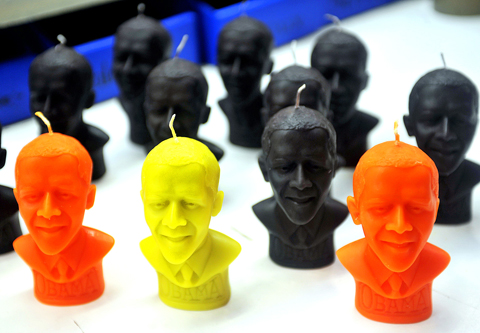
PHOTO: AFP
Obama’s coordinator on healthcare, former Senate majority leader Tom Daschle, was to participate in a healthcare reform debate in Colorado yesterday that was expected to begin detailing the plans for change.
During the campaign, Obama pledged to bring health insurance to millions of uninsured Americans and spend about US$50 billion to make health records electronic.
BIG PROBLEM
Many health reform advocates believe Obama will need broad public support to overhaul an industry that has become among the most intractable of US political problems.
Voters put healthcare reform as their third biggest concern after the economy and the Iraq War. Finding the money and ingenuity to fix the system will be difficult.
The US now spends more on healthcare than any other developed nation, yet has some 47 million people without health insurance.
Most insured people receive coverage through their employers, but businesses complain that exploding costs threaten their competitiveness in a global market.
High worker healthcare costs have been cited as a major reason why US automakers, which are seeking US$34 billion from the federal government, are in such trouble.
US healthcare costs now account for about 16 percent of US GDP — or US$2.3 trillion — a proportion projected to grow to 20 percent, or US$4 trillion, by 2015.
John Castellani, president of the Business Roundtable, part of a health reform coalition that includes the AARP, an advocacy group for older Americans, and the Service Employees International Union, said maintaining the status quo was not an option.
“The current system and its costs and inefficiencies is really unsustainable,” he said.
Daschle, the former South Dakota Democratic senator who is expected to be tapped by Obama to be health and human services secretary, has been in talks with consumer, business, labor and health industry groups that have stakes in reform.
“I think this is going to be a very cooperative endeavor that will involve both the president and [nominated] Secretary Daschle and the Congress,” said Ron Pollack, executive director of Families USA, a healthcare reform advocacy group.
“Obama and Tom Daschle are going to work very closely with the Congress in developing a proposal,” he said.
Obama will be able to lean on the grass-roots networks of groups that supported him during the election campaign, such as the Service Employees International Union, which represents more than a million healthcare workers.
Any reform has its winners and losers and while there is broad agreement the current system is unsustainable, many competing groups — consumers, labor unions, pharmaceutical companies, insurers and health professionals — will be pushing to protect their interests.
Lawmakers have already swung into action even though the new Congress will not be seated until Jan. 6.
“We are thrilled that there is this much activity this early on by this many committed leaders because the issue of healthcare reform is just that important,” said Jim Dau, spokesman for AARP.
SHARING THE JOY
Meanwhile, at the JW Marriott Hotel, US$1 million will buy you 300 hotel rooms, US$200,000 worth of food and private access to a tented, heated balcony overlooking the parade route of Obama’s inauguration.
Earl W. Stafford is buying it all — and giving it away to strangers.
Stafford, a Virginia businessman, plans to invite disadvantaged people, wounded soldiers and others to the prime location on the parade avenue. He’s calling it the “People’s Inaugural Project,” inviting those who would never otherwise have a chance to wear tuxedos or satin dresses to the president’s swearing in on Jan. 20.
‘AMERICAN DREAM’
“We believe it is important to include those who are less fortunate because like Barack Obama, we too believe in the American dream,” Stafford said on Thursday.
Stafford bought the package a week before the election, said Erick Speight, the hotel’s senior sales executive. Several corporations expressed interest, but Stafford was quick to turn in his deposit.
Guests found by nonprofits and social service groups will also get gowns and tuxedos, and grooming from hairstylists and makeup artists.
There will be a prayer breakfast and luncheon the day before the inauguration, Martin Luther King Day.
And if Obama were to show up?
Stafford said: “That certainly would be icing on the cake.”

‘CROSSING THE LINE’: China’s embassy in Seoul criticized US Forces Korea Commander General Xavier Brunson, asking if his ‘hostile’ remarks were authorized by Washington South Korea and the US are in talks over recent public remarks by the commander of US Forces Korea, Seoul’s presidential office said yesterday, after the comments drew sharp criticism from China. In a recent podcast interview, US Forces Korea Commander General Xavier Brunson described South Korea as “the dagger in the heart of Asia” from China’s east coast, prompting the Chinese embassy in Seoul to say that he had “truly crossed the line.” The interview came amid growing speculation that Washington might seek to expand the role of US Forces Korea in countering the growing regional influence of China, a key

SEEKING ORDER: Rodrigo Paz said that ‘anyone who wants to destroy the nation will have to deal with this president and the full force of the constitution’ Bolivian President Rodrigo Paz on Wednesday said that the nation was at a “breaking point” after nearly a month of protests that have caused shortages of food, fuel and medicine. Paz, who took office six months ago amid the worst economic crisis there in four decades, is battling a groundswell of fury over his policies. The political capital, La Paz, has been besieged by low-income workers and members of the indigenous majority calling for his resignation. “The country needs order and is reaching breaking point,” the 58-year-old said at a public event in La Paz, renewing his appeal for dialogue. On Tuesday, the Bolivian

Through the noise of rushing papers and whirring belts at a print factory in Kyoto, two creators watch their photo essay come to life in broadsheet form — part of an effort to win new audiences in the age of artificial intelligence (AI). Despite the decline of the publishing industry, self-publication and handmade “zine” magazines are growing in popularity in Japan, reflecting the nation’s enduring love of paper in the digital era. While speaking to Agence France-Presse at the plant, his hands black with ink, one of the creators, Kazuma Obara, said: “I think [paper] is a medium that engages all five

Australian researchers have trained lab-grown brain cells on a silicon computer chip to play the 1990s shooter game Doom and said they are just scratching the surface of what the neurons could be capable of doing. It is the science-fiction work of biotech boffins at Cortical Labs, who researched and developed the technology that harnesses the workings of the brain’s networking system. Each so-called “biological computer” contains about 200,000 living human brain cells, grown from stem cells that were harvested from blood donations. Having mastered the simple computer game Pong, where a paddle is moved up and down to send a ball


 RSS
RSS