


The loyalist killer Michael Stone was sent back to prison on Friday after a judge found him guilty of attempting to kill the Sinn Fein leaders Gerry Adams and Martin McGuinness in Northern Ireland.
His attack at Stormont in November 2006 was the second time in 20 years that Stone, one of the most notorious terrorists to emerge from the Troubles, had tried to murder Adams and McGuinness.
Stone was also convicted at Belfast crown court on six charges including possession of weapons and explosive devices. He will be sentenced at a later date and is likely to spend the rest of his life in jail.
Stone claimed the attack at the Stormont parliament in November 2006 was merely a work of performance art, and that the axe, three knives, garrotte, imitation handgun and homemade bombs found on him were artistic props. The 53-year-old from east Belfast was freed early eight years ago under the terms of the 1998 Good Friday agreement. Life-sentence prisoners released in the amnesty are out on license and can be sent back to jail if they commit further crimes.
Justice Deeney said Stone’s defense was “wholly undeserved of belief.”
“I am satisfied that Mr Stone went to Stormont to try and murder the two Sinn Fein leaders on Nov. 24, 2006.”
Wearing a denim jacket and jeans, Stone shouted from the dock: “It is another concession to the Shinners [Sinn Fein].”
Television crews at parliament buildings captured the moment Stone burst through the main door and was wrestled to the ground by guards. As he was dragged out, Stone shouted “no surrender”, the battle cry of Ulster loyalism.
The attack was a few months before the signing of the power-sharing deal between Sinn Fein and Ian Paisley’s Democratic Unionists, and on the day Martin McGuinness was due to be nominated as deputy first minister.
Stone, a former Ulster Defence Association (UDA) member, gained worldwide notoriety in 1988 by killing three mourners when he launched a lone gun and grenade attack on an Irish Republican Army (IRA) funeral at Milltown cemetery in west Belfast. Later, while in the Maze prison, Stone said he had meant to kill Adams and McGuinness. The funeral was for three IRA members that the Special Air Service (SAS) shot dead in controversial circumstances in Gibraltar.
The attack made Stone a hero among loyalists, but two decades on he is regarded as something of an embarrassment. Stone argued his attack at Stormont was intended to expose the hypocrisy of the politicians.
Johnny “Mad Dog” Adair, the UDA commander on the Shankill Road for most of the 1990s, has described Stone as a “fantasy merchant”
Adair told reporters that Stone had admitted recently to a string of UDA murders that he had nothing to do with.
After his release, Stone insisted he was a strong supporter of the peace process. He turned up at a rally in 1998 for loyalist supporters of the Good Friday agreement. His presence almost undermined the pro-agreement Ulster Unionist campaign with many law-abiding unionists repulsed at the sight of a multiple murderer being clapped and feted as a hero at the rally.
Stone was still protesting his innocence yesterday. As he was taken away by court security officers he shouted: “Make art, not war.”

South Korea’s air force yesterday apologized for a 2021 midair collision involving two fighter jets, a day after auditors said the pilots were taking selfies and filming during the flight and held them responsible for the accident. “We sincerely apologize to the public for the concern caused by the accident that occurred in 2021,” an air force spokesman told a news conference, adding that one of the pilots involved had been suspended from flying duties, received severe disciplinary action and has since left the military. The apology followed a report released on Wednesday by the South Korean Board of Audit and Inspection,

Indonesian police have arrested 13 people after shocking images of alleged abuse against small children at a daycare center went viral, sparking outrage across the nation, officials said on Monday. Police on Friday last week raided Little Aresha, a daycare center in Yogyakarta on Java island, following a report from a former employee. CCTV footage circulating on social media showed children, most younger than two, lying on the floor wearing only diapers, their hands and feet bound with rags. The police have confirmed that the footage is authentic. Police said they also found 20 children crammed into a room just 3m by 3m. “So

About 240 Indians claiming descent from a Biblical tribe landed at Tel Aviv airport on Thursday as part of a government operation to relocate them to Israel. The newcomers passed under a balloon arch in blue and white, the colors of the Israeli flag, as dozens of well-wishers welcomed them with a traditional Jewish song. They were the first “bnei Menashe” (“sons of Manasseh”) to arrive in Israel since the government in November last year announced funding for the immigration of about 6,000 members of the community from the states of Manipur and Mizoram in northeast India. The community claims to descend from
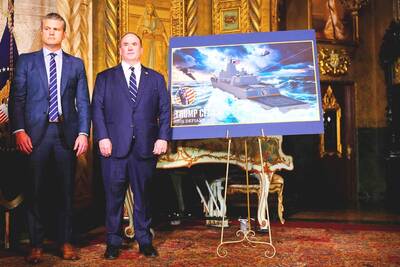
‘TROUBLING’: The firing of Phelan, who was an adviser to a nonprofit that supported the defense of Taiwan, was another example of ‘dysfunction’ under Trump, a US senator said US Secretary of the Navy John Phelan has been fired, a US official and a person familiar with the matter said on Wednesday, in another wartime shakeup at the Pentagon coming just weeks after US Secretary of Defense Pete Hegseth ousted the Army’s top general. The Pentagon announced his departure in a brief statement, saying he was leaving the administration “effective immediately,” but it did not provide a reason or say whether it was his decision to go. The sources, who spoke on condition of anonymity, said Phelan was dismissed in part because he was moving too slowly to implement reforms to


 RSS
RSS