


Canadian police on Thursday arrested the main suspect in the 1980 bombing of a synagogue in Paris that killed four people and injured 20 others, officials said.
Hassan Diab was taken into custody on a provisional extradition warrant issued at the request of French authorities, Canadian Justice Department spokesman Christian Girouard said.
Diab was being held pending a bail hearing yesterday.
Girouard said that, under Canadian law, French officials will have 45 days to provide further legal details to back up their extradition request.
Royal Canadian Mounted Police Corporal Jean Hainey said the man was detained at his residence in Gatineau, Quebec — across the river from Ottawa.
Diab, a part-time sociology instructor at the University of Ottawa, was first named in French news reports last month. He said at the time he was a victim of mistaken identity.
Defense lawyer Rene Duval said his client was shocked by the arrest.
“This is someone who has no criminal record whatsoever,” said Duval, who claims Diab did not enter France in 1980. “It’s a mistaken identification.”
Michele Alliot-Marie, France’s interior minister, welcomed the arrest. In a statement, she credited the “excellent cooperation” between French police and intelligence services and Canadian authorities, but did not provide further details on the suspect.
Diab, a 55-year-old of Palestinian origin, has Lebanese and Canadian passports and lived in the US for several years before moving to Canada, a French judicial official said. The official spoke on condition of anonymity in accordance with judicial policy.
Diab said in an interview with the French daily Le Figaro last month that he was a victim of mistaken identity and had nothing to do with the attack.
Anti-terrorist judges Marc Trevidic and Yves Jannier traveled to Canada at the beginning of the week to further their inquiry into the bombing, the judicial official said. Investigators were searching Diab’s home and office for clues including DNA samples.
On Oct. 3, 1980, a bomb containing pentrite — one of the most powerful high explosives known — and hidden in the saddlebags of a parked motorcycle exploded outside the synagogue of the conservative ULIF group as hundreds of worshippers were gathered inside for a Sabbath service.
Three French men and one Israeli woman were killed. Around 200,000 people later marched through the streets of Paris to protest the attack.
The Popular Front for the Liberation of Palestine-Special Operations was blamed at the time. Diab’s name was on a list of former members of the Palestinian extremist group obtained by German intelligence officials.
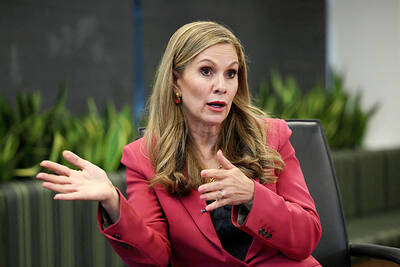
Australians were downloading virtual private networks (VPNs) in droves, while one of the world’s largest porn distributors said it was blocking users from its platforms as the country yesterday rolled out sweeping online age restriction. Australia in December became the first country to impose a nationwide ban on teenagers using social media. A separate law now requires artificial intelligence (AI)-powered chatbot services to keep certain content — including pornography, extreme violence and self-harm and eating disorder material — from minors or face fines of up to A$49.5 million (US$34.6 million). The country also joined Britain, France and dozens of US states requiring
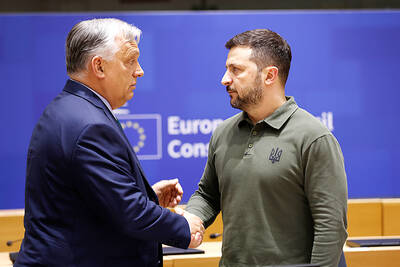
Hungarian authorities temporarily detained seven Ukrainian citizens and seized two armored cars carrying tens of millions of euros in cash across Hungary on suspicion of money laundering, officials said on Friday. The Ukrainians were released on Friday, following their detention on Thursday, but Hungarian officials held onto the cash, prompting Ukraine to accuse Hungary’s Russia-friendly government of illegally seizing the money. “We will not tolerate this state banditism,” Ukrainian Minister of Foreign Affairs Andrii Sybiha said. The seven detained Ukrainians were employees of the Ukrainian state-owned Oschadbank, who were traveling in the two armored cars that were carrying the money between Austria and
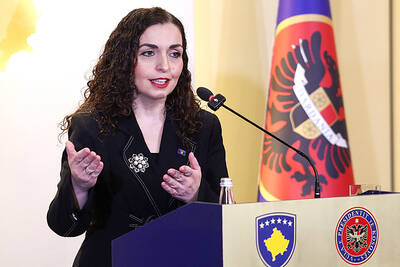
Kosovar President Vjosa Osmani on Friday after dissolving the Kosovar parliament said a snap election should be held as soon as possible to avoid another prolonged political crisis in the Balkan country at a time of global turmoil. Osmani said it is important for Kosovo to wrap up the upcoming election process and form functional institutions for political stability as the war rages in the Middle East. “Precisely because the geopolitical situation is that complex, it is important to finish this electoral process which is coming up,” she said. “It is very hard now to imagine what will happen next.” Kosovo, which declared

MORE BANS: Australia last year required sites to remove accounts held by under-16s, with a few countries pushing for similar action at an EU level and India considering its own ban Indonesia on Friday said it would ban social media access for children under 16, citing threats from online pornography, cyberbullying, online fraud and Internet addiction. “Accounts belonging to children under 16 on high-risk platforms will start to be deactivated, beginning with YouTube, TikTok, Facebook, Instagram, Threads, X, Bigo Live and Roblox,” Indonesian Minister of Communications and Digital Meutya Hafid said. “The government is stepping in so that parents no longer have to fight alone against the giants of the algorithm. Implementation will begin on March 28, 2026,” she said. The social media ban would be introduced in stages “until all platforms fulfill their


 RSS
RSS