

North Korea looked to be further isolating itself, with reports yesterday that it was restricting travelers from major benefactor China and ignoring calls to lift a threat to close its border with the South.
The moves come a day after the North said it would not let international inspectors remove nuclear samples from its plant that produces weapons-grade plutonium, which could drag down an international disarmament-for-aid deal.
“By restricting the flow of Chinese visitors, North Korea seems to be trying to have a firmer grip on its internal situation, especially with Kim Jong-il’s suspected health problems receiving global attention,” said Park Young-ho of South’s Korea Institute for National Unification.
The Financial Times quoted US officials as saying Beijing had increased the number of troops on its border with North Korea to prevent a possible flood of refugees flowing into China if leader Kim lost control.
“I have not heard about any abnormal circumstances on the border between China and North Korea,” Chinese Foreign Ministry spokesman Qin Gang (秦剛) said when asked about the reports of closing the border.
Travel agents in China, who send a steady though small stream of tourists to North Korea, said they were still organizing visits, though trips had to be made via air rather than by rail.
South Korean Foreign Minister Yu Myung-hwan said the North may be trying to strong-arm the international community into giving it more aid in exchange for Pyongyang taking its foot off the brakes on the disarmament deal.
“If we consider North Korea’s clear negotiation pattern, its strategy has always been to create a crisis before resolving something and trying to use that point to secure further concessions,” he said.
“The South urges the North to continue to work for co-existence, co-prosperity and better relations of the two Koreas through dialogue and cooperation,” a South Korean defense official said.
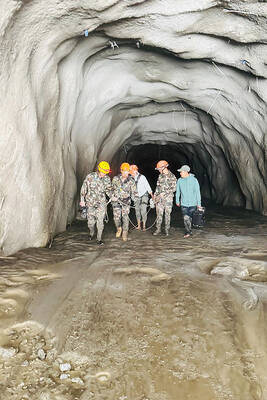
DEATH TOLL 903: More than 900 workers are believe to be trapped in the tunnels and underground areas of several hydropower projects after flash floods in Nepal-Tibet Rescue teams were working to reach more than 900 people thought to be trapped in the tunnels and underground areas of half a dozen hydropower projects in Nepal following the devastating flash floods, ?the National Disaster Risk Reduction and Management Authority said yesterday. The death toll from the unprecedented deluge of ice, rock, mud ?and debris that crashed through valleys of Nepal on Wednesday last week has risen to 903 people, with 16 more dead reported on the Tibet side of the border. More than 4,000 are missing in Nepal, with another 500 in Tibet. Hundreds of bodies, many unidentified, have been

Ontario Premier Doug Ford on Saturday answered US President Donald Trump’s “Lake America” decree with a billboard-sized message on the Canadian shoreline — “Lake Ontario. Now and Always” — as Canadian leaders met Trump’s move with ridicule rather than outrage. Wearing a Canada national soccer team jersey, Ford unveiled the sign near Grimsby and posed for photographs. The message is repeated in French. The display followed Trump’s executive order directing US federal agencies to call Lake Ontario “Lake America.” After months of tariffs, threats to make Canada the 51st US state and personal attacks on its leaders, the reaction in
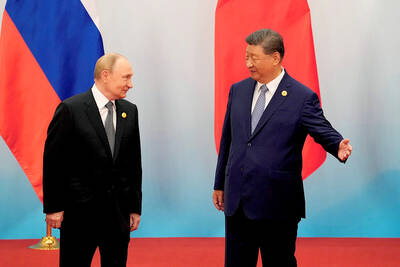
PLENARY SESSION: Although the SCO says it is ‘not an alliance directed against other states,’ Putin and Xi have repeatedly made anti-Western speeches during its summits Russian President Vladimir Putin and Chinese President Xi Jinping (習近平) are expected tomorrow in Kyrgyzstan for a two-day summit, also attended by Iran’s and India’s leaders, of a regional bloc seeking to be a counter-influence to the West. Around a dozen heads of states would head to the Kyrgyz capital, Bishkek, to mark 25 years of the Shanghai Cooperation Group (SCO). The group brings together Russia, China, India, Pakistan, Iran, four Central Asian countries and Moscow-allied Belarus. Putin and Xi have previously used SCO summits to promote their vision of a multipolar world and present a united front against the

Dozens of Israeli settlers on Saturday attacked the Palestinian village of Qusra in the northern occupied West Bank after nearly three weeks of tension in the area, drawing rare condemnation from Israeli Prime Minister Benjamin Netanyahu. Earlier this month, a group of settlers began blocking supplies from entering Palestinian houses on the outskirts of the village near Nablus, trapping residents inside and drawing unusually strong criticism from the US ambassador. Weeks later, Israeli forces continue to operate in the area while settlers still roam the surrounding hills. On Saturday, Qusra residents and dozens of settlers had descended on the village,


 RSS
RSS