

The British government has decided that patriotism is no holiday.
British Prime Minister Gordon Brown’s government has shelved a proposal for a new public holiday to celebrate Britishness, one of a series of ideas intended to promote social cohesion and combat extremism.
“Britain Day” has been championed by Brown and was proposed in a government-commissioned report earlier this year. But Constitution Minister Michael Wills told lawmakers in a written statement to parliament last week that “there are no plans to introduce a national day at the present time.”
It has been a favorite theme for Brown, who first raised the idea in 2006, when he was the country’s Treasury chief. Brown said Britain lacked a day celebrating “who we are and what we stand for,” and pointed to the Fourth of July and France’s Bastille Day as examples of holidays celebrating their country’s spirit.
Unlike the US and many European countries, the UK has no official national day, although the countries that make up Britain do — Wales marks St David’s Day on March 1, England St George’s Day on April 23, and Scotland St Andrew’s Day on Nov. 30. But these are not widely celebrated, and none is a mandatory public holiday.
Brown’s left-of-center Labour Party has traditionally shied away from displays of flag-waving patriotism. But since the July 7, 2005, London transit bombings, during which British-bred suicide bombers killed 52 commuters, ministers have grappled with ways of encouraging cohesion in an increasingly diverse, sometimes fractious country being reshaped by new waves of immigration.
British unity also has been assailed by increasing cultural assertiveness in Scotland, Wales and Northern Ireland, which have gained devolved political power over the last decade. Sports fans, too, usually cheer English, Scottish or Welsh — rather than British — national teams. The Olympics is one of the few international competitions in which Britain fields a united team.
A Ministry of Justice spokeswoman said on Monday the idea was still “very much alive.”
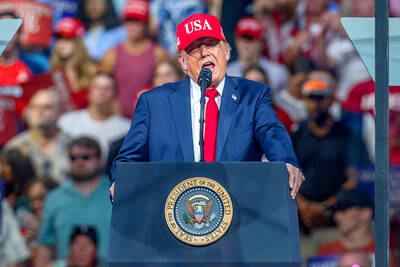
US President Donald Trump on Wednesday threatened to take action against the EU if it moves forward with European Commission President Ursula von der Leyen’s proposal to make Canada the bloc’s first associate member. “If they do that, if I think it’s at all a hostile act; I will put very serious tariffs or stop trading with Europe on many things,” Trump told reporters en route to an event in North Carolina, calling the proposal “laughable.” “If it’s a good intention, that’s fine. If it’s a bad intention, we’ll put very heavy tariffs on Europe,” he said. Von der Leyen made the proposal
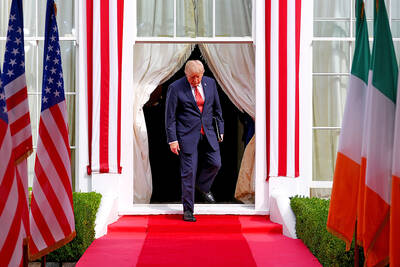
FROSTY RECEPTION: ‘I conveyed the strong view of the Irish people that the normalization of war and genocide can never be accepted,’ the Irish president said US President Donald Trump on Saturday said that he would “love to see” a united Ireland, wading into a politically sensitive subject as he embarked on a two-day Irish visit that blurs the lines between his presidency and personal business interests. After meeting Irish Prime Minister Micheal Martin in Dublin, Trump said reunification of the Republic of Ireland and Northern Ireland — split for more than a century — would be “a fantastic thing.” “It’s going to happen eventually. It may as well happen now,” he told reporters, adding that “the UK will have something to say about it, obviously.”
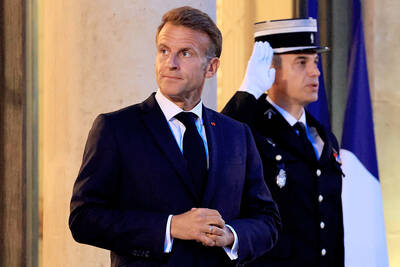
French President Emmanuel Macron today embarks on a rare and symbolic visit to a remote French territory in the North Atlantic, hosting Canadian Prime Minister Mark Carney at a time of growing tensions with Washington. The three-day visit to Saint Pierre and Miquelon, a three-island archipelago of less than 6,000 people just 25km off Newfoundland, would be the first by a French president in more than a decade. The trip to France’s only remaining possession in North America, a vestige of the huge territories Paris once controlled in what is now Canada and the US, carries immense symbolic resonance. Macron insists that US
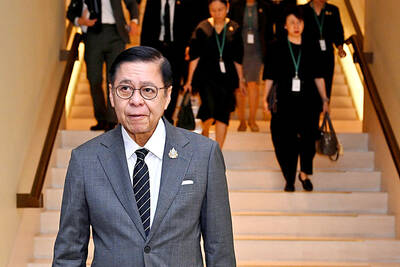
SEEKING AN AGREEMENT: The Cambodian foreign minister said Phnom Penh aimed to build trust through the mediation process, not further escalate tensions Thailand yesterday said that Cambodia was playing the victim in a dispute over maritime resources, as the Southeast Asian neighbors took their feud to international mediators a year after deadly clashes over their land border. Cambodia, which initiated the case before the Permanent Court of Arbitration (PCA) in Singapore, said it hoped the hearings would yield a peaceful resolution for both countries. In May, Thailand unilaterally pulled out of a bilateral framework agreement that aimed to resolve overlapping maritime border claims, but denied any link to their land dispute. Cambodia subsequently initiated a UN-backed conciliation process at the PCA, saying it hoped to


 RSS
RSS