


More than 1,000 Pashtun demonstrators shouted anti-Taliban slogans in eastern Afghanistan to protest the slayings this week of 26 young men from their community by militants in the south.
The unprecedented demonstration Friday in Laghman Province was one of the largest anti-Taliban gatherings since the fall of the hardline Islamist regime following the US invasion after the events of Sept. 11, 2001.
On Sunday, Taliban militants stopped a bus in southern Kandahar Province’s Maiwand district, a militant-controlled area, and killed 26 of the passengers — beheading at least six of them.
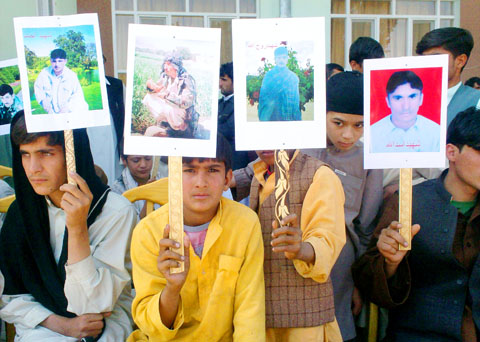
PHOTO: AP
A Taliban spokesman said the men were targeted because they were members of Afghan security forces.
But Afghan officials disputed that any soldiers were on the bus, saying the Taliban insurgents had killed innocent civilians who were on their way to find jobs in neighboring Iran.
Hundreds of thousands of Afghans cross illegally into Iran every year, seeking jobs and refuge.
Protesters from Laghman’s Alingar district — where most of those killed came from — shouted “Death to Taliban” and “Death to killers” in the provincial capital of Mehtar Lam.
They waved black flags in a sign of mourning.
“They were innocent people, trying to find jobs, and they killed them,” Abdul Wakil Attock, the spokesman for the provincial governor, said about the victims.
The protest in Laghman, a province next to Kabul, underscores the growing rivalry among Pashtuns, the dominant ethnic group in Afghanistan that also form the core of the Taliban fighters.
An anti-Taliban protest by Pashtuns, like Friday’s, will likely provide the US and other international forces with an opportunity to exploit the rift to drive a wedge between the insurgent group and the civilian population.
Separately, a US coalition raid in Paktika killed three insurgents on Thursday; four others were detained, the coalition said in a statement.
The troops were targeting an insurgent leader accused of facilitating the movement of foreign fighters and weapons throughout eastern Afghanistan.
The region borders Pakistan’s lawless tribal belt, which the US says militants use as a sanctuary from which to launch attacks in both countries.

‘CROSSING THE LINE’: China’s embassy in Seoul criticized US Forces Korea Commander General Xavier Brunson, asking if his ‘hostile’ remarks were authorized by Washington South Korea and the US are in talks over recent public remarks by the commander of US Forces Korea, Seoul’s presidential office said yesterday, after the comments drew sharp criticism from China. In a recent podcast interview, US Forces Korea Commander General Xavier Brunson described South Korea as “the dagger in the heart of Asia” from China’s east coast, prompting the Chinese embassy in Seoul to say that he had “truly crossed the line.” The interview came amid growing speculation that Washington might seek to expand the role of US Forces Korea in countering the growing regional influence of China, a key

Through the noise of rushing papers and whirring belts at a print factory in Kyoto, two creators watch their photo essay come to life in broadsheet form — part of an effort to win new audiences in the age of artificial intelligence (AI). Despite the decline of the publishing industry, self-publication and handmade “zine” magazines are growing in popularity in Japan, reflecting the nation’s enduring love of paper in the digital era. While speaking to Agence France-Presse at the plant, his hands black with ink, one of the creators, Kazuma Obara, said: “I think [paper] is a medium that engages all five

Australian researchers have trained lab-grown brain cells on a silicon computer chip to play the 1990s shooter game Doom and said they are just scratching the surface of what the neurons could be capable of doing. It is the science-fiction work of biotech boffins at Cortical Labs, who researched and developed the technology that harnesses the workings of the brain’s networking system. Each so-called “biological computer” contains about 200,000 living human brain cells, grown from stem cells that were harvested from blood donations. Having mastered the simple computer game Pong, where a paddle is moved up and down to send a ball

France experienced its hottest spring on record, the French weather service said on Tuesday, after an exceptional early heat wave that also broke highs for the season in England and Wales. Meteo-France said the average nationwide temperature over March to May was 13.8°C — about 1.7°C above the norm, and surpassing records set in 2011 and 2020. “The warmest spring since records began in 1900,” it said in a bulletin. All three months were warmer than average, but the onset of an “unprecedented heatwave” late last month pushed the mercury to highs typically seen at the height of the summer. “Our country had never


 RSS
RSS