

The US is close to removing North Korea from its terrorism blacklist in hopes of saving a crumbling nuclear disarmament deal, several media reports said yesterday.
Pyongyang ramped up the pressure by barring UN inspectors from its nuclear complex and warning Seoul of possible naval clashes along their disputed sea border.
The reports said Washington, which sent its chief negotiator Christopher Hill to Pyongyang last week, was nearing agreement with the hardline communist state on inspection procedures for its nuclear plants.
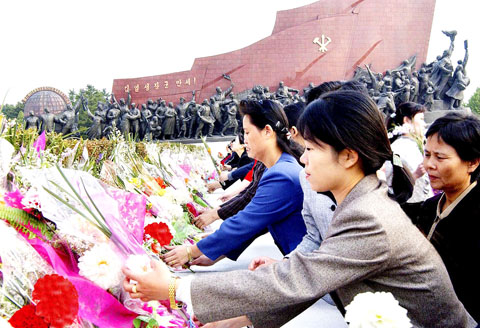
PHOTO: AP
South Korean Foreign Minister Yu Myung-hwan said the US was expected to decide soon on whether to drop the North from its blacklist, but no final deal on “verification” inspections had yet been reached.
He confirmed that verification would at present cover only the North’s admitted plutonium bomb-making program, and not a suspected secret enriched uranium program — a decision likely to anger US hardliners.
The US insists it must have agreement on verification before it can drop the North from the terror list, which blocks some bilateral and multilateral aid.
In protest at the delay, the North is preparing to restart the Yongbyon complex which made the plutonium for nuclear bombs. Yongbyon was shut down in July last year under an accord involving the two Koreas, the US, Russia, China and Japan.
Pyongyang accepted the landmark aid-for-disarmament deal in February last year, just four months after staging its first nuclear weapons test.
South Korea’s Chosun Ilbo newspaper said both sides had practically reached an agreement that the North would resume disabling Yongbyon in return for the delisting.
“The North’s resuming the disabling and the US delisting may come as early as this month,” it quoted a Seoul government official as saying.
Dong-A Ilbo said there were still differences on verification, but the US would go ahead with delisting and continue with negotiations.
Japan’s Kyodo News agency said delisting would come by the end of this month. White House spokesman Gordon Johndroe said no decision had been made yet.
“The US government is expected to make a decision [on the blacklist] in the near future,” Yu told reporters. “Discussions on a verification protocol are still under way.”
Yu said verification would cover only the program which the North declared in June.
“Negotiations have always been under way with an assumption that verification will be carried out on reported facilities first,” he said.
“The issues of the UEP [uranium enrichment program] and others like waste sites will be handled afterwards as we cannot deal with all the issues at the same time,” he said.
Meanwhile, Tokyo said it would not object to the removal of North Korea from the US terrorism blacklist if the move was seen as paving the way for Pyongyang to scrap its nuclear program.
Japanese Foreign Minister Hirofumi Nakasone told a news conference he did not know if the US would go ahead with the move to remove the North from its terror blacklist, but that he would not see it as a problem if it was deemed as yielding results.
“We expect the United States to tell us before making a final decision and if we think that it is enough, or enough to some extent, to resolve the nuclear issue, then I think it would be fine,” Nakasone said.
The North yesterday marked the anniversary of its ruling communist party. Official media made no mention of any appearance by Kim, 66.
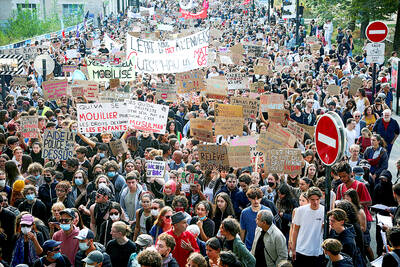
VIOLENT STANDOFFS: The government said 215 students have been injured since the start of the movement last month, including a teenager who lost a hand on Monday Thousands of demonstrators yesterday massed under heavy police surveillance in Paris and cities across France, as unions and teachers joined high-school students who for days have been demanding better conditions in protests punctuated by violent clashes. Students have blocked the entrances to hundreds of high schools for 15-to-17-year-olds since late last month, complaining of missing teachers, overloaded schedules, dilapidated classrooms and buildings that cannot cope with rising temperatures. In the Paris suburb of Creteil, where the protests started last month, students piled barriers outside the Saint-Exupery high school. “We are here to make our voice heard, all too often forgotten,” student Abderrahmane Abdelkader

As shark attack survivor Mel Ismail fought the predator that severed his leg, he noticed something odd. “I saw its eye ... a big black eye,” Ismail said. “But it was winking back at me — I was trying to get my fingers in its eye and just pushing its eye as I was being dragged.” When the shark swam off, he managed to struggle back to shore, the surfer and professional firefighter said in an Australian Broadcasting Corp interview broadcast on Thursday. He was surfing at Glenfield Beach near Geraldton on Australia’s west coast when he was attacked on Sept. 14. He
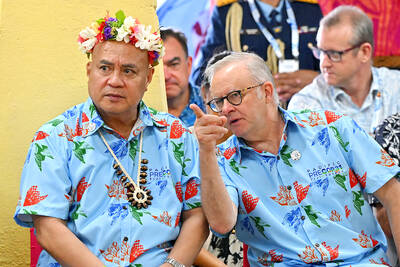
A Tuvalu government adviser yesterday said it felt like Australia had “taken over” the tiny country’s sovereignty during a visit by leaders to the Pacific island. The official — a senior government adviser who asked to remain anonymous because they were not authorized to speak to the media — said they were disappointed in Australia’s handling of the visit. The comments came during a visit by Australian Prime Minister Anthony Albanese and other leaders to Tuvalu, which has become a symbol of the existential threat posed by rising seas and is a key partner in Canberra’s Pacific strategy. “Just because we signed the

Halfway around the world from Russia, in a Caribbean tourism hot spot, men young and old are being lured by Moscow with tantalizing job offers, only to find themselves en route to the front lines in Ukraine. Moscow and Kyiv have recruited thousands of foreign nationals into their armies since Russia launched its invasion of Ukraine in 2022. Moscow is accused, in some cases, of using fake job ads to hoodwink men from deprived backgrounds in Africa, Asia and Latin America into traveling to Russia and then forcing them to fight on arrival. From countries such as India, Kenya, Equatorial Guinea, Colombia and


 RSS
RSS