

Canadian Prime Minister Stephen Harper acknowledged on Thursday his Conservatives could lose Monday’s parliamentary election, in the face of global financial turmoil and the cross-border impact of the US economic downturn.
“I’ve said from the outset that I believe that this is a close election that can go any way,” Harper told reporters, as a new opinion poll indicated that Conservative support is slipping as election day nears.
“I’ve reminded some of you that we were behind in the polls two weeks before this election began, so this is an election that could go either way,” he said, pointing to “one of two outcomes” — either a Conservative or Liberal victory.
When campaigning began, the Conservatives enjoyed a 10-point lead over the main opposition Liberals led by Stephane Dion.
But with stock markets tumbling and predictions this week of Canada falling into recession next year, Harper’s “stay the course” campaign has stumbled.
His bid to reassure Canadians — telling them “not to panic” as the Toronto Stock Exchange on Monday saw its biggest one-day drop in two decades — was proof the prime minister is “completely out of touch with reality,” Dion said in Toronto.
Both Dion and Jack Layton, leader of the socialist New Democratic Party (NDP), jumped on Harper for saying, in a television interview on Tuesday, that the falling stock markets are a buying opportunity for Canadians.
“I think there are probably some gains to be made in the stock market,” Harper said. “That’s my own view.”
In a tracking poll released on Thursday for CPAC, a public affairs cable channel, Nanos put the Conservatives at 33 percent, just four points ahead of the Liberals, with the NDP at 20 percent.
Some 1,031 decided voters took part in the poll, which had a margin of error of 2.9 percent.
Support for Harper was strongest in Western Canada — he himself is from oil-rich Alberta province — but flagging in Ontario, the industrial and financial core of the nation, and in poorer Atlantic Canada.
In French-speaking Quebec, the nationalist Bloc Quebecois led the field.
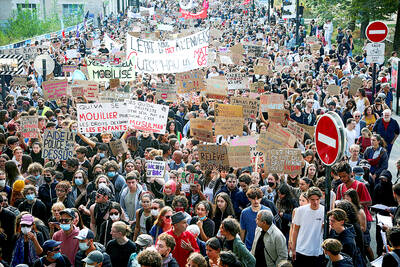
VIOLENT STANDOFFS: The government said 215 students have been injured since the start of the movement last month, including a teenager who lost a hand on Monday Thousands of demonstrators yesterday massed under heavy police surveillance in Paris and cities across France, as unions and teachers joined high-school students who for days have been demanding better conditions in protests punctuated by violent clashes. Students have blocked the entrances to hundreds of high schools for 15-to-17-year-olds since late last month, complaining of missing teachers, overloaded schedules, dilapidated classrooms and buildings that cannot cope with rising temperatures. In the Paris suburb of Creteil, where the protests started last month, students piled barriers outside the Saint-Exupery high school. “We are here to make our voice heard, all too often forgotten,” student Abderrahmane Abdelkader

As shark attack survivor Mel Ismail fought the predator that severed his leg, he noticed something odd. “I saw its eye ... a big black eye,” Ismail said. “But it was winking back at me — I was trying to get my fingers in its eye and just pushing its eye as I was being dragged.” When the shark swam off, he managed to struggle back to shore, the surfer and professional firefighter said in an Australian Broadcasting Corp interview broadcast on Thursday. He was surfing at Glenfield Beach near Geraldton on Australia’s west coast when he was attacked on Sept. 14. He

A Tuvalu government adviser yesterday said it felt like Australia had “taken over” the tiny country’s sovereignty during a visit by leaders to the Pacific island. The official — a senior government adviser who asked to remain anonymous because they were not authorized to speak to the media — said they were disappointed in Australia’s handling of the visit. The comments came during a visit by Australian Prime Minister Anthony Albanese and other leaders to Tuvalu, which has become a symbol of the existential threat posed by rising seas and is a key partner in Canberra’s Pacific strategy. “Just because we signed the
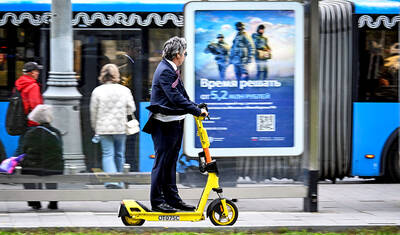
Halfway around the world from Russia, in a Caribbean tourism hot spot, men young and old are being lured by Moscow with tantalizing job offers, only to find themselves en route to the front lines in Ukraine. Moscow and Kyiv have recruited thousands of foreign nationals into their armies since Russia launched its invasion of Ukraine in 2022. Moscow is accused, in some cases, of using fake job ads to hoodwink men from deprived backgrounds in Africa, Asia and Latin America into traveling to Russia and then forcing them to fight on arrival. From countries such as India, Kenya, Equatorial Guinea, Colombia and


 RSS
RSS