


Canadian Prime Minister Stephen Harper said on Friday that while the country doesn’t need a panicky US-style government, he does need a strong mandate from the Oct. 14 election so he can deal with a slowing Canadian economy.
“We don’t need a parliament that acts and functions like the American Congress,” Harper said. “We’re not going to get into a situation like we have in the United States where we’re panicking and annunciating a different plan every day.”
The US Congress defeated a US$700 billion bailout of the US financial industry last Monday amid partisan bickering, but passed it on a second try on Friday.
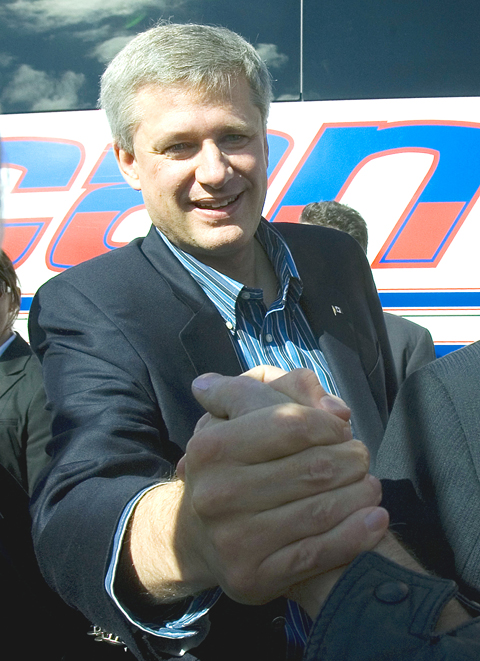
PHOTO: AP
Harper criticized the way the US has managed the credit crisis, a day after his Canadian political rivals attacked him during a leadership debate for being out of touch with the seriousness of Canada’s economic slowdown.
Harper’s opponents accused him of being lax about the country’s economy, which they say is teetering from shock waves from the US credit crisis. Thursday’s debate took place on a day the country’s main stock exchange plunged almost 7 percent as investors dumped Canada’s commodity stocks.
“The prime minister is ignoring it,” Liberal leader Stephane Dion said of the financial crisis. “We will not ignore the difficulties of today. We’ll act right away to help Canadians when they have a lot of concerns about their savings, their pensions, their mortgages and their jobs.”
Dion said Harper has no plan to tackle Canada’s economic challenges or make it more competitive over the long term.
The prime minister, meanwhile, urged Canadians to vote for the party they think can best run the economy. Harper acknowledged Canada’s economy is slowing but argues that — unlike the US — the country has avoided a mortgage meltdown and a banking crisis. He has promised a steady hand on the economy and has accused his Liberal opponent of wanting to raise energy taxes at the wrong time.
The Conservative leader called early elections in hopes his party would increase its seats in parliament in the Oct. 14 vote. Recent polls say the opposition Liberals are trailing badly and that the Conservatives could win a majority of seats.
As a minority government, the Conservatives have had to rely on the opposition to pass budgets and legislation.
Harper will get a five-year mandate if his Conservative party wins the majority of parliament’s 308 seats. Opposition parties couldn’t topple his government in a “no confidence” vote.
“The country would be better off if the government had a strong mandate than if we had a parliament that is weak,” Harper said.
Dion has moved his party to the crowded left by staking his leadership on a “Green Shift” tax plan. Dion, a former environment minister who named his dog Kyoto after the site of the first climate change accord, wants to increase taxes on greenhouse gas emitters.
The Conservatives have been targeting Dion’s plan in television and radio ads, saying it would drive up energy costs. Dion has said he would offset the higher energy prices by cutting income taxes.
Harper said a carbon tax would be a disaster that would be felt the most by commodity and energy producers, both of which have been hit hard on the stock market.
“We see what’s happening to some portfolios. Where are the drops? They are in energy and commodity stocks. What does the opposition propose? To raise taxes on energy and commodities, to hit the very stocks that are taking a fall,” Harper said.
“This is exactly what we don’t need. If we don’t panic here, if we stick on course, we keep taking additional actions, make sure everything we do is affordable, we will emerge from this as strong as ever,” he said.
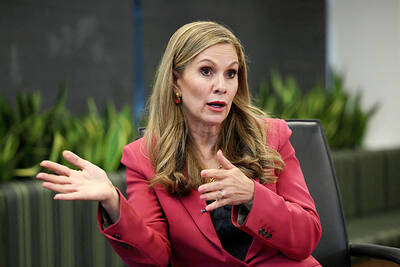
Australians were downloading virtual private networks (VPNs) in droves, while one of the world’s largest porn distributors said it was blocking users from its platforms as the country yesterday rolled out sweeping online age restriction. Australia in December became the first country to impose a nationwide ban on teenagers using social media. A separate law now requires artificial intelligence (AI)-powered chatbot services to keep certain content — including pornography, extreme violence and self-harm and eating disorder material — from minors or face fines of up to A$49.5 million (US$34.6 million). The country also joined Britain, France and dozens of US states requiring
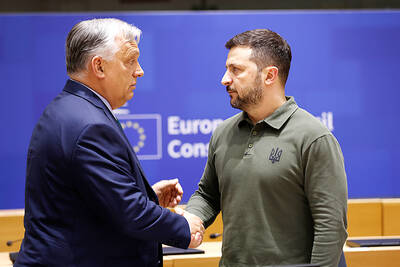
Hungarian authorities temporarily detained seven Ukrainian citizens and seized two armored cars carrying tens of millions of euros in cash across Hungary on suspicion of money laundering, officials said on Friday. The Ukrainians were released on Friday, following their detention on Thursday, but Hungarian officials held onto the cash, prompting Ukraine to accuse Hungary’s Russia-friendly government of illegally seizing the money. “We will not tolerate this state banditism,” Ukrainian Minister of Foreign Affairs Andrii Sybiha said. The seven detained Ukrainians were employees of the Ukrainian state-owned Oschadbank, who were traveling in the two armored cars that were carrying the money between Austria and
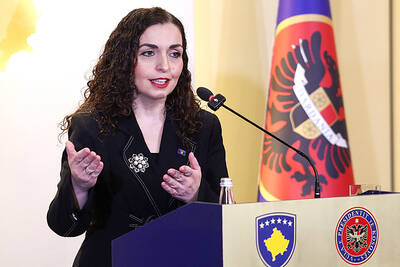
Kosovar President Vjosa Osmani on Friday after dissolving the Kosovar parliament said a snap election should be held as soon as possible to avoid another prolonged political crisis in the Balkan country at a time of global turmoil. Osmani said it is important for Kosovo to wrap up the upcoming election process and form functional institutions for political stability as the war rages in the Middle East. “Precisely because the geopolitical situation is that complex, it is important to finish this electoral process which is coming up,” she said. “It is very hard now to imagine what will happen next.” Kosovo, which declared

MORE BANS: Australia last year required sites to remove accounts held by under-16s, with a few countries pushing for similar action at an EU level and India considering its own ban Indonesia on Friday said it would ban social media access for children under 16, citing threats from online pornography, cyberbullying, online fraud and Internet addiction. “Accounts belonging to children under 16 on high-risk platforms will start to be deactivated, beginning with YouTube, TikTok, Facebook, Instagram, Threads, X, Bigo Live and Roblox,” Indonesian Minister of Communications and Digital Meutya Hafid said. “The government is stepping in so that parents no longer have to fight alone against the giants of the algorithm. Implementation will begin on March 28, 2026,” she said. The social media ban would be introduced in stages “until all platforms fulfill their


 RSS
RSS