


The dramatic increase in piracy in the Gulf of Aden could trigger a humanitarian and environmental disaster in the Horn of Africa and cut off global sea routes through the Suez Canal, a report warned on Wednesday.
The report, by the Chatham House foreign policy think tank, calls for a reinforced international naval presence in the region to combat the mostly Somalia-based pirates, with a significantly strengthened European component.
It also suggests the creation of a coast guard run on Somalia’s behalf, possibly by the UN or African Union in the absence of a stable government in Mogadishu.
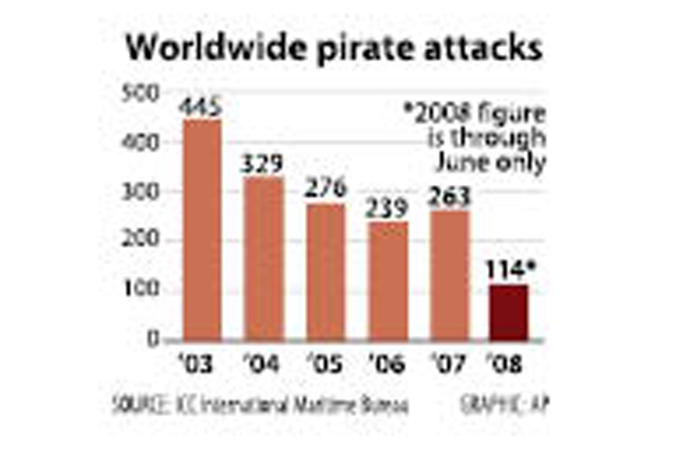
SOURCE:ICC lnternational Maeiyime Bureau GRAPHIC:AP
The Chatham House report emerged in the midst of a tense maritime standoff between the US navy and pirates who have seized a Ukrainian ship filled with tanks and other heavy weapons.
The Somali foreign ministry said on Wednesday that telephone negotiations were taking place between the owners of the MV Faina and the pirates, who are demanding a US$20 million ransom to release the vessel and its 21-strong crew. But the ministry added that foreign forces had permission to use force if necessary.
One of the pirates told Agence France-Presse by telephone that they were “prepared for any eventuality.” He also denied reports that three of the pirates had been killed during infighting on board.
The US Department of Defense, which is seeking to ensure that the weapons are not off-loaded and used to fuel the Islamist-led insurgency in Somalia, said yesterday it was in no hurry to take action.
According to figures compiled by the International Maritime Bureau (IMB), 16,000 ships sail through the Gulf of Aden each year. There have already been more than 60 pirate attacks off the Somali coast and in the Gulf of Aden so far this year — more than twice last year’s total.
IMB director Pottengal Mukundan said 12 vessels and 259 crew were being held for ransom. Shipping companies are thought to have paid up to US$30 million in ransoms so far this year.
“They have no choice. They have no one to turn to, to deal with the pirates,” Mukundan said.
The Chatham House report said that insurance premiums for shipping through the Gulf of Aden have increased tenfold, and that the combined danger and cost could “mean that shipping could be forced to avoid the Gulf of Aden/Suez canal and divert around the Cape of Good Hope.”
“This would add considerably to the costs of manufactured goods and oil from Asia and the Middle East,” the report said.
It also warns that if an oil tanker were seriously damaged in a pirate attack it could cause a “major environmental disaster.”
The pirates have hitherto focused on extorting ransom, but the report warns that if any were co-opted by international terrorist networks, the objective could switch to causing maximum damage, perhaps by scuttling a large ship at the entrance to the Suez Canal.
There is also an immediate humanitarian threat. Ships delivering about 185,000 tonnes of food aid to Somalia are being protected for now by the Canadian Navy, but its mandate runs out at the end of this month and it is so far unclear what would take its place. If the supply from the World Food Program was halted, millions could starve.

An American scientist convicted of lying to US authorities about payments from China while he was at Harvard University has rebuilt his research lab in Shenzhen, China, to pursue technology the Chinese government has identified as a national priority: embedding electronics into the human brain. Charles Lieber, 67, is among the world’s leading researchers in brain-computer interfaces. The technology has shown promise in treating conditions such as amyotrophic lateral sclerosis and restoring movement in paralyzed people. It also has potential military applications: Scientists at the Chinese People’s Liberation Army have investigated brain interfaces as a way to engineer super soldiers by boosting

Indonesian police have arrested 13 people after shocking images of alleged abuse against small children at a daycare center went viral, sparking outrage across the nation, officials said on Monday. Police on Friday last week raided Little Aresha, a daycare center in Yogyakarta on Java island, following a report from a former employee. CCTV footage circulating on social media showed children, most younger than two, lying on the floor wearing only diapers, their hands and feet bound with rags. The police have confirmed that the footage is authentic. Police said they also found 20 children crammed into a room just 3m by 3m. “So
A grieving mother has ended her life at a clinic in Switzerland four years after the death of her only child. Wendy Duffy, 56, a physically healthy woman, died at the Pegasos clinic in Basel after struggling to cope with the death of her 23-year-old son, Marcus. The former care worker, from the West Midlands, England, had previously attempted to take her own life. The case comes as assisted dying would not become law in England and Wales after proposed legislation, branded “hopelessly flawed” by opponents, ran out of time. Ruedi Habegger, the founder of Pegasos, described Duffy’s death as

From post offices and parks to stations and even the summit of Mount Fuji, Japan’s vending machines are ubiquitous, but with the rapid pace of inflation cooling demand for their drinks, operators are being forced to rethink the business. Last month beverage giant DyDo Group Holdings announced it would remove about 20,000 vending machines — about 7 percent of their stock nationwide — by January next year, to “reconstruct a profitable network.” Pokka Sapporo Food & Beverage, based in Nagoya, also said last month it would sell its 40,000-machine operation to Osaka-based Lifedrink Co. “The strength of the vending machine


 RSS
RSS