


US President George W. Bush highlighted civilian reconstruction work that has improved daily life in Afghanistan despite extremists attacks that have made this the most violent year since the US-led invasion that threw out the hardline Taliban regime in 2001.
During his session with Afghan President Hamid Karzai on Friday, Bush said work being done by more than two dozen reconstruction teams is a central part of the counterinsurgency strategy in the nation.
“No question it’s difficult, but if you listen to the people who are actually on the ground working with the citizens of Afghanistan on matters such as agriculture, or education, or infrastructure, you’ll understand why I said that there is progress and promise and hope,” Bush said.
The two leaders are trying to quell violence being waged by Taliban and al-Qaeda extremists hiding in the border regions of Pakistan. Also, US-Afghan relations have been strained by the deaths of Afghan civilians in bombing raids that Karzai says are undermining the credibility of the international community’s partnership with the Afghan people.
Still, Karzai praised the work of reconstruction teams, saying Afghanistan has made more progress in the past six or seven years than it would have been able to make on its own in 50 or 60 years.
“Life is better,” Karzai said. “Of course we have challenges, and the challenges will continue to face us as we move ahead. The success is already there; the picture will be completed.”
The meeting was likely Karzai’s last with Bush at the White House. Karzai thanked Bush for his commitment to his country and for the president’s patience in coping with the nation’s many problems.
“I’ve yelled at times,” Karzai said, prompting a laugh from Bush. “I’ve been angry at times. But you’ve always been smiling and generous, and just so nice.”
During the meeting, Bush and Karzai had a videoconference with US provincial reconstruction team leaders, representatives from the National Guard’s agriculture development team and Afghan governors in two provinces in eastern Afghanistan. Twenty-six reconstruction teams now operate in Afghanistan, 12 led by the US and 14 directed by NATO allies and coalition partners.
Lieutenant Colonel Frank Sturek, branch chief for Afghan policy at the Joint Chiefs of Staff who worked with provisional reconstruction teams in two provinces in southeast Afghanistan in 2006, recounted how reconstruction team workers helped to open schools for children who had not been to class in two years.
“That’s only about 8,000 to 10,000 kids going to school, which is not a big deal here in the US, but to the Afghans in that area, it was huge,” Sturek said after the meeting. “The country is so poor and the country is in such need, and wants to grow, that what we consider small improvements are really strategic successes over there.”
Early this week, US Secretary of Defense Robert Gates said the Pentagon may be able to send thousands more combat troops to Afghanistan starting in the spring, but he also pointedly cautioned against overdoing a military buildup in a country that long has resisted the presence of foreign forces. About 31,000 US troops are in Afghanistan and roughly an equal number of other coalition troops.
At least 120 US troops and 104 from other NATO nations have died in Afghanistan this year, both record numbers. Overall, more than 4,500 people, mostly militants, have died in attacks this year.
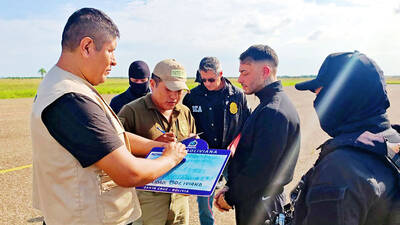
KINGPIN: Marset allegedly laundered the proceeds of his drug enterprise by purchasing and sponsoring professional soccer teams and even put himself in the starting lineups Notorious Latin American narco trafficker Sebastian Marset, who eluded police for years, was handed over to US authorities after his arrest on Friday in Bolivia. Marset, a Uruguayan national who was on the US most-wanted list, was passed to agents of the US Drug Enforcement Administration at Santa Cruz airport in Bolivia, then put on a US airplane, Bolivian state television showed. “The arrest and deportation were carried out pursuant to a court order issued by the US justice system,” Bolivian Minister of Government Marco Antonio Oviedo told reporters. The alleged kingpin was arrested in an upscale neighborhood of Santa
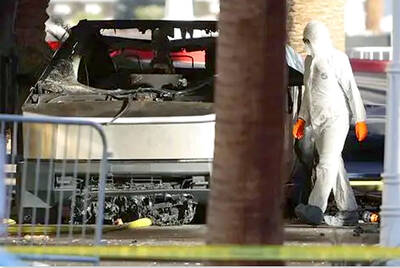
ACTIONABLE ADVICE: The majority of chatbots tested provided guidance on weapons, tactics and target selections, with Perplexity and Meta AI deemed to be the least safe From school shootings to synagogue bombings, leading artificial intelligence (AI) chatbots helped researchers plot violent attacks, according to a study published on Wednesday that highlighted the technology’s potential for real-world harm. Researchers from the nonprofit watchdog Center for Countering Digital Hate and CNN posed as 13-year-old boys in the US and Ireland to test 10 chatbots, including ChatGPT, Google Gemini, Perplexity, Deepseek and Meta AI. Eight of the chatbots assisted the make-believe attackers in more than half the responses, providing advice on “locations to target” and “weapons to use” in an attack, the study said. The chatbots had become a “powerful accelerant for
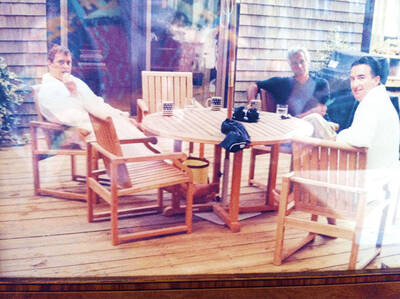
SCANDAL: Other images discovered earlier show Andrew bent over a female and lying across the laps of a number of women, while Mandelson is pictured in his underpants A photograph of former British prince Andrew and veteran politician Peter Mandelson sitting in bathrobes alongside late sex offender Jeffrey Epstein was unearthed on Friday in previously published documents. The image is believed to be the first known photograph of the two men with Epstein. They are currently engulfed in scandal in the UK over their ties to their mutual friend. The undated photograph, first reported by ITV News, shows King Charles III’s disgraced brother and former British ambassador to the US sitting barefoot outside on a wooden deck. They appear to have mugs with a US flag on them
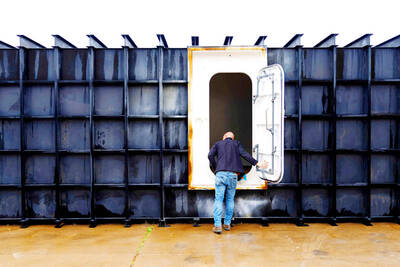
Since the war in the Middle East began nearly two weeks ago, the telephone at Ron Hubbard’s bomb shelter company in Texas has not stopped ringing. Foreign and US clients are rushing to buy his bunkers, seeking refuge in case of air raids, nuclear fallout or apocalypse. With the US and Israel pounding Iran, and Tehran retaliating with strikes across the region, Hubbard has seen demand for his product soar, mostly from Gulf nation customers in Bahrain, Qatar, Kuwait and the United Arab Emirates. “You can imagine how many people are thinking: ‘I wish I had a bomb shelter,’” Hubbard, 63, said in


 RSS
RSS