


Venezuelan President Hugo Chavez arrived in Cuba late on Sunday to meet with former Cuban president Fidel Castro as Caracas’ firebrand leader sets out on a tour that includes China, Russia, Portugal and France.
He was greeted at Jose Marti International Airport by Cuban President Raul Castro, who wore his customary military uniform. In an article published Sunday in Cuba’s state-run press, Castro, 82, said the one-hour meeting with his close friend Chavez will be “a great honor for me.” The meeting follows a tete-a-tete between the two leftist leaders in June.
Chavez had been authorized by the legislature to stop in Belarus as well, but said Sunday in his Hello Mr. President weekly broadcast that he would not be traveling there, without explaining why.
Chavez has said his travels hold “great strategic interest,” for his country. Venezuelan lawmakers approved his week-long tour, designed to “strengthen international relations with those countries and sign exchange and cooperation deals on economic, social and cultural matters.”
After his stop in Cuba, Chavez travels to China for talks with Chinese President Hu Jintao (胡錦濤) on the capitalization of a US$6 billion bilateral investment fund which he says Caracas will use for “socialist productive projects.”
China is contributing US$4 billion and Venezuela US$2 billion, Chavez said.
While in China Chavez could firm up announced plans for Venezuela’s purchase of 24 K-8 Chinese training and combat planes, which could be part of Venezuela’s air force next year.
Chavez will then head to Moscow. Caracas in recent years has been broadening its military ties to Moscow, and Chavez backed Russia in the recent Georgian conflict.
Earlier this month, Russian supersonic Tu-160 heavy bombers for the first time flew training runs with Venezuela in an area of the Caribbean traditionally considered the US military’s sphere of influence.
Caracas and Moscow have naval maneuvers planned for the Caribbean in November or December.
Chavez will then travel to France, where he will meet with French President Nicolas Sarkozy.
On the last stop in Portugal, Chavez will sign agreements on housing and computer technology. Portugal is a partner in natural gas projects in Venezuela.
Chavez will also purchase 50,000 prefabricated homes in Portugal, and is seeking to sign a deal to build a factory for prefab homes in Venezuela.
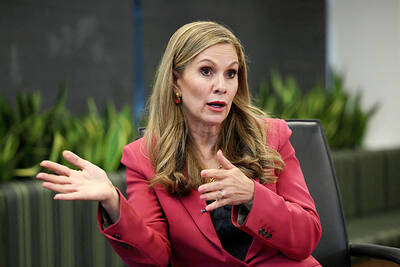
Australians were downloading virtual private networks (VPNs) in droves, while one of the world’s largest porn distributors said it was blocking users from its platforms as the country yesterday rolled out sweeping online age restriction. Australia in December became the first country to impose a nationwide ban on teenagers using social media. A separate law now requires artificial intelligence (AI)-powered chatbot services to keep certain content — including pornography, extreme violence and self-harm and eating disorder material — from minors or face fines of up to A$49.5 million (US$34.6 million). The country also joined Britain, France and dozens of US states requiring
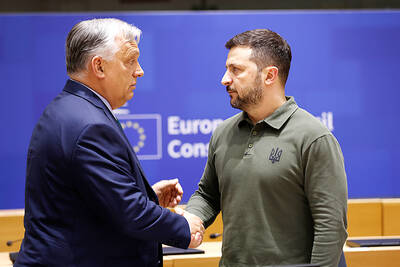
Hungarian authorities temporarily detained seven Ukrainian citizens and seized two armored cars carrying tens of millions of euros in cash across Hungary on suspicion of money laundering, officials said on Friday. The Ukrainians were released on Friday, following their detention on Thursday, but Hungarian officials held onto the cash, prompting Ukraine to accuse Hungary’s Russia-friendly government of illegally seizing the money. “We will not tolerate this state banditism,” Ukrainian Minister of Foreign Affairs Andrii Sybiha said. The seven detained Ukrainians were employees of the Ukrainian state-owned Oschadbank, who were traveling in the two armored cars that were carrying the money between Austria and
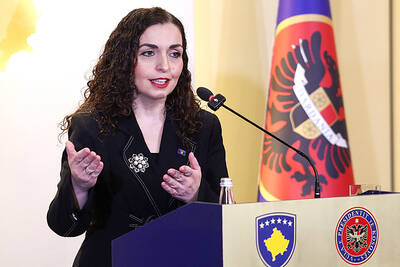
Kosovar President Vjosa Osmani on Friday after dissolving the Kosovar parliament said a snap election should be held as soon as possible to avoid another prolonged political crisis in the Balkan country at a time of global turmoil. Osmani said it is important for Kosovo to wrap up the upcoming election process and form functional institutions for political stability as the war rages in the Middle East. “Precisely because the geopolitical situation is that complex, it is important to finish this electoral process which is coming up,” she said. “It is very hard now to imagine what will happen next.” Kosovo, which declared

MORE BANS: Australia last year required sites to remove accounts held by under-16s, with a few countries pushing for similar action at an EU level and India considering its own ban Indonesia on Friday said it would ban social media access for children under 16, citing threats from online pornography, cyberbullying, online fraud and Internet addiction. “Accounts belonging to children under 16 on high-risk platforms will start to be deactivated, beginning with YouTube, TikTok, Facebook, Instagram, Threads, X, Bigo Live and Roblox,” Indonesian Minister of Communications and Digital Meutya Hafid said. “The government is stepping in so that parents no longer have to fight alone against the giants of the algorithm. Implementation will begin on March 28, 2026,” she said. The social media ban would be introduced in stages “until all platforms fulfill their


 RSS
RSS