


Japan’s agriculture minister resigned yesterday in a widening scandal over rice contaminated with mold and pesticide that was sold as food for thousands of people, including schoolchildren and nursing home patients.
Seiichi Ota’s departure only seven weeks after he took office was a further embarrassment to the teetering government of Japanese Prime Minister Yasuo Fukuda, who announced recently his own resignation amid a parliamentary stalemate.
“I met with Prime Minister Fukuda and told him my decision to resign, considering the seriousness of the tainted rice problem for society,” Ota said.
Chief Cabinet Secretary Nobutaka Machimura will take over as interim farm minister, the government said.
Japanese consumers have been horrified in recent weeks over the discovery that contaminated rice intended for industrial uses such as the manufacture of glue had been distributed instead as food to thousands of people.
The rice, imported from China, Vietnam and the US, was shipped to food companies, schools, day-care centers and nursing homes, the government said.
News reports said it was also discovered in rice balls sold at convenience stores.
“We deeply regret causing worries over food safety. We recognize that this is a very serious situation,” Machimura said.
The rice was tainted with the pesticide methamidophos at concentrations that exceeded government regulations but were too low to threaten anyone’s health, officials said.
There have been no reports of anyone getting sick from the rice.
The discovery is the latest in a string of food scandals including the false labeling of meat, vegetables and sweets, and Chinese-made dumplings that sickened at least 10 people in Japan.
Ota’s resignation comes just days before the ruling Liberal Democratic Party’s (LDP) election on Monday to choose a new president. The winner is expected to be elected by parliament to succeed Fukuda two days later.
Japan’s top opposition party, the Democratic Party of Japan, said the resignation was an attempt by the ruling party to halt damage from the scandal before calling parliamentary elections, possibly later this year.
The LDP “must have figured they cannot win elections” without firing Ota, DPJ Secretary-General Yukio Hatoyama told reporters.
The five candidates running to replace Fukuda were split yesterday on whether elections for parliament should be held soon as has been widely predicted.
In their final major speaking engagement before the party selects its new president, the five were hesitant to comment on when broader elections for parliament should be held.
Polls indicate many voters want such elections so that they can have more of a say in who leads the country, and it had been widely reported in Japan that an election could be called as early as Oct. 26.
But Taro Aso, the front-runner in the party leadership race, said the issue remained fluid.
“None of us has said that date,” Aso said.
One of Aso’s opponents, Nobuteru Ishihara, said that elections should be held “as soon as possible.” The other three stressed the importance of finishing up government business, including passing a budget, as high priorities in deciding when to hold the vote.
On another sensitive topic, the candidates had different opinions on whether it would be appropriate for them to visit the Yasukuni shrine while in office.
Visits to the shrine, which honors Japan’s war dead, have been controversial because of the shrine’s association with Japan’s pre-1945 militarism.
News of sitting prime ministers worshipping at the shrine usually bring protests from China and Korea.
Ishihara said he would like to visit, because he has a relative enshrined there.
Aso, who is seen by many as a hawk, was vague in his response, but Kaoru Yosano said flatly he would not go.
Former defense ministers Yuriko Koike and Shigeru Ishiba did not explicitly answer one way or the other, but said it was important to create an atmosphere in which the emperor can visit the shrine.

‘TERRORIST ATTACK’: The convoy of Brigadier General Hamdi Shukri resulted in the ‘martyrdom of five of our armed forces,’ the Presidential Leadership Council said A blast targeting the convoy of a Saudi Arabian-backed armed group killed five in Yemen’s southern city of Aden and injured the commander of the government-allied unit, officials said on Wednesday. “The treacherous terrorist attack targeting the convoy of Brigadier General Hamdi Shukri, commander of the Second Giants Brigade, resulted in the martyrdom of five of our armed forces heroes and the injury of three others,” Yemen’s Saudi Arabia-backed Presidential Leadership Council said in a statement published by Yemeni news agency Saba. A security source told reporters that a car bomb on the side of the road in the Ja’awla area in

PRECARIOUS RELATIONS: Commentators in Saudi Arabia accuse the UAE of growing too bold, backing forces at odds with Saudi interests in various conflicts A Saudi Arabian media campaign targeting the United Arab Emirates (UAE) has deepened the Gulf’s worst row in years, stoking fears of a damaging fall-out in the financial heart of the Middle East. Fiery accusations of rights abuses and betrayal have circulated for weeks in state-run and social media after a brief conflict in Yemen, where Saudi airstrikes quelled an offensive by UAE-backed separatists. The United Arab Emirates is “investing in chaos and supporting secessionists” from Libya to Yemen and the Horn of Africa, Saudi Arabia’s al-Ekhbariya TV charged in a report this week. Such invective has been unheard of

US President Donald Trump on Saturday warned Canada that if it concludes a trade deal with China, he would impose a 100 percent tariff on all goods coming over the border. Relations between the US and its northern neighbor have been rocky since Trump returned to the White House a year ago, with spats over trade and Canadian Prime Minister Mark Carney decrying a “rupture” in the US-led global order. During a visit to Beijing earlier this month, Carney hailed a “new strategic partnership” with China that resulted in a “preliminary, but landmark trade agreement” to reduce tariffs — but
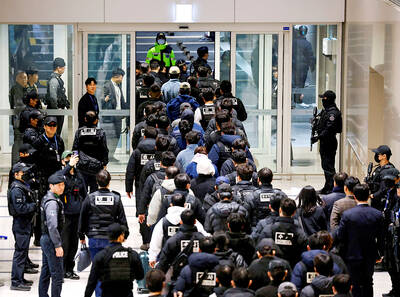
SCAM CLAMPDOWN: About 130 South Korean scam suspects have been sent home since October last year, and 60 more are still waiting for repatriation Dozens of South Koreans allegedly involved in online scams in Cambodia were yesterday returned to South Korea to face investigations in what was the largest group repatriation of Korean criminal suspects from abroad. The 73 South Korean suspects allegedly scammed fellow Koreans out of 48.6 billion won (US$33 million), South Korea said. Upon arrival in South Korea’s Incheon International Airport aboard a chartered plane, the suspects — 65 men and eight women — were sent to police stations. Local TV footage showed the suspects, in handcuffs and wearing masks, being escorted by police officers and boarding buses. They were among about 260 South


 RSS
RSS