


Two strong earthquakes rattled Asia yesterday, triggering alerts for a tsunami that harmlessly lapped Japan’s northern coast and another in Indonesia that didn’t materialize but briefly sent residents fleeing to high ground.
The more powerful of the quakes, with a preliminary magnitude of 7.0, hit at 9:21am off Japan’s northernmost main island of Hokkaido at a depth of about 120km, the nation’s meteorological agency said.
A 10cm tsunami rippled to shore 35 minutes later, but there were no signs of damage.
“There was some light shaking, but it was nothing major,” said Yukio Yoshida, a police spokesman in Hokkaido.
Authorities temporarily advised about 10,600 residents of Ofunato in Iwate Prefecture, about 200km northwest of Tokyo, to evacuate their homes and ordered people to stay away from beaches.
An hour earlier, northeastern Indonesia was hit by a 6.6 magnitude quake that struck 90km beneath the Molucca Sea, the US Geological Survey said.
Though on the same tectonic plate, the temblors were unrelated, local officials said.
A tsunami alert was briefly issued over the radio and television and people in the Maluku capital of Ternate, which was closest to the epicenter, fled from houses and buildings as the earth rumbled beneath them.
The feared wave never came, however, and there were no reports of casualties or damage.
“I ran out of the hotel with other guests and we fled to high ground,” Benyamin Otte said.
“I could see people on the beach, checking to see if the were any signs of a tsunami, but everything looked normal. Within a half hour, we were heading back down,” Otte said.
Indonesia and Japan are both prone to seismic upheaval due to their location on the so-called Pacific “Ring of Fire,” an arc of volcanos and fault lines encircling the Pacific Basin.
In December 2004, a massive earthquake off Indonesia’s Sumatra island triggered a tsunami that battered much of the Indian Ocean coastline and killed more than 230,000 people — 131,000 of them in Aceh province alone.
A tsunami off Java last year killed nearly 5,000.
Japan also is one of the world’s most earthquake prone nations.
In 1995, a 7.2 magnitude quake in the western port city of Kobe killed 6,400 people and experts believe Tokyo has a 90 percent chance of being hit by a major quake over the next 50 years.
In related news, at least seven people were killed and 47 injured in the powerful earthquake that struck southern Iran on Wednesday, the Mehr news agency reported yesterday.
“Based on the latest information, seven people were killed and 47 have been injured,” Hormozgan Provincial Governor Abdolali Saheb Mohammadi was quoted as saying.
The US Geological Survey said the 6.1 magnitude quake jolted an area southwest of the port of Bandar Abbas, the capital of Hormozgan.
The quake occurred on Qeshm island, a popular tourist and free-trade island which lies just off the coast from Bandar Abbas in the Strait of Hormuz, the strategic Gulf oil route.
“The earthquake yesterday afternoon hit the same area as another three years ago and with the same magnitude, but because of reconstruction since, there was no serious damage now,” Saheb Mohammadi said.
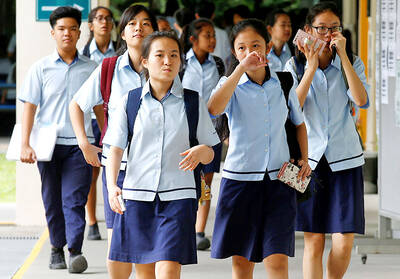
School bullies in Singapore are to face caning under new guidelines, but the education minister on Tuesday said it would be meted out only as a last resort with strict safeguards. Human rights groups regularly criticize Singapore for the use of corporal punishment, which remains part of the school and criminal justice systems, but authorities have defended it as a deterrent to crime and serious misconduct. Caning was discussed in the parliament after legislators asked how it would be used in relation to bullying in schools. The debate followed stricter guidelines on serious student misconduct, including bullying, unveiled by the Singaporean Ministry of

Jailed media entrepreneur Jimmy Lai (黎智英) has been awarded Deutsche Welle’s (DW) freedom of speech award for his contribution to Hong Kong’s pro-democracy movement. The German public broadcaster on Thursday said Lai would be presented in absentia with the 12th iteration of the award on June 23 at the DW Global Media Forum in Bonn. Deutsche Welle director-general Barbara Massing praised the 78-year-old founder of the now-shuttered news outlet Apple Daily for standing “unwaveringly for press freedom in Hong Kong at great personal risk.” “With Apple Daily, he gave journalists a platform for free reporting and a voice to the democracy movement in

As evening falls in Fiji’s capital, a steady stream of people approaches a makeshift clinic that is a first line of defense against one of the world’s fastest-growing HIV epidemics. In the South Pacific nation — a popular tourist destination of just under a million people — more than 2,000 new HIV cases were recorded last year, a 26 percent increase from 2024. The government has declared an HIV outbreak and described it as a national crisis. “It’s spreading like wildfire,” said Siteri Dinawai, 46, who came to be tested. The Moonlight Clinic, a converted minibus parked in a suburban cul-de-sac in Suva, is
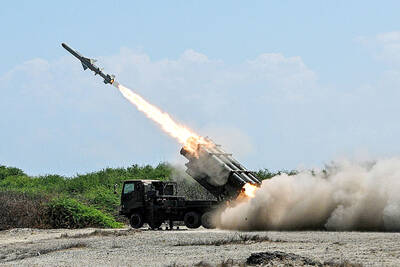
A MESSAGE: Japan’s participation in the Balikatan drills is a clear deterrence signal to China not to attack Taiwan while the US is busy in the Middle East, an analyst said The Japan Self-Defense Forces yesterday fired a Type 88 anti-ship missile during a joint maritime exercise with US, Australian and Philippine forces, hitting a decommissioned Philippine Navy ship in waters facing the disputed South China Sea, in drills that underscore Tokyo’s rising willingness to project military power on China’s doorstep. The drill took place as Manila and Tokyo began talks on a potential defense equipment transfer, made possible by Japan’s decision to scrap restrictions on military exports. The discussions include the possible early transfer of Abukuma-class destroyers and TC-90 aircraft to the Philippines, Japanese Minister of Defense Shinjiro Koizumi said. Philippine Secretary of


 RSS
RSS