

Colombian politician Ingrid Betancourt, freed just weeks ago from rebels who held her hostage for years, on Tuesday implored diplomats to create an international bill of rights for victims of terrorism.
“If there is no political will, there is nothing,” Betancourt said at the UN’s first symposium on victims of terrorism.
Such a statement could spell out legal protections and lead to the creation of a UN Web site that lists acknowledged terrorism victims, she said, adding that “the most important step now is to think about the possibility of having a status.”
Betancourt holds Colombian-French citizenship and was running for Colombia’s presidency when she was kidnapped by leftist guerrillas six years ago. Colombia’s military freed her in July along with 14 other hostages.
She was among 18 people summoned from the Middle East, Europe, Africa, Asia and the Americas to share their experiences as victims of bombings, hostage-takings and other terrorist attacks in the past several decades. Arranging the discussion was especially tricky considering that the UN does not have an agreed upon definition of what constitutes terrorism.
Naomi Monchari Kerongo, a former trade development officer in Kenya, was among 4,000 injured when twin bombs ripped through US embassies in Nairobi and Dar es Salaam, Tanzania, killing 213 people. Al-Qaeda claimed responsibility for that attack, which collapsed buildings into rubble.
In a trance-like recitation on Tuesday, Kerongo told of spending two years in a mental hospital, losing her job, her house and her family. Ten years after the attack, she is now destitute and living in the slums of Nairobi. Tanzania bombing survivor Henry Kessy was moved to put his hand on her shoulder when her eyes glistened.
“Nothing can take us back to the day before the bomb blast,” Kerongo said. “But something can and must be done to answer our call for help … We are not asking for charity. It is justice we seek.”
Most speakers urged greater international cooperation in fighting terrorists, with greater attention paid to the societal and mental health consequences of the losses and pain caused to victims, their families and the broader communities.
Betancourt and Laura Dolci Kanaan — a UN human rights officer in Geneva, whose five-year-old son is growing up without a father because he was killed in the 2003 bombing that targeted the UN headquarters in Baghdad — proposed an international bill of rights for victims of terrorism.
That’s something UN Secretary-General Ban Ki-moon said he would consider.
“The list keeps growing longer, bringing with it greater pain and grief that cascades mercilessly through families, communities and nations,” Ban said. “And it is for the sake of humanity that we must create a global forum for your voice and listen to you, the victims. Your stories of how terrorism has affected your lives are our strongest argument why it can never be justified.”
Ban’s top policy official, Robert Orr, who also heads a counterterrorism task force, said the UN decided what should be considered a terrorist act and the participants were then chosen accordingly.
Some in attendance noted the absence of any victims of “state-sponsored” terrorism that is not defined legally.
The UN General Assembly agreed by consensus last week to reaffirm its counterterrorism strategy adopted two years ago. It calls for stepping up border controls, developing a database on “biological incidents,” clamping down on counterfeiting of travel documents and developing ways to stem terrorism on the Internet.
By shifting attention onto victims’ needs and away from terrorists, UN officials also hoped the symposium would show the generational impacts of terrorism.
Ashraf Al-Khaled recalled the shock of losing his father and father-in-law during a suicide bombing attack at his wedding reception in Amman, Jordan, in November 2005.
Al-Qaeda claimed responsibility for three bomb blasts at three luxury hotels that night, killing at least 57 and injuring hundreds more.
“Suddenly everything white turned into red,” he said. “My wife and I lost 27 people in our wedding.”
Australian Ben Borgia recalled losing his mother and 13-year-old sister in the 2002 nightclub bombings on Bali.
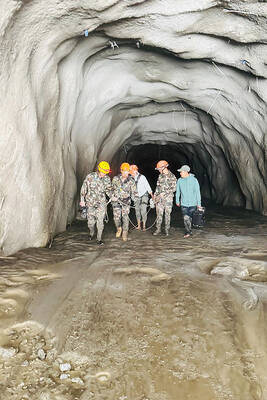
DEATH TOLL 903: More than 900 workers are believe to be trapped in the tunnels and underground areas of several hydropower projects after flash floods in Nepal-Tibet Rescue teams were working to reach more than 900 people thought to be trapped in the tunnels and underground areas of half a dozen hydropower projects in Nepal following the devastating flash floods, ?the National Disaster Risk Reduction and Management Authority said yesterday. The death toll from the unprecedented deluge of ice, rock, mud ?and debris that crashed through valleys of Nepal on Wednesday last week has risen to 903 people, with 16 more dead reported on the Tibet side of the border. More than 4,000 are missing in Nepal, with another 500 in Tibet. Hundreds of bodies, many unidentified, have been

Ontario Premier Doug Ford on Saturday answered US President Donald Trump’s “Lake America” decree with a billboard-sized message on the Canadian shoreline — “Lake Ontario. Now and Always” — as Canadian leaders met Trump’s move with ridicule rather than outrage. Wearing a Canada national soccer team jersey, Ford unveiled the sign near Grimsby and posed for photographs. The message is repeated in French. The display followed Trump’s executive order directing US federal agencies to call Lake Ontario “Lake America.” After months of tariffs, threats to make Canada the 51st US state and personal attacks on its leaders, the reaction in
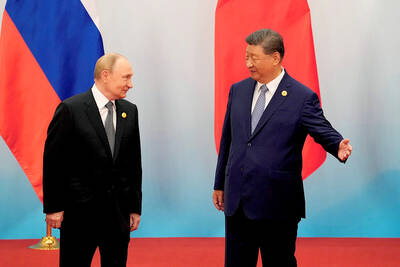
PLENARY SESSION: Although the SCO says it is ‘not an alliance directed against other states,’ Putin and Xi have repeatedly made anti-Western speeches during its summits Russian President Vladimir Putin and Chinese President Xi Jinping (習近平) are expected tomorrow in Kyrgyzstan for a two-day summit, also attended by Iran’s and India’s leaders, of a regional bloc seeking to be a counter-influence to the West. Around a dozen heads of states would head to the Kyrgyz capital, Bishkek, to mark 25 years of the Shanghai Cooperation Group (SCO). The group brings together Russia, China, India, Pakistan, Iran, four Central Asian countries and Moscow-allied Belarus. Putin and Xi have previously used SCO summits to promote their vision of a multipolar world and present a united front against the
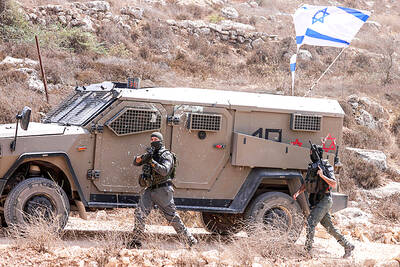
Dozens of Israeli settlers on Saturday attacked the Palestinian village of Qusra in the northern occupied West Bank after nearly three weeks of tension in the area, drawing rare condemnation from Israeli Prime Minister Benjamin Netanyahu. Earlier this month, a group of settlers began blocking supplies from entering Palestinian houses on the outskirts of the village near Nablus, trapping residents inside and drawing unusually strong criticism from the US ambassador. Weeks later, Israeli forces continue to operate in the area while settlers still roam the surrounding hills. On Saturday, Qusra residents and dozens of settlers had descended on the village,


 RSS
RSS