


Disgraced rocker Gary Glitter arrived back in Bangkok yesterday after Hong Kong denied him entry, continuing a two-day odyssey that began when he was released from a Vietnamese prison after serving time for molesting children.
Glitter, a British citizen, flew to Hong Kong on Wednesday night after Thai authorities barred him from entering the country. Hong Kong immigration officials then refused him entry after interviewing him, a British Foreign Office spokesman said.
Police Colonel Worawat Amornwiwat said Glitter arrived back in Bangkok yesterday and would again be denied entry. He said Glitter’s airline, Thai Airways, should ensure he continues on his originally planned journey to England.
“Thailand is not allowing him to enter the country and Hong Kong is turning him back so there is no choice for him now,” Worawat said. “It is the responsibility of Thai Airways to take him out of the country.”
On Tuesday night, Glitter, whose real name is Paul Francis Gadd, was taken from his prison cell to a Thai Airways flight out of Ho Chi Minh City in Vietnam. He had been booked to change planes in Bangkok en route to London, but refused to board the flight to Britain, complaining of an earache.
Lieutenant General Chatchawal Suksomchit, chief of Thailand’s immigration police, said Glitter was denied entry because under Thai immigration laws those convicted of child sex abuse in a foreign country can be barred.
Glitter, 64, was convicted in March 2006 of committing “obscene acts with children.”
He served two years and nine months of a three-year sentence, which was reduced for good behavior.
Meanwhile Britain announced new measures to crack down on child sex offenders on Wednesday, as Glitter’s release from jail reignited a fierce debate about pedophiles.
In an announcement timed just hours before Glitter was originally due back in London, British Home Secretary Jacqui Smith unveiled a raft of new measures to tighten restrictions on child sex offenders and their movements.
“The UK has a rigorous system in place for managing child sex offenders which is among the toughest in the world. The changes I’m announcing today will strengthen that even further,” she said.
These could include taking away pedophiles’ passports and extending travel bans.
Branding Glitter “despicable,” Smith said she found it “pretty hard to imagine” that he would be allowed to travel abroad again.
Doctor Michele Elliott, of the children’s charity Kidscape, told the Daily Mail newspaper: “It makes you sick ... He should go and live on a desert island. Nobody wants him.”
And Lorraine Williams, landlady of the Swan Inn in Glitter’s old village, told reporters: “He won’t be getting a pint in here. We have children coming in with their parents. You can’t be too careful.”

Australians were downloading virtual private networks (VPNs) in droves, while one of the world’s largest porn distributors said it was blocking users from its platforms as the country yesterday rolled out sweeping online age restriction. Australia in December became the first country to impose a nationwide ban on teenagers using social media. A separate law now requires artificial intelligence (AI)-powered chatbot services to keep certain content — including pornography, extreme violence and self-harm and eating disorder material — from minors or face fines of up to A$49.5 million (US$34.6 million). The country also joined Britain, France and dozens of US states requiring
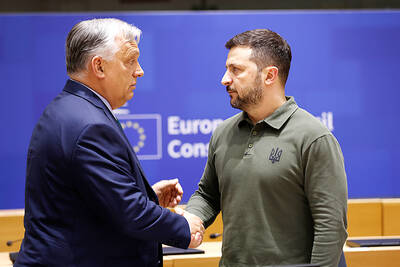
Hungarian authorities temporarily detained seven Ukrainian citizens and seized two armored cars carrying tens of millions of euros in cash across Hungary on suspicion of money laundering, officials said on Friday. The Ukrainians were released on Friday, following their detention on Thursday, but Hungarian officials held onto the cash, prompting Ukraine to accuse Hungary’s Russia-friendly government of illegally seizing the money. “We will not tolerate this state banditism,” Ukrainian Minister of Foreign Affairs Andrii Sybiha said. The seven detained Ukrainians were employees of the Ukrainian state-owned Oschadbank, who were traveling in the two armored cars that were carrying the money between Austria and
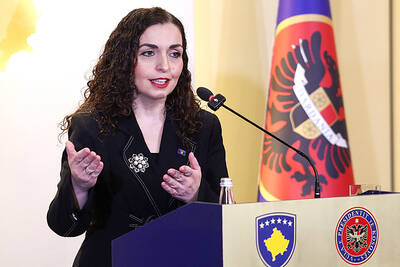
Kosovar President Vjosa Osmani on Friday after dissolving the Kosovar parliament said a snap election should be held as soon as possible to avoid another prolonged political crisis in the Balkan country at a time of global turmoil. Osmani said it is important for Kosovo to wrap up the upcoming election process and form functional institutions for political stability as the war rages in the Middle East. “Precisely because the geopolitical situation is that complex, it is important to finish this electoral process which is coming up,” she said. “It is very hard now to imagine what will happen next.” Kosovo, which declared

MORE BANS: Australia last year required sites to remove accounts held by under-16s, with a few countries pushing for similar action at an EU level and India considering its own ban Indonesia on Friday said it would ban social media access for children under 16, citing threats from online pornography, cyberbullying, online fraud and Internet addiction. “Accounts belonging to children under 16 on high-risk platforms will start to be deactivated, beginning with YouTube, TikTok, Facebook, Instagram, Threads, X, Bigo Live and Roblox,” Indonesian Minister of Communications and Digital Meutya Hafid said. “The government is stepping in so that parents no longer have to fight alone against the giants of the algorithm. Implementation will begin on March 28, 2026,” she said. The social media ban would be introduced in stages “until all platforms fulfill their


 RSS
RSS