


The humpback whale, nearly hunted into history four decades ago, is now on the “road to recovery” and is no longer considered at high risk of extinction, an environmental group said yesterday.
The International Union for Conservation of Nature (IUCN) — the producer each year of a Red List of threatened species — also upgraded the status of the southern “right” whale from vulnerable. The right whale gets its name from whalers who deemed it a particularly good species to hunt, because it floats after being killed.
“Humpbacks and southern right whales are making a comeback in much of their range mainly because they have been protected from commercial hunting,” said Randall Reeves, an expert on marine mammals for the conservation organization.
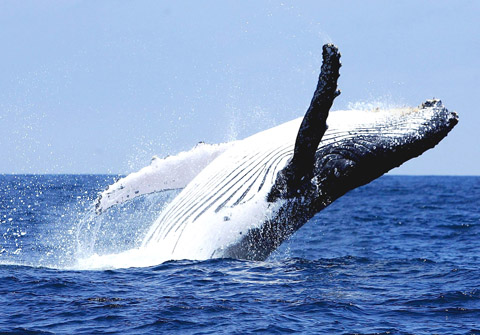
PHOTO: EPA
“This is a great conservation success and clearly shows what needs to be done to ensure these ocean giants survive,” he said in a statement.
Bill Perrin, another expert at IUCN, said the humpback whale population dropped to the “low thousands” when it was finally banned from commercial hunts in 1966. Its numbers have since risen to at least 60,000, Perrin said, adding that the population is growing at a healthy rate of 5 percent each year in the North Pacific.
While the right whales that hug the southern coasts of Argentina, South Africa and Australia are also recuperating, their cousins in the north are struggling.
There may be only 300 North Atlantic right whales along the US Eastern Seaboard, Perrin said, adding that while hunting them is illegal, many continue to be wounded or killed in collisions with ships or entanglements with fishing gear.
The IUCN said a number of other large sea animals were moving closer to extinction.
Overall, nearly a quarter of all such species are threatened and over a 10th are listed as endangered or critically endangered, representing the greatest threat of extinction.
The Irrawaddy dolphin of southeast Asia, the finless porpoise that swims from the Persian Gulf to the coast of north Japan and South America’s franciscana dolphin are all considered vulnerable — largely because they are often a bycatch in fisheries.
In Mexico’s Gulf of California, the vaquita porpoise will probably be the next animal of this type to become extinct. Already critically endangered, about 15 percent of those remaining are killed each year in gill nets, the organization said. It estimated that only 150 are left in the wild.
Noting the decline in hunts of whales and other sea mammals over the last few decades, the IUCN said accidental killing in fishing gear was now the “main threat” to these species.
Those being particularly hard hit also include the Black Sea harbor porpoise and the western gray whale.

ROCKY RELATIONS: The figures on residents come as Chinese tourist numbers drop following Beijing’s warnings to avoid traveling to Japan The number of Chinese residents in Japan has continued to rise, even as ties between the two countries have become increasingly fractious, data released on Friday showed. As of the end of December last year, the number of Chinese residents had increased by 6.5 percent from the previous year to 930,428. Chinese people accounted for 22.6 percent of all foreign residents in Japan, making them by far the largest group, Japanese Ministry of Justice data showed. Beijing has criticized Tokyo in increasingly strident terms since Japanese Prime Minister Sanae Takaichi last year suggested that a military conflict around Taiwan could

A retired US colonel behind a privately financed rocket launch site in the Dominican Republic sees the project as a response to China’s dominance of the space race in Latin America. Florida-based Launch on Demand is slated to begin building a US$600 million facility in a remote region near the border with Haiti late this year. The project is designed to meet surging demand for the heavy-lift rockets needed to put clusters of satellites into orbit. It is also an answer to China’s growing presence in the region, said CEO Burton Catledge, a former commander of the US Air Force’s 45th Operations

Germany is considering Australia’s Ghost Bat robot fighter as it looks to select a combat drone to modernize its air force, German Minister of Defense Boris Pistorius said yesterday. Germany has said it wants to field hundreds of uncrewed fighter jets by 2029, and would make a decision soon as it considers a range of German, European and US projects developing so-called “collaborative combat aircraft.” Australia has said it will integrate the Ghost Bat, jointly developed by Boeing Australia and the Royal Australian Air Force, into its military after a successful weapons test last year. After inspecting the Ghost Bat in Queensland yesterday,

A pro-Iran hacking group claimed to breach FBI Director Kash Patel’s personal e-mail inbox and posted some of the contents online. The e-mails provided by the hacking group include travel details, correspondence with leasing agents in Washington and global entry, and loyalty account numbers. The e-mail address the hackers claim to have compromised has been previously tied to Patel’s personal details, and the leaked e-mails contain photos of Patel and others, in addition to correspondence with family members and colleagues. “The FBI is aware of malicious actors targeting Director Patel’s personal email information,” the agency said in a statement on


 RSS
RSS