


Late into the night one Sunday last month, as people in Taiwan were bracing themselves for Typhoon Fung-wong, a group of about 200 expatriates gathered in a pub on Taipei’s An-he Road to participate in a fundraising quiz night.
The group was summoned by Sean McCormack, a British native who founded Animals Taiwan (AT) three-and-a-half years ago.
The shelter, which gained non-governmental organization (NGO) status in June and hosts between 40 to 60 dogs depending on adoption rates, has served as a channel for expatriates to give back to Taiwan, which for some has been home for as much as 15 years.
“Originally, Sean was only hosting stray dogs in his own apartment in Taipei, until he got evicted from his residence,” said Kim Phillips, the writer of the AT newsletter and an English lecturer at Chinese Culture University, who has been with the organization for two-and-a-half years.
One day, McCormack met Jane Goodall, the British primatologist, whose involvement in environmental and humanitarian affairs has gained her international fame, during a visit in Taiwan. The meeting inspired him to set up his own animal shelter, Phillips, who comes from Canada, said.
But setting up AT has not always been a smooth ride, McCormack said.
“Originally, a guy named Eric started the shelter with me, but he quit after a month; while 10 people showed up for the first monthly organization meeting. All of them quit within weeks,” he said.
Money has also been a problem for AT, volunteers said.
The games nights, which attract mostly expatriates who come for a night of fun and to donate for a worthy cause, are an important source of income for the shelter, said Liza Milne, from Britain, who was the organization’s treasurer until she handed the role over to a certified accountant after the AT became an NGO.
AT is sustained by donations, sponsorships, fees paid when people adopt an animal and fundraising events, such as a regular Sunday flea market run by Milne, she said.
“We pull in about NT$200,000 a month, which just breaks us even, since our basic expenditures [including salary for three local full-time staff and rent] is around NT$160,000 per month. Depending on the number of animals in the shelter, we also need NT$20,000 to NT$30,000 for food,” she said.
Some months, when AT gets an injured or sick animal, medical expenditures are also added to the operating costs, she said.
The situation can get even worse, as “unlike some animal shelters, we don’t kill our animals except on very rare occasions,” Phillips said. “So some dogs live in AT for years.”
The tradition started with AT’s very first rescue, which involved a mutt named Lazarus, whose life was hanging on a thread from a long list of medical problems. McCormack was the one who found it.
“Lazarus [the name of a man in the Bible who was raised from the dead by Jesus] was a complete mess when we found him. You can see pictures of him on our Web site [animalstaiwan.org/rescues.htm]. But by the time he got out and found an owner, he was happy, energetic and loving,” he said.
In the three years that AT has been in operation, only eight dogs have been put down, McCormack said.
“Even for animals that are blind or have only two legs, as long as there is life in their eyes, we would give them a try because it is not our job to take away their desire to live. We have always been amazed by their recoveries,” he said.
As such, aside from the full-time staff, all AT participants are strictly volunteers, said Peter Dearman, AT’s Webmaster, who is also an English teacher from Canada.
Another problem AT has faced is public ignorance of animals, Phillips said.
“Some people too freely dump their dogs because the puppies turned into dogs and are not cute anymore, or because their pets behave badly, or because it is not convenient for them to keep dogs anymore,” she said.
The situation is especially prevalent in pure breeds, where owners expect to have “perfect dogs, without behavioral problems even with no training,” McCormack said. “Which is just like dumping dogs out of the owners’ own stupidity and ignorance, because no dog would behave without proper training and training them is the responsibility of the owners.”
While AT volunteers all agree that Taiwan has come a long way in the past decade, they also say that a lot remains to be done.
“You don’t see caged animals as much. Some people are changing their way of interacting with their pets and are beginning to treat them like family. If anything, some people are starting to baby their dogs, which may not necessarily be a good thing if it is too extreme,” McCormack said.
However, “there is always going to be stray or mistreated dogs,” Phillips said.
To combat the problem, education is key, she said.
“One of future key focuses of AT [will be] to run an educational program that teaches the public compassion for animals, as well as how to care for and train them,” she said, adding that the program — which she heads — will be launched sometime this month.
On the Internet, AT is also compiling its own “Wikipedia” on dog-care and training, Dearman said, adding that anyone can edit or add to it. Another vital part of the education program is a neutering campaign, where AT aims to promote the importance of neutering pets as well as strays so that the stray problem can be mitigated, Milne said.
With AT gaining NGO status, the volunteers are expecting bigger funding and greater involvement for the organization.
“As an NGO, we can now apply for governmental funding, receive money from international charities, as well as get corporate sponsorship,” McCormack said.
From 15 dogs crammed in a small apartment to a certified NGO with a full-size shelter, McCormack has come a long way in his work with animals in Taiwan. Asked why he stuck to the cause, McCormack said: “I have always liked and felt dedicated to animals and I want to see a change in Taiwan.”
“Whenever you feel like quitting, it is a test of whether you are going to succeed [in your pursuit] or not, those that give up do not succeed,” he said.
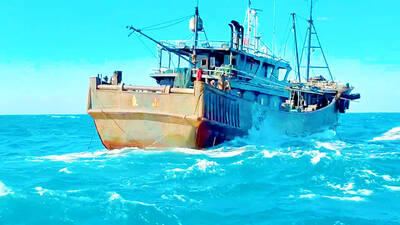
MAKING WAVES: China’s maritime militia could become a nontraditional threat in war, clogging up shipping lanes to prevent US or Japanese intervention, a report said About 1,900 Chinese ships flying flags of convenience and fishing vessels that participated in China’s military exercises around Taiwan last month and in January last year have been listed for monitoring, Coast Guard Administration (CGA) Deputy Director-General Hsieh Ching-chin (謝慶欽) said yesterday. Following amendments to the Commercial Port Act (商港法) and the Law of Ships (船舶法) last month, the CGA can designate possible berthing areas or deny ports of call for vessels suspected of loitering around areas where undersea cables can be accessed, Oceans Affairs Council Minister Kuan Bi-ling (管碧玲) said. The list of suspected ships, originally 300, had risen to about

DAREDEVIL: Honnold said it had always been a dream of his to climb Taipei 101, while a Netflix producer said the skyscraper was ‘a real icon of this country’ US climber Alex Honnold yesterday took on Taiwan’s tallest building, becoming the first person to scale Taipei 101 without a rope, harness or safety net. Hundreds of spectators gathered at the base of the 101-story skyscraper to watch Honnold, 40, embark on his daredevil feat, which was also broadcast live on Netflix. Dressed in a red T-shirt and yellow custom-made climbing shoes, Honnold swiftly moved up the southeast face of the glass and steel building. At one point, he stepped onto a platform midway up to wave down at fans and onlookers who were taking photos. People watching from inside

Japan’s strategic alliance with the US would collapse if Tokyo were to turn away from a conflict in Taiwan, Japanese Prime Minister Sanae Takaichi said yesterday, but distanced herself from previous comments that suggested a possible military response in such an event. Takaichi expressed her latest views on a nationally broadcast TV program late on Monday, where an opposition party leader criticized her for igniting tensions with China with the earlier remarks. Ties between Japan and China have sunk to the worst level in years after Takaichi said in November that a hypothetical Chinese attack on Taiwan could bring about a Japanese

The WHO ignored early COVID-19 warnings from Taiwan, US Deputy Secretary of Health and Human Services Jim O’Neill said on Friday, as part of justification for Washington withdrawing from the global health body. US Secretary of State Marco Rubio on Thursday said that the US was pulling out of the UN agency, as it failed to fulfill its responsibilities during the COVID-19 pandemic. The WHO “ignored early COVID warnings from Taiwan in 2019 by pretending Taiwan did not exist, O’Neill wrote on X on Friday, Taiwan time. “It ignored rigorous science and promoted lockdowns.” The US will “continue international coordination on infectious


 RSS
RSS