


US lawmakers will review the language of an anti-drug plan that Mexican officials contend infringes on their nation’s sovereignty by conditioning aid to performance on human rights, a senior US senator said on Sunday.
Democratic Senator Christopher Dodd of Connecticut said that a visiting delegation of US lawmakers would take concerns expressed to them by Mexican legislators this weekend back to the US Congress, which has been considering the aid plan, known as the Merida Initiative.
The plan, proposed in October by US President George W. Bush, would give Mexico and other Latin American countries US$1.4 billion over several years to fight drug trafficking.
OBJECTIONS
But Mexican lawmakers object to several conditions, including performance evaluations, reviews of how the money was spent and guarantees that civilian investigators would be allowed to look into allegations of abuse by Mexico’s military.
“We heard from everyone here the common message that this language has got to be changed,” said Dodd, one of 11 US legislators attending a two-day meeting with their Mexican counterparts in Monterrey. “Our friends in Mexico needed to vent and explain how this issue was not handled well. Anything that smacks of certification is a nonstarter.”
NO CONDITIONS
Ruth Zavaleta, speaker of Mexico’s lower house of Congress, said the chamber would refuse any conditions on US aid and welcomed Dodd’s promise to review the plan.
“There is a commitment to take our concerns and discuss them in the US Congress, and we hope that they can correct [the plan] with the demands we are making,” Zavaleta said.
Democratic Senator Patrick Leahy, chairman of the US Senate subcommittee that oversees State Department and international program funding, has defended conditioning the aid. He sent a letter to Sunday’s meeting underlining US commitment to the plan.
“We recognize the responsibility of the United States as the primary market for illegal drugs and the source of most of the guns used by the Mexican cartels,” Leahy said in the letter.
“I am confident that in the final version of the Supplemental the Congress will provide support for the Merida Initiative in a manner that addresses our shared interests and concerns,” Leahy said.

Gaza is rapidly running out of its limited fuel supply and stocks of food staples might become tight, officials said, after Israel blocked the entry of fuel and goods into the war-shattered territory, citing fighting with Iran. The Israeli military closed all Gaza border crossings on Saturday after announcing airstrikes on Iran carried out jointly with the US. Israeli authorities late on Monday night said that they would reopen the Kerem Shalom crossing from Israel to Gaza yesterday, for “gradual entry of humanitarian aid” into the strip, without saying how much. Israeli authorities previously said the crossings could not be operated safely during
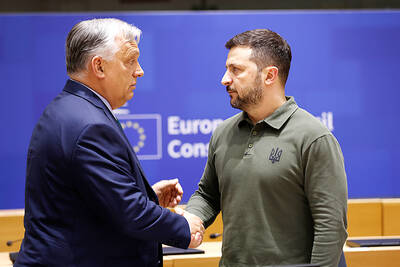
Hungarian authorities temporarily detained seven Ukrainian citizens and seized two armored cars carrying tens of millions of euros in cash across Hungary on suspicion of money laundering, officials said on Friday. The Ukrainians were released on Friday, following their detention on Thursday, but Hungarian officials held onto the cash, prompting Ukraine to accuse Hungary’s Russia-friendly government of illegally seizing the money. “We will not tolerate this state banditism,” Ukrainian Minister of Foreign Affairs Andrii Sybiha said. The seven detained Ukrainians were employees of the Ukrainian state-owned Oschadbank, who were traveling in the two armored cars that were carrying the money between Austria and

Kosovar President Vjosa Osmani on Friday after dissolving the Kosovar parliament said a snap election should be held as soon as possible to avoid another prolonged political crisis in the Balkan country at a time of global turmoil. Osmani said it is important for Kosovo to wrap up the upcoming election process and form functional institutions for political stability as the war rages in the Middle East. “Precisely because the geopolitical situation is that complex, it is important to finish this electoral process which is coming up,” she said. “It is very hard now to imagine what will happen next.” Kosovo, which declared

MORE BANS: Australia last year required sites to remove accounts held by under-16s, with a few countries pushing for similar action at an EU level and India considering its own ban Indonesia on Friday said it would ban social media access for children under 16, citing threats from online pornography, cyberbullying, online fraud and Internet addiction. “Accounts belonging to children under 16 on high-risk platforms will start to be deactivated, beginning with YouTube, TikTok, Facebook, Instagram, Threads, X, Bigo Live and Roblox,” Indonesian Minister of Communications and Digital Meutya Hafid said. “The government is stepping in so that parents no longer have to fight alone against the giants of the algorithm. Implementation will begin on March 28, 2026,” she said. The social media ban would be introduced in stages “until all platforms fulfill their


 RSS
RSS