

Bird flu outbreaks have spread to six of South Korea’s nine provinces despite a massive cull that saw the slaughter of more than 5 million chickens and ducks last month, officials said yesterday.
An outbreak reported on Wednesday at a farm around 300km southeast of Seoul was confirmed after blood tests as the virulent H5N1 strain of the disease, the agriculture ministry said.
It raised to 23 the total number of outbreaks reported across six provinces of South Korea.
Only the northeastern province of Gangweon, North Chungcheong in the center and the southern island of Jeju have been unaffected so far, the ministry said.
Meanwhile, quarantine authorities denied allegations they had covered up an outbreak of avian influenza in the province of North Gyeongsang last month.
Responding to a television report, they said they had been cautious of the results of preliminary tests on poultry at Yeongcheon City, but final results confirmed the outbreak.
South Korea reported seven cases of H5N1 infection cases between November 2006 and March last year, resulting in temporary suspension of poultry exports to Japan, Hong Kong, Taiwan and elsewhere.
Last June, however, the World Organization for Animal Health classified the country as free from the disease.
The H5N1 strain has killed more than 240 people worldwide since late 2003. No South Koreans are known to have contracted the disease.

CRACKED SCREEN: The problem is an embarrassing setback for Apple, which spent more than a decade developing the device and touted its durability The iPhone Duo, one of Apple’s biggest new products in years, is drawing a growing number of complaints from customers who say the foldable display cracked after just hours or days of use. In these cases, customers reported hearing a crunching sound when unfolding the phone, followed by a large crack forming along the center crease. Some users also experienced a white patch or other display malfunction on the right side of the screen. Reports of the problem first surfaced on Reddit and other social media platforms. Bloomberg News has since independently verified the issue with more than half a
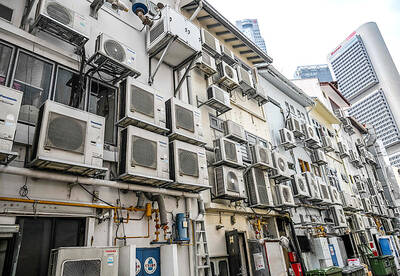
Long dubbed an “air-conditioned nation,” Singapore is experimenting with cooling alternatives from chilled beams to “passive displacement” to curb its thirst for energy-guzzling air-conditioning. The city-state has the highest per-capita air-conditioner ownership rate in Southeast Asia, with about 99 percent of private residences equipped with cooling units. Singapore’s local building sector accounts for one-fifth of its emissions, while cooling itself accounts for 40 to 60 percent of a building’s energy consumption, according to studies. A stroll down Orchard Road highlights that dependence. Shoppers are greeted by blasts of cool air that waft into the street as doors swing open — a major draw
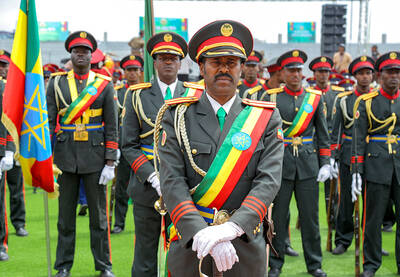
Ethiopian online influencers are pushing for their government to invade neighboring Eritrea and seize access to the sea, following its success against rebel and Eritrean forces in the past few weeks. The Ethiopian army has advanced right up to the border after repelling an offensive by rebels in the northern Tigray State who were supported by Eritrean troops. Ethiopian Prime Minister Abiy Ahmed has repeatedly said that securing a base on the Red Sea is a vital national objective for Ethiopia, which lost its coastline when Eritrea gained independence in 1993. Some online influencers say that the opportunity to invade has arrived. “The time

Beijing yesterday dismissed as “groundless speculation” a report that said Nvidia CEO Jensen Huang (黃仁勳) was the target of a Chinese spy plot. The article by the New York Times, published on Thursday, said that US intelligence officials concluded that a Chinese executive linked to a Singapore-based data center company had been funneling information to Beijing. “The report in question is based on groundless speculation and is nothing more than an attempt to smear China,” Chinese Ministry of Foreign Affairs spokesman Guo Jiakun (郭嘉昆) told a regular briefing. China is in a race for tech dominance with the US, which restricts the export


 RSS