


Seventeen Mexican drug gang members were killed near the US border on Saturday, their bodies scattered along a road after one of the deadliest shootouts in Mexico’s three-year narco-war.
Rival factions of the Arellano Felix drug cartel in Tijuana on the Mexico-California border battled each other with rifles and machine guns in the early hours of the morning, police said.
Fourteen bodies were lying in pools of blood on a road near assembly-for-export maquiladora plants on the city’s eastern limits. The corpses were surrounded by hundreds of bullet casings and many of their faces were destroyed.
Bullet holes could be seen in the walls of a factory building and on the perimeter wall of a housing complex along the road, but no bystander deaths were reported. It was not clear how long the gunbattles lasted.
The 15th body was found nearby. Two more men died in hospital on Saturday evening, police said.
Six men were wounded and six others arrested, but some gang members are thought to have escaped.
Two of the dead were believed to be senior hitmen for the Arellano Felix cartel and were identified by large gold rings on their fingers. The rings carried the icon of Saint Death, a ghoulish figure that gangsters believe protects them, police said.
“Today shows we are facing a terrible war never seen before on the [US-Mexico] border,” Baja California Attorney General Rommel Moreno told a news conference.
Some 190 people have been killed in Tijuana so far this year. Last year there were more than 2,500 drug killings across Mexico and there have been more than 900 this year.
Police cordoned off the surrounding roads, forcing workers at a nearby maquiladora to walk through the crime scene to get to work.
Heavily armed federal police patrolled across Tijuana after the gunfight. Soldiers and police guarded the city’s main hospital where the wounded were being treated to prevent any attempt by drug gangs to pull them out.
Baja California state police chief Daniel de la Rosa said fresh troops from Mexico City were arriving in Tijuana, which borders San Diego, California.
Mexican President Felipe Calderon has sent thousands of troops to Tijuana and Baja California state since taking office in December 2006. Some 25,000 soldiers and federal police are deployed to fight cartels in drug hot spots across Mexico.
The army in Tijuana said it was on high alert for reprisals against soldiers and federal police after the shootout and the ensuing arrests.
“The risk of attacks against our agents after an event like this is extremely high,” Tijuana police chief Lieutenant Colonel Julian Leyzaola said.
The Arellano Felix gang was long the dominant trafficking organization in Tijuana, smuggling drugs into California.
Recently the group has been under attack from a rival gang from the Pacific state of Sinaloa, led by Mexico’s most wanted man, Joaquin “Shorty” Guzman.
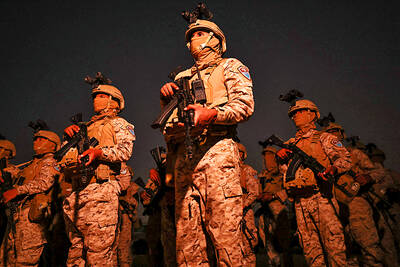
PRECARIOUS RELATIONS: Commentators in Saudi Arabia accuse the UAE of growing too bold, backing forces at odds with Saudi interests in various conflicts A Saudi Arabian media campaign targeting the United Arab Emirates (UAE) has deepened the Gulf’s worst row in years, stoking fears of a damaging fall-out in the financial heart of the Middle East. Fiery accusations of rights abuses and betrayal have circulated for weeks in state-run and social media after a brief conflict in Yemen, where Saudi airstrikes quelled an offensive by UAE-backed separatists. The United Arab Emirates is “investing in chaos and supporting secessionists” from Libya to Yemen and the Horn of Africa, Saudi Arabia’s al-Ekhbariya TV charged in a report this week. Such invective has been unheard of
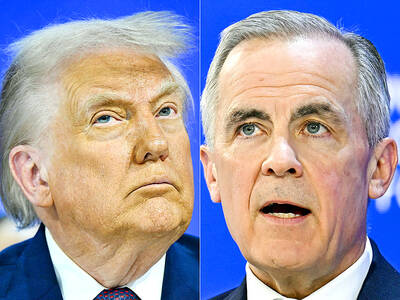
US President Donald Trump on Saturday warned Canada that if it concludes a trade deal with China, he would impose a 100 percent tariff on all goods coming over the border. Relations between the US and its northern neighbor have been rocky since Trump returned to the White House a year ago, with spats over trade and Canadian Prime Minister Mark Carney decrying a “rupture” in the US-led global order. During a visit to Beijing earlier this month, Carney hailed a “new strategic partnership” with China that resulted in a “preliminary, but landmark trade agreement” to reduce tariffs — but

Chinese President Xi Jinping’s (習近平) purge of his most senior general is driven by his effort to both secure “total control” of his military and root out corruption, US Ambassador to China David Perdue said told Bloomberg Television yesterday. The probe into Zhang Youxia (張又俠), Xi’s second-in-command, announced over the weekend, is a “major development,” Perdue said, citing the family connections the vice chair of China’s apex military commission has with Xi. Chinese authorities said Zhang was being investigated for suspected serious discipline and law violations, without disclosing further details. “I take him at his word that there’s a corruption effort under
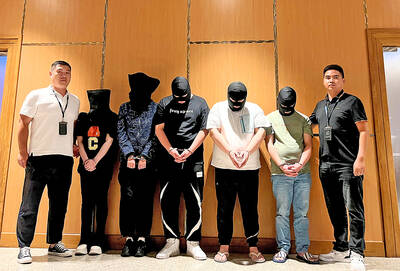
China executed 11 people linked to Myanmar criminal gangs, including “key members” of telecom scam operations, state media reported yesterday, as Beijing toughens its response to the sprawling, transnational industry. Fraud compounds where scammers lure Internet users into fake romantic relationships and cryptocurrency investments have flourished across Southeast Asia, including in Myanmar. Initially largely targeting Chinese speakers, the criminal groups behind the compounds have expanded operations into multiple languages to steal from victims around the world. Those conducting the scams are sometimes willing con artists, and other times trafficked foreign nationals forced to work. In the past few years, Beijing has stepped up cooperation


 RSS
RSS