


Resolving the question of Zimbabwean President Robert Mugabe’s fate may hold the key to breaking the impasse over Zimbabwe’s disputed presidential vote.
Mugabe has not himself suggested he would be willing to step aside if he were granted immunity for alleged human rights abuses and allowed to fade into comfortable retirement.
But others in Africa have made that case for him — saying that as a one-time lion of African liberation he deserves a dignified exit, and that other African strongmen have followed that path.
Recent flexibility within his own party could signal movement toward such an arrangement. The strongest sign has been a proposal by Mugabe’s ZANU-PF to share power with the opposition.
The opposition Movement for Democratic Change rejects that, saying its leader Morgan Tsvangirai won outright. But the ZANU-PF overture hints at a dawning realization in the Mugabe camp that it has lost its iron grip on power.
As the political camps circle each other, election officials have yet to release the vote results, and the opposition says the delay is part of a plot by Mugabe to cling to power while his people suffer international isolation and an economy spiraling out of control.
Increasingly, it appears that unless Mugabe is assured of a future, his people won’t have one.
The top US envoy on Africa, Jendayi Frazer, told reporters in southern Africa this week that Tsvangirai had won the right to lead any unity government.
As to Mugabe, she said: “If he does the right thing, he should be allowed to stay in Zimbabwe with the dignity of a former president.”
A proposal that ZANU-PF and the Movement for Democratic Change share power in a government headed by Mugabe surfaced in an unlikely quarter on Wednesday: a column in Zimbabwe’s state-run Herald newspaper usually devoted to denunciations of the opposition.
On Thursday, the column was back to accusing the Movement for Democratic Change of working “to frustrate land reforms and protect the interests of the minority landed classes,” and called the unity government proposal unfeasible.
But it is significant that the debate is being played out in ZANU-PF’s mouthpiece.
The idea of a coalition government — akin to the solution that helped calm postelection violence in Kenya earlier this year — seems to have galvanized diplomacy.
In Zambia on Thursday, a government spokesman said a national unity government in neighboring Zimbabwe could be a “welcome decision” if it can unite the country. The Zimbabwean opposition has called on Zambian President Levy Mwanawasa to help mediate their nation’s crisis.
Frazer, who helped mediate the Kenyan solution, met on Thursday with officials in South Africa, whose President Thabo Mbeki has been a key mediator in Zimbabwe. On Friday, she was to visit Zambia and planned a stop in Angola as part of her Zimbabwe diplomacy.
At independence, Mugabe was hailed for campaigning for racial reconciliation, and for bringing education and health to millions.
Today, he regularly denounces whites — at independence celebrations last week, he accused them of plotting to recolonize the country.
“The man invokes conflicting emotions,” Tsvangirai said in a recent interview with The Associated Press. “The transformation he’s gone through, from hero to villain, is unprecedented.”
Mugabe, though, isn’t a villain to everyone. He holds fellow African leaders in thrall with fiery rhetoric at regional meetings.
Tsvangirai told reporters in Nigeria he respected Mugabe as a liberation leader. Perhaps one who deserves a cushy retirement on a farm somewhere in Zimbabwe.

VAGUE: The criteria of the amnesty remain unclear, but it would cover political violence from 1999 to today, and those convicted of murder or drug trafficking would not qualify Venezuelan Acting President Delcy Rodriguez on Friday announced an amnesty bill that could lead to the release of hundreds of prisoners, including opposition leaders, journalists and human rights activists detained for political reasons. The measure had long been sought by the US-backed opposition. It is the latest concession Rodriguez has made since taking the reins of the country on Jan. 3 after the brazen seizure of then-Venezuelan president Nicolas Maduro. Rodriguez told a gathering of justices, magistrates, ministers, military brass and other government leaders that the ruling party-controlled Venezuelan National Assembly would take up the bill with urgency. Rodriguez also announced the shutdown
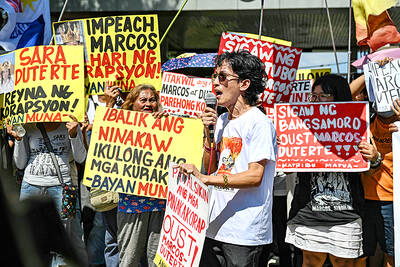
Civil society leaders and members of a left-wing coalition yesterday filed impeachment complaints against Philippine Vice President Sara Duterte, restarting a process sidelined by the Supreme Court last year. Both cases accuse Duterte of misusing public funds during her term as education secretary, while one revives allegations that she threatened to assassinate former ally Philippine President Ferdinand Marcos Jr. The filings come on the same day that a committee in the House of Representatives was to begin hearings into impeachment complaints against Marcos, accused of corruption tied to a spiraling scandal over bogus flood control projects. Under the constitution, an impeachment by the
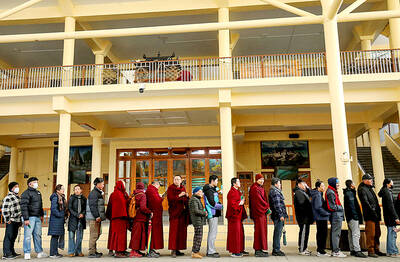
Exiled Tibetans began a unique global election yesterday for a government representing a homeland many have never seen, as part of a democratic exercise voters say carries great weight. From red-robed Buddhist monks in the snowy Himalayas, to political exiles in megacities across South Asia, to refugees in Australia, Europe and North America, voting takes place in 27 countries — but not China. “Elections ... show that the struggle for Tibet’s freedom and independence continues from generation to generation,” said candidate Gyaltsen Chokye, 33, who is based in the Indian hill-town of Dharamsala, headquarters of the government-in-exile, the Central Tibetan Administration (CTA). It

A Virginia man having an affair with the family’s Brazilian au pair on Monday was found guilty of murdering his wife and another man that prosecutors say was lured to the house as a fall guy. Brendan Banfield, a former Internal Revenue Service law enforcement officer, told police he came across Joseph Ryan attacking his wife, Christine Banfield, with a knife on the morning of Feb. 24, 2023. He shot Ryan and then Juliana Magalhaes, the au pair, shot him, too, but officials argued in court that the story was too good to be true, telling jurors that Brendan Banfield set


 RSS
RSS