


Armenians yesterday marked the 93rd anniversary of mass killings of their compatriots under the Ottoman Empire, an event many countries have recognized as genocide despite Turkey’s angry rejection of the label.
Thousands were expected to attend ceremonies in the Armenian capital Yerevan and in other countries to commemorate the killings, which began in 1915 and lead to a mass exodus of Armenians from what is now eastern Turkey.
Armenian President Serzh Sarkisian and other officials were to lead a ceremony on a hilltop memorial in central Yerevan, where an eternal flame has burned since its construction in 1965, when Armenia was part of the Soviet Union.
On Wednesday night, more than 10,000 young people carrying torches and candles marched through the streets of Yerevan demanding that Turkey recognize the killings as genocide.
Some held banners reading: “Save Europe! Keep Turkey out of the EU!” and “93 years since the Armenian genocide.”
“They tell us: Forget this tragedy, move on with your life. But how can we forget? The pain of this tragedy is passed from generation to generation,” said 19-year-old Dvin Titizian, a Canadian student who was among the many from Armenia’s widespread diaspora taking part in the march. “We will continue to condemn Turkey for denying the genocide because we must believe that one day it will recognize the genocide and ask our forgiveness.”
Armenians say up to 1.5 million of their kinsmen died in orchestrated killings during the final years of the Ottoman Empire.
Turkey rejects the killings constituted genocide, saying that 300,000 Armenians and at least an equal number of Turks were killed in civil strife from 1915 to 1917 when the Christian Armenians, backed by Russia, rose up against the Ottomans. The dispute has been a major obstacle in relations between Turkey and Armenia, which have no diplomatic ties and whose border has remained closed for more than a decade.
It has also complicated relations between EU-aspirant Turkey and many Western countries, especially those with large ethnic Armenian communities such as the US and France.
More than 20 countries, including Belgium, Canada, Poland and Switzerland, have officially recognized the killings as genocide. In 2006, French lawmakers voted to make it a criminal offense to deny that Armenians were victims of genocide.
But many countries, including Britain and the US, refuse to use the term to describe the events, mindful of relations with Turkey. The US House Foreign Affairs Committee’s endorsement of a resolution labeling the killings as genocide last October sparked fury in Ankara, which recalled its ambassador to Washington. Under intense pressure from the White House, the authors of the bill later asked Congress not to hold a debate on the issue.

ACTIONABLE ADVICE: The majority of chatbots tested provided guidance on weapons, tactics and target selections, with Perplexity and Meta AI deemed to be the least safe From school shootings to synagogue bombings, leading artificial intelligence (AI) chatbots helped researchers plot violent attacks, according to a study published on Wednesday that highlighted the technology’s potential for real-world harm. Researchers from the nonprofit watchdog Center for Countering Digital Hate and CNN posed as 13-year-old boys in the US and Ireland to test 10 chatbots, including ChatGPT, Google Gemini, Perplexity, Deepseek and Meta AI. Eight of the chatbots assisted the make-believe attackers in more than half the responses, providing advice on “locations to target” and “weapons to use” in an attack, the study said. The chatbots had become a “powerful accelerant for

Australians were downloading virtual private networks (VPNs) in droves, while one of the world’s largest porn distributors said it was blocking users from its platforms as the country yesterday rolled out sweeping online age restriction. Australia in December became the first country to impose a nationwide ban on teenagers using social media. A separate law now requires artificial intelligence (AI)-powered chatbot services to keep certain content — including pornography, extreme violence and self-harm and eating disorder material — from minors or face fines of up to A$49.5 million (US$34.6 million). The country also joined Britain, France and dozens of US states requiring
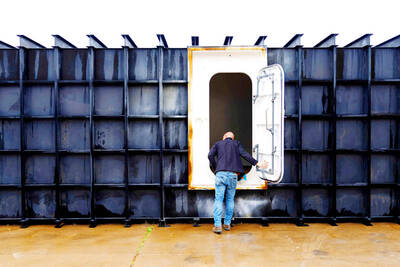
Since the war in the Middle East began nearly two weeks ago, the telephone at Ron Hubbard’s bomb shelter company in Texas has not stopped ringing. Foreign and US clients are rushing to buy his bunkers, seeking refuge in case of air raids, nuclear fallout or apocalypse. With the US and Israel pounding Iran, and Tehran retaliating with strikes across the region, Hubbard has seen demand for his product soar, mostly from Gulf nation customers in Bahrain, Qatar, Kuwait and the United Arab Emirates. “You can imagine how many people are thinking: ‘I wish I had a bomb shelter,’” Hubbard, 63, said in
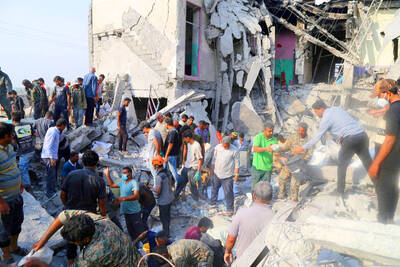
STILL IN POWER: US intelligence reports showed that the Iranian regime is not in danger of collapse and retains control of the public, casting doubt on Trump’s exit Nearly every US Senate Democrat on Wednesday signed a letter sent to US Secretary of Defense Pete Hegseth requesting a “swift investigation” of airstrikes on a girls’ school in Iran that killed scores of children and any other potential US military actions causing civilian harm. Reuters reported on Thursday last week that US military investigators believe it is likely that US forces were responsible for the Feb. 28 strike on the school, as US and Israeli forces launched attacks on Iran. “The results of this school attack are horrific. The majority of those killed in the strikes were girls between the ages


 RSS
RSS