


A tough-talking new political party yesterday vowed to fight what it called the “enslavement” of Singapore after nearly half-a-century of rule by the People’s Action Party (PAP).
“Our people have been enslaved all this while,” J.B. Jeyaretnam, 82, interim secretary general of the Reform Party, told a news conference.
He said Singaporean society has been “castrated” and its people left powerless by an executive that holds “absolute power.”
For Jeyaretnam, who has for decades been a rare voice criticizing the PAP, the party’s formation marks his full return to politics after emerging from bankruptcy and being reinstated as a lawyer.
“We now in the Reform Party are not going to play pussy-foot with the PAP,” he told reporters at the close of an 80-minute address which outlined what he sees as the country’s social, political and economic problems.
“I think it’s time now to ask questions and hold the PAP to account,” he said.
Party officials said they held the news conference a day after filing documents to register their party.
The opposition plays only a marginal role in Singapore but Jeyaretnam made political history in 1981 when he became the first opposition politician elected to parliament. He was then secretary general of the Workers’ Party.
A lawyer, he was disbarred when he was declared bankrupt in 2001 after failing to pay libel damages to members of the PAP, including former prime minister Goh Chok-tong.
Last year Jeyaretnam paid S$233,255 (now US$172,578) to clear his bankruptcy, which had prevented him from running for political office.
The country’s leaders say its tough laws against dissent and other political activity are necessary to ensure the stability which has helped it achieve economic success.
They dismiss criticisms from human rights groups who have said the government uses libel laws to silence critics, saying they have to protect their reputations.
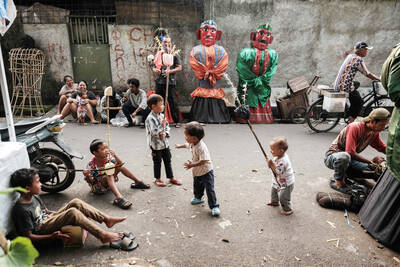
In the sweltering streets of Jakarta, buskers carry towering, hollow puppets and pass around a bucket for donations. Now, they fear becoming outlaws. City authorities said they would crack down on use of the sacred ondel-ondel puppets, which can stand as tall as a truck, and they are drafting legislation to remove what they view as a street nuisance. Performances featuring the puppets — originally used by Jakarta’s Betawi people to ward off evil spirits — would be allowed only at set events. The ban could leave many ondel-ondel buskers in Jakarta jobless. “I am confused and anxious. I fear getting raided or even

Kemal Ozdemir looked up at the bare peaks of Mount Cilo in Turkey’s Kurdish majority southeast. “There were glaciers 10 years ago,” he recalled under a cloudless sky. A mountain guide for 15 years, Ozdemir then turned toward the torrent carrying dozens of blocks of ice below a slope covered with grass and rocks — a sign of glacier loss being exacerbated by global warming. “You can see that there are quite a few pieces of glacier in the water right now ... the reason why the waterfalls flow lushly actually shows us how fast the ice is melting,” he said.

RISING RACISM: A Japanese group called on China to assure safety in the country, while the Chinese embassy in Tokyo urged action against a ‘surge in xenophobia’ A Japanese woman living in China was attacked and injured by a man in a subway station in Suzhou, China, Japanese media said, hours after two Chinese men were seriously injured in violence in Tokyo. The attacks on Thursday raised concern about xenophobic sentiment in China and Japan that have been blamed for assaults in both countries. It was the third attack involving Japanese living in China since last year. In the two previous cases in China, Chinese authorities have insisted they were isolated incidents. Japanese broadcaster NHK did not identify the woman injured in Suzhou by name, but, citing the Japanese
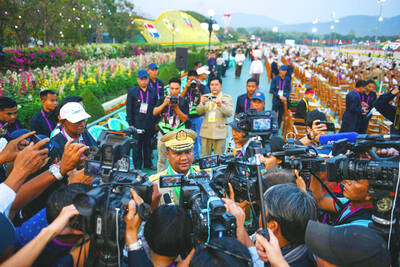
RESTRUCTURE: Myanmar’s military has ended emergency rule and announced plans for elections in December, but critics said the move aims to entrench junta control Myanmar’s military government announced on Thursday that it was ending the state of emergency declared after it seized power in 2021 and would restructure administrative bodies to prepare for the new election at the end of the year. However, the polls planned for an unspecified date in December face serious obstacles, including a civil war raging over most of the country and pledges by opponents of the military rule to derail the election because they believe it can be neither free nor fair. Under the restructuring, Myanmar’s junta chief Min Aung Hlaing is giving up two posts, but would stay at the


 RSS
RSS