


Five former US secretaries of state on Thursday urged the next presidential administration to close down the Guantanamo Bay prison camp and open a dialogue with Iran.
The former chief US diplomats agreed at a conference aimed at giving the next president some bipartisan foreign policy advice that shutting down the prison camp in Cuba would bolster the US' image abroad.
"It says to the world: `We are now going back to our traditional respective forms of dealing with people who potentially committed crimes,'" said Colin Powell, who served as US President George W. Bush's first secretary of state.
Powell was joined by Henry Kissinger, James Baker, Warren Christopher and Madeleine Albright at a round-table discussion sponsored by the University of Georgia.
Kissinger, who served in the Cabinets of presidents Richard Nixon and Gerald Ford, called the base a "blot on us" that should be closed, but wondered aloud about the consequences of a closure.
Baker, a lawyer who served in former president George Bush's Cabinet, said he had struggled with its legal implications.
"It gives us a very, very bad name -- not just internationally," he said. "I have a great deal of difficulty understanding how we can hold someone, pick someone up, particularly someone who might be an American citizen -- even if they were caught somewhere abroad, acting against American interests -- and hold them without ever giving them an opportunity to appear before a magistrate."
They also urged that the US open talks with Iran, saying it is important to maintain contact with both adversaries and allies.
Albright stressed the importance of finding "common ground" and Christopher urged diplomats to explore opening contact with other "vectors of power," such as clerics and former political leaders.
Albright and Christopher served under former president Bill Clinton.
Baker suggested the dialogue could center on a common dilemma, saying a "dysfunctional Iraq, a chaotic Iraq, is not something that's in the interest to Iran. There's every incentive on their part to help us, the same way they did in Afghanistan."
Powell compared the potential talks to difficult visits he made to Syria while he served as chief diplomat.
"They are not always pleasant visits," he said. "But you've got to do it."
Kissinger, who laid the groundwork for Nixon's historic 1972 visit to China that opened relations between the counties, had sharp words when the topic veered to the US' perception of China.
"We should not look at China as a military adversary," Kissinger said. "We should see where we could cooperate."
Powell said the biggest threat to a peaceful relationship with China would be Taiwan declaring its independence.
"And, frankly we can keep that from happening," Powell said.
Some of the strongest words were reserved for the trade embargo against Cuba.
"The 50-year-old embargo has not worked, not worked to our benefit or their benefit. This is one of those issues that is driven more by politics than foreign policy," Christopher said.
"When policies don't work for 50 years," he said, "it's time to start thinking about something else."
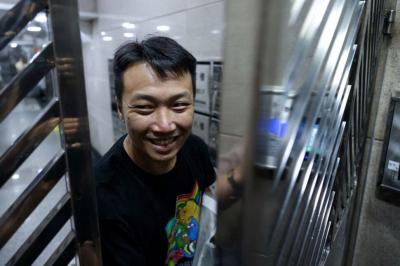
Four people jailed in the landmark Hong Kong national security trial of "47 democrats" accused of conspiracy to commit subversion were freed today after more than four years behind bars, the second group to be released in a month. Among those freed was long-time political and LGBTQ activist Jimmy Sham (岑子杰), who also led one of Hong Kong’s largest pro-democracy groups, the Civil Human Rights Front, which disbanded in 2021. "Let me spend some time with my family," Sham said after arriving at his home in the Kowloon district of Jordan. "I don’t know how to plan ahead because, to me, it feels

‘A THREAT’: Guyanese President Irfan Ali called on Venezuela to follow international court rulings over the region, whose border Guyana says was ratified back in 1899 Misael Zapara said he would vote in Venezuela’s first elections yesterday for the territory of Essequibo, despite living more than 100km away from the oil-rich Guyana-administered region. Both countries lay claim to Essequibo, which makes up two-thirds of Guyana’s territory and is home to 125,000 of its 800,000 citizens. Guyana has administered the region for decades. The centuries-old dispute has intensified since ExxonMobil discovered massive offshore oil deposits a decade ago, giving Guyana the largest crude oil reserves per capita in the world. Venezuela would elect a governor, eight National Assembly deputies and regional councilors in a newly created constituency for the 160,000
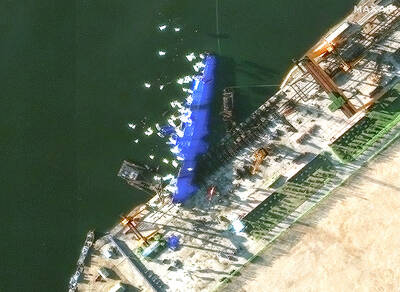
North Korea has detained another official over last week’s failed launch of a warship, which damaged the naval destroyer, state media reported yesterday. Pyongyang announced “a serious accident” at Wednesday last week’s launch ceremony, which crushed sections of the bottom of the new destroyer. North Korean leader Kim Jong-un called the mishap a “criminal act caused by absolute carelessness.” Ri Hyong-son, vice department director of the Munitions Industry Department of the Party Central Committee, was summoned and detained on Sunday, the Korean Central News Agency (KCNA) reported. He was “greatly responsible for the occurrence of the serious accident,” it said. Ri is the fourth person

At a calligraphy class in Hanoi, Hoang Thi Thanh Huyen slides her brush across the page to form the letters and tonal marks of Vietnam’s unique modern script, in part a legacy of French colonial rule. The history of romanized Vietnamese, or Quoc Ngu, links the arrival of the first Christian missionaries, colonization by the French and the rise to power of the Communist Party of Vietnam. It is now reflected in the country’s “bamboo diplomacy” approach of seeking strength through flexibility, or looking to stay on good terms with the world’s major powers. A month after Chinese President Xi Jinping (習近平) visited,


 RSS
RSS