


Cuba and Venezuela on Wednesday clashed with the US during a UN Security Council debate on terrorism over the case of Luis Posada Carriles, a former CIA operative wanted for the 1976 downing of a Cuban airliner.
"Posada Carriles, who is rightly considered the most notorious terrorist of the Western Hemisphere, was released [by US justice] last year in spite of the fact that there was enough evidence linking him to some of the most infamous crimes of the 20th century," Cuban Ambassador to the UN Rodrigo Malmierca Diaz told the council.
He specifically referred to the 1976 downing of a Cuban airliner off Barbados as well as bombings in Havana hotels in 1997.
"Despite Posada Carriles's notorious hideous actions, the US government only charged him with minor migration crimes," Malmierca said.
"There is no doubt today that the true intention was to prevent the details of his criminal actions under CIA orders from becoming public ... The truth will not be concealed forever," he said.
TORTURE
US delegate Carolyn Willson responded by noting that her government was not in a position to extradite the Cuban-born Venezuelan to either Cuba or Venezuela as it was determined that "more likely than not that he would be tortured if he was so transferred."
This brought a scathing reply from Venezuelan Deputy Ambassador to the UN Aura Mahuampi Rodriguez de Ortiz, who accused Washington of protecting "a terrorist" as "a way to undermine justice."
"Venezuela simply cannot understand why the United States does not honor an extradition treaty," she said.
"This is the only thing Venezuela asks: Please comply with the commitments you have undertaken. We have presented our legitimate requests and all the necessary evidence to have the terrorist Posada arrested and extradited to our country," Rodriguez de Ortiz said.
Posada Carriles was arrested in 2005 on immigration charges, but was released in May last year after a federal judge in Texas dropped the indictment, saying the government tricked the former CIA contractor by using a citizenship interview to obtain evidence against him.
In an appeal of the decision, the US government insisted that "the record shows no deceit or trickery, nor outrageous conduct that justifies the extreme sanction of dismissal."
ACTIVITIES
Posada Carriles was jailed in Venezuela in 1976 for allegedly masterminding the downing of the Cuban jet. He escaped in 1985.
He was sentenced to eight years in jail in Panama for a 2000 bomb plot to assassinate former Cuban president Fidel Castro and was pardoned four years later.
Declassified US documents show that Posada Carriles worked for the CIA from 1965 to June 1976.
He also reportedly helped the US government ferry supplies to the Contra rebels who waged a bloody campaign to oust the socialist Sandinista government in Nicaragua in the 1980s.

Kouri Richins, a Utah mother who published a children’s book about grief after the death of her husband is to serve a life sentence for his murder without the possibility of parole, a judge ruled on Wednesday. Richins was convicted in March of aggravated murder for lacing a cocktail given to her husband, Eric Richins, with five times the lethal dose of fentanyl at their home near Park City in 2022. A jury also found her guilty of four other felonies, including insurance fraud, forgery and attempted murder for trying to poison her husband weeks earlier on Feb. 14, 2022, with a
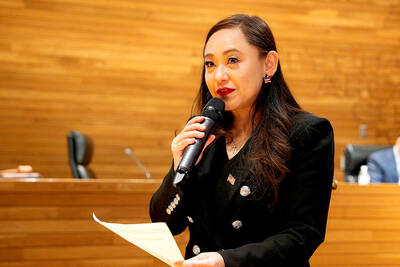
‘PERSONAL MISTAKES’: Eileen Wang has agreed to plead guilty to the felony, which comes with a maximum sentence of 10 years in federal prison A southern California mayor has agreed to plead guilty to acting as an illegal agent for the Chinese government and has resigned from her city position, officials said on Monday. Eileen Wang (王愛琳), mayor of Arcadia, was charged last month with one count of acting in the US as an illegal agent of a foreign government. She was accused of doing the bidding of Chinese officials, such as sharing articles favorable to Beijing, without prior notification to the US government as required by law. The 58-year-old was elected in November 2022 to a five-person city council, from which the mayor is selected
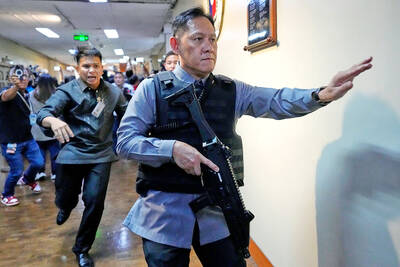
DELA ROSA CASE: The whereabouts of the senator, who is wanted by the ICC, was unclear, while President Marcos faces a political test over the senate situation Philippine authorities yesterday were seeking confirmation of reports that a top politician wanted by the International Criminal Court (ICC) had fled, a day after gunfire rang out at the Philippine Senate where he had taken refuge fearing his arrest. Senator Ronald “Bato” dela Rosa, the former national police chief and top enforcer of former Philippine president Rodrigo Duterte’s “war on drugs,” has been under Senate protection and is wanted for crimes against humanity, the same charges Duterte is accused of. “Several sources confirmed that the senator, Senator Bato, is no longer in the Senate premises, but we are still getting confirmation,” Presidential
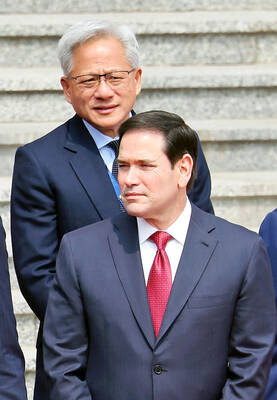
HELP DENIED? The US Department of State said that the Cuban leadership refuses to allow the US to provide aid to Cubans, ‘who are in desperate need of assistance’ US Secretary of State Marco Rubio on Wednesday said that Cuba’s leadership must change, as Washington renewed an offer of US$100 million in aid if the communist nation agrees to cooperate. Cuba has been suffering severe economic tumult led by an energy shortage that plunged 65 percent of the country into darkness on Tuesday. Cuba’s leaders have blamed US sanctions, but Rubio, a Cuban American and critic of the government established by Fidel Castro, said the system was to blame, including corruption by the military. “It’s a broken, nonfunctional economy, and it’s impossible to change it. I wish it were different,” he told


 RSS
RSS