


A South Korean biotechnology professor agreed to retract two papers on anti-aging technology published in international science journals after the institute discovered he fabricated data, officials said.
Kim Tae-kook, a professor at the state-run Korea Advanced Institute of Science and Technology (KAIST), acknowledged that he forged data for a paper on anti-aging technology that was published by the journal Science in 2005 and a follow-up report published by Nature Chemical Biology in 2006, Seo Yeon-soo, a member of the KAIST investigation team, said on Friday.
EDITOR statement
Science issued a statement later in the day alerting its readers "that serious questions have been raised" about the validity of the findings in the published papers.
"We are working with the authors and KAIST to determine appropriate next steps," editor-in-chief Bruce Alberts and editor emeritus Donald Kennedy said in the statement.
KAIST has suspended Kim from teaching and conducting further research at the institute, Seo said
The university was still investigating to determine whether to take further disciplinary measures, KAIST spokesman Kim Chul-hwan said.
It was not immediately clear if Kim Tae-kook would face criminal charges.
The news is the latest blow to South Korean academics after the country's most prominent scientist, Hwang Woo-suk, was found in 2005 to have used faked evidence in purported stem cell breakthroughs that had been internationally hailed.
One of Hwang's papers also had been published in Science.
NOT SO `MAGIC'
In Kim Tae-kook's 2005 paper, he claimed to have discovered a technique he named "MAGIC" to use magnetic nano particles to find target proteins in human bodies, a step toward potentially developing anti-aging drugs.
The next year, he published a paper claiming he had found target proteins by using the technology and created two chemical substances that could slow aging.
On Thursday, the school announced that Kim Tae-kook had admitted his 2005 paper was based on fabricated results.
Seo said the anti-aging substance Kim Tae-kook claimed to have created in his 2006 paper had already been developed by Harvard University and that he had disguised it as his own finding.
"The aforementioned facts alone were already serious enough to justify retraction of both papers from the distinguished journals for the benefits of the scientific community," the school said in a statement offering an apology.
Kim Tae-kook was not available to talk to the media, Seo said.

Gaza is rapidly running out of its limited fuel supply and stocks of food staples might become tight, officials said, after Israel blocked the entry of fuel and goods into the war-shattered territory, citing fighting with Iran. The Israeli military closed all Gaza border crossings on Saturday after announcing airstrikes on Iran carried out jointly with the US. Israeli authorities late on Monday night said that they would reopen the Kerem Shalom crossing from Israel to Gaza yesterday, for “gradual entry of humanitarian aid” into the strip, without saying how much. Israeli authorities previously said the crossings could not be operated safely during
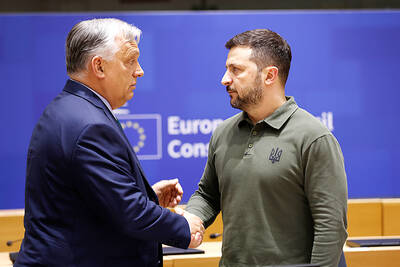
Hungarian authorities temporarily detained seven Ukrainian citizens and seized two armored cars carrying tens of millions of euros in cash across Hungary on suspicion of money laundering, officials said on Friday. The Ukrainians were released on Friday, following their detention on Thursday, but Hungarian officials held onto the cash, prompting Ukraine to accuse Hungary’s Russia-friendly government of illegally seizing the money. “We will not tolerate this state banditism,” Ukrainian Minister of Foreign Affairs Andrii Sybiha said. The seven detained Ukrainians were employees of the Ukrainian state-owned Oschadbank, who were traveling in the two armored cars that were carrying the money between Austria and
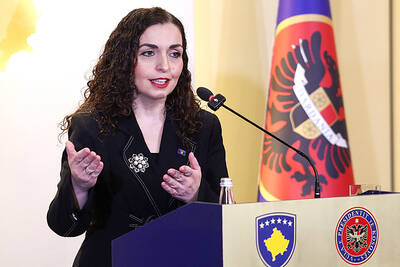
Kosovar President Vjosa Osmani on Friday after dissolving the Kosovar parliament said a snap election should be held as soon as possible to avoid another prolonged political crisis in the Balkan country at a time of global turmoil. Osmani said it is important for Kosovo to wrap up the upcoming election process and form functional institutions for political stability as the war rages in the Middle East. “Precisely because the geopolitical situation is that complex, it is important to finish this electoral process which is coming up,” she said. “It is very hard now to imagine what will happen next.” Kosovo, which declared

MORE BANS: Australia last year required sites to remove accounts held by under-16s, with a few countries pushing for similar action at an EU level and India considering its own ban Indonesia on Friday said it would ban social media access for children under 16, citing threats from online pornography, cyberbullying, online fraud and Internet addiction. “Accounts belonging to children under 16 on high-risk platforms will start to be deactivated, beginning with YouTube, TikTok, Facebook, Instagram, Threads, X, Bigo Live and Roblox,” Indonesian Minister of Communications and Digital Meutya Hafid said. “The government is stepping in so that parents no longer have to fight alone against the giants of the algorithm. Implementation will begin on March 28, 2026,” she said. The social media ban would be introduced in stages “until all platforms fulfill their


 RSS
RSS