


The world's wealthy countries need to pump more money into financing poorer nations' efforts to cut greenhouse gas emissions and cope with climate change, environmentalists said yesterday ahead of a global warming conference.
Representatives of 20 countries -- including the US, European nations, Japan and China -- were to hold a weekend meeting outside Tokyo to focus on developing clean technology and financing the race to stave off possible environmental disaster caused by rising world temperatures.
Environmentalists were taking aim at the US-backed clean technology fund to which Washington announced a US$2 billion contribution in January.
The US government says the fund, which is seeking donations from other countries, would speed up the development of cleaner, more efficient technologies, in developing nations, especially up-and-coming polluters like India and China.
Japan, meanwhile, has pledged US$10 billion over five years for a similar fund, and Britain last year announced its own fund.
CONSULTATION
To be effective, funds such as the US one need more money, should be formed with full consultation with the countries receiving the funds and should continually generate additional money, said Jennifer Morgan, with the E3G environmentalist group.
"Unfortunately, none of these criteria have been met," she said.
Developing nations say they need access to cleaner fuels, alternative energy sources and cleaner burning power plants to reduce carbon dioxide emissions, while at the same time building seawalls to battle rising oceans and taking other steps to counteract the effects of warming.
Alden Meyer, of the Union of Concerned Scientists, said that the UN has estimated it would take about US$200 billion a year in clean technologies to get greenhouse gas emissions back down to current levels by 2030 -- much more than what's on the table so far.
The money should come from new contributions from governments, investment redirected from the private sector and money generated through a vast expansion of the trading of carbon credits -- a system that is already being experimented with in Europe.
"A key part of negotiations over the next two years is to come up with resources that are predictable, dedicated and of the magnitude needed," he said.
The critics also said the funding efforts so far had been set up by the donors without sufficient consultation with poorer nations.
OBLIGATION
Rashed Al Mahmud Titumir, of the ActionAid environmentalist group, said rich nations had an obligation to help developing nations.
"We want to see that this is not a matter of charity," he said, adding that pollution caused by wealthy nations has caused the crisis that poorer nations now have to grapple with.
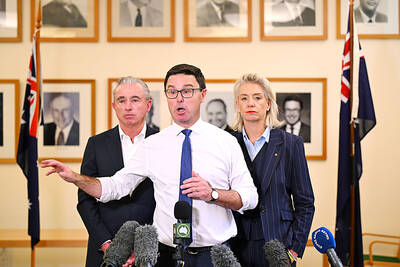
BACKLASH: The National Party quit its decades-long partnership with the Liberal Party after their election loss to center-left Labor, which won a historic third term Australia’s National Party has split from its conservative coalition partner of more than 60 years, the Liberal Party, citing policy differences over renewable energy and after a resounding loss at a national election this month. “Its time to have a break,” Nationals leader David Littleproud told reporters yesterday. The split shows the pressure on Australia’s conservative parties after Prime Minister Anthony Albanese’s center-left Labor party won a historic second term in the May 3 election, powered by a voter backlash against US President Donald Trump’s policies. Under the long-standing partnership in state and federal politics, the Liberal and National coalition had shared power

A Croatian town has come up with a novel solution to solve the issue of working parents when there are no public childcare spaces available: pay grandparents to do it. Samobor, near the capital, Zagreb, has become the first in the country to run a “Grandmother-Grandfather Service,” which pays 360 euros (US$400) a month per child. The scheme allows grandparents to top up their pension, but the authorities also hope it will boost family ties and tackle social isolation as the population ages. “The benefits are multiple,” Samobor Mayor Petra Skrobot told reporters. “Pensions are rather low and for parents it is sometimes

CONTROVERSY: During the performance of Israel’s entrant Yuval Raphael’s song ‘New Day Will Rise,’ loud whistles were heard and two people tried to get on stage Austria’s JJ yesterday won the Eurovision Song Contest, with his operatic song Wasted Love triumphing at the world’s biggest live music television event. After votes from national juries around Europe and viewers from across the continent and beyond, JJ gave Austria its first victory since bearded drag performer Conchita Wurst’s 2014 triumph. After the nail-biting drama as the votes were revealed running into yesterday morning, Austria finished with 436 points, ahead of Israel — whose participation drew protests — on 357 and Estonia on 356. “Thank you to you, Europe, for making my dreams come true,” 24-year-old countertenor JJ, whose

Two people died and 19 others were injured after a Mexican Navy training ship hit the Brooklyn Bridge, New York City Mayor Eric Adams said yesterday. The ship snapped all three of its masts as it collided with the New York City landmark late on Saturday, while onlookers enjoying the balmy spring evening watched in horror. “At this time, of the 277 on board, 19 sustained injuries, 2 of which remain in critical condition, and 2 more have sadly passed away from their injuries,” Adams posted on X. Footage shared online showed the Mexican Navy ship Cuauhtemoc, its sails furled


 RSS
RSS