


British Prime Minister Gordon Brown held telephone talks with Iraqi Prime Minister Nuri al-Maliki yesterday about video footage of one of five British hostages being held by militants in Iraq.
The Britons -- - a computer instructor and his four bodyguards -- were seized by a Shiite militant group from inside an Iraqi Finance Ministry building in a brazen raid in Baghdad last May.
Video footage of one of the captives was aired on Tuesday by Al Arabiya television, which said the captive called for the release of nine Iraqis in return for their freedom.
Brown's spokesman said the prime minister had been "in close contact" with Maliki about the case and had "discussed it again with him over the phone this morning."
An Iraqi embassy spokeswoman said Maliki was in London, but declined to give any more details.
The hostage, who said in the video that his name was Peter, looked tired but not distressed. He had a scraggly beard and wore what appeared to be a white and black track suit.
"I miss my family a lot and the only thing I want is to get out of here. I tell Gordon Brown: Free their prisoners and we can go home," he said in remarks dubbed into Arabic.
Militants holding the five Britons released a video last December showing another of the hostages, who identified himself as Jason, saying they would kill one of the five unless Britain withdrew its troops from Iraq.
Meanwhile, Information Commissioner Richard Thomas has ordered the government to release the minutes of two Cabinet meetings held in March 2003, under former prime minister Tony Blair to discuss the legality of the allied invasion of Iraq that began later that month.
The commissioner, acting on a request made under Britain's Freedom of Information Act, said his ruling was based on "the gravity and controversial nature" of Britain's decision to go to war, and would not, as government officials have argued, set a "dangerous precedent" for releasing Cabinet papers that have traditionally remained secret for 30 years.
Thomas cited the controversy surrounding the ruling by the Blair government's attorney general, Lord Goldsmith, that going to war was legal, and the protest resignations of several of Blair's ministers that followed.
"The commissioner considers that the decision on whether to take military action against another country is so important that the accountability for such decision-making is paramount," Thomas' ruling said.
A spokesman for Brown said the government would decide whether to appeal the ruling to the courts, a step that must be taken within five weeks.
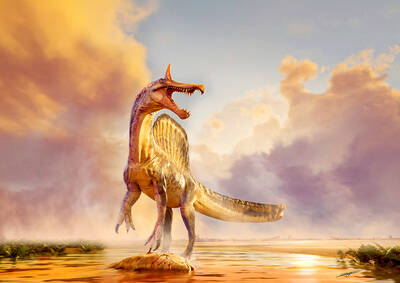
FEROCIOUS FISH-EATER Scientists have found a new species of dinosaur from the Cretaceous Period, a ‘hell heron’ that stalked the rivers, deep in the Saharan desert At a remote Sahara desert site in Niger, scientists have unearthed fossils of a new species of Spinosaurus, among the biggest of the meat-eating dinosaurs, notable for its large blade-shaped head crest and jaws bearing interlocking teeth for snaring fish. It prowled a forested inland environment and strode into rivers to catch sizable fish like a modern-day wading bird — a “hell heron,” as one of the researchers put it, considering it was about 12 meters long and weighed 5-7 tons. The dinosaur presented a striking profile on the Cretaceous Period landscape of Africa some 95 million years ago as it hunted
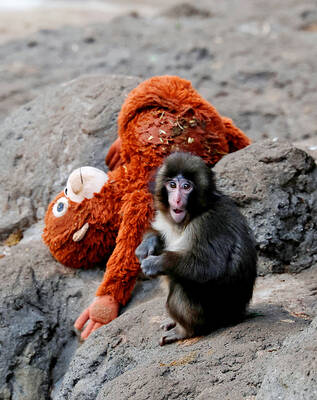
THE TRAGEDY OF PUNCH: Footage of the seven-month-old Japanese macaque has gone viral online after he was rejected by his mother and formed a bond with a soft toy A baby monkey in Japan has captured hearts around the world after videos of him being bullied by other monkeys and rejected by his mother went viral last week. Punch, a Japanese macaque, was born in July last year at Ichikawa City Zoo. He has drawn international attention after zookeepers gave him a stuffed orangutan toy after he was abandoned by his mother. Without maternal guidance to help him integrate, Punch has turned to the toy for comfort. He has been filmed multiple times being dragged and chased by older Japanese macaques inside the enclosure. Early clips showed him wandering alone with
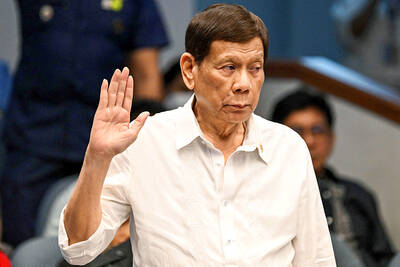
DRUG WAR: The former president said there was no campaign to kill addicts, but his speeches called for violence and told police to use lethal force if necessary Former Philippine president Rodrigo Duterte earned global infamy for the deadly drug crackdown that led to his arrest over crimes against humanity charges, despite his huge popularity at home. A profane-lipped populist and self-professed killer, Duterte’s anti-crime campaign resulted in the deaths of thousands of alleged dealers and addicts. Rights groups said many of those killed were poor men, often without any proof they were linked to drugs. Yet, while drawing condemnation abroad, tens of millions of Filipinos backed his swift brand of justice — even as he joked about rape in his rambling speeches, locked up his critics and failed to
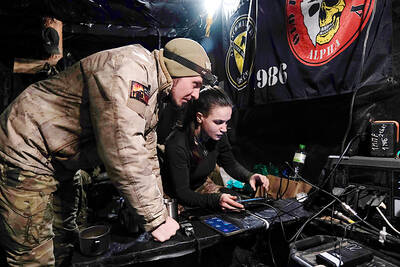
GAME CHANGER The Russian invasion of Ukraine has shown the utility of small drones for recon, for supporting logistics and for killing across the modern battlefield Five European nations have announced a new program to produce low-cost air defense systems and autonomous drones using Ukrainian expertise, hard-won over the past four years fighting against Russia. Friday’s initiative of the five nations — France, Poland, Germany, the UK and Italy — comes as one of many European efforts to bolster defense along their borders, like a “drone wall ” with Russia and Ukraine to better detect, track and intercept drones violating Europe’s airspace. Both Moscow and Kyiv have cutting-edge drone warfare capabilities forged in the grim laboratory of war where battlefield innovations have rewritten modern battle tactics. Poland is


 RSS
RSS