


A wide-ranging investigation of tax evasion by Germans stashing their money abroad has led to the recovery of more than US$40 million and netted 163 people, a prosecutor said.
Similar probes have started elsewhere in Europe and Australia.
In brief televised comments from Bochum, Germany, prosecutor Hans-Ulrich Krueck said on Tuesday that so far 91 people targeted in the investigation "have admitted to the facts" and had made payments totaling US$41.2 million.
"At the moment, that sum is rising daily," Krueck said.
He added that another 72 people had turned themselves in to tax authorities.
Krueck did not name any names or say what they did for a living -- a marked contrast with a high-profile Feb. 14 raid on the house of then-Deutsche Post chief executive Klaus Zumwinkel.
Prosecutors in the investigation -- which now has prompted probes as far afield as Australia -- say the suspects evaded taxes by putting money in foundations in the tiny tax haven of Liechtenstein.
Krueck said that the foundations checked so far had "capital of well over 200 million euros [US$296 million]."
Tax officials and prosecutors began conducting raids after the German intelligence service paid an informant as much as 5 million euros for a CD-ROM believed to contain 1,400 names of suspected tax cheats, about 600 of whom were Germans.
Liechtenstein's LGT Group says it assumes the data were sold by Heinrich Kieber, a Liechtenstein citizen who has been convicted in his home country of stealing personal information from LGT Treuhand, a unit of LGT Group.
In a statement this week, LGT said that as far as it is concerned "the data material illegally disclosed to the German authorities is limited, with almost complete certainty, to the client data stolen from LGT Treuhand in 2002."
The German Finance Ministry has said the acquisition of the disc was legal and has given no information on the informant.
In Ireland, Denis Harkin, a spokesman for that country's revenue commissioners, said they were aware of the list "and we will be in contact with German authorities to see if there are any Irish residents on the list."
Swedish tax agency chief Mats Sjostrand said Sweden and eight other countries were working with Germany to reveal tax cheats in Liechtenstein.
They include Britain, France, Italy, Spain, Canada, the US, Australia and New Zealand, Sjostrand said in an article published on Tuesday in the newspaper Dagens Nyheter.
"For Sweden it's about 100 Swedes with bank assets in this so-called tax paradise," he said.
Spain's Tax Agency, part of the Finance Ministry, confirmed it was analyzing information on Spanish citizens who had accounts in Liechtenstein as part of the probe that began in Germany.
Liechtenstein officials have defended the practice of allowing foreigners to open trusts there anonymously.
LGT, owned by Liechtenstein's ruling family, has denied any wrongdoing.
French tax authorities were also looking into information on possible tax dodgers with bank accounts in Liechtenstein, the Budget Ministry said on Tuesday, while Australian and New Zealand authorities yesterday mounted raids on residents suspected of dodging tax through Liechtenstein.
The Organization of Economic Cooperation and Development (OECD), the world's leading anti-corruption watchdog, is spearheading the effort to force tax havens to be more transparent.
The US has told the OECD that tax evasion costs it up to US$100 billion a year, while Sweden has said it costs them US$7.5 billion.

SPEAKING OUT: After Siranudh Scott’s allegations surfaced, celebrities and public figures took to social media to share their own experiences of sexual misconduct and abuse A high-profile alleged sexual abuse case within a wealthy Thai beer brewing family has prompted a wave of painful accounts from survivors of unconnected abuse in the conservative nation. Siranudh Scott, a member of the billionaire Thai family that founded the ubiquitous Singha beer brand, posted an emotional video this month accusing his elder brother Sunit of repeatedly abusing him when he was a teenager. Sunit, who is in his 30s, later denied the allegations in a video posted online, but Singha parent Boonrawd dismissed him from his executive role with the company on Tuesday last week. “I felt I needed to speak

SEEKING ORDER: Rodrigo Paz said that ‘anyone who wants to destroy the nation will have to deal with this president and the full force of the constitution’ Bolivian President Rodrigo Paz on Wednesday said that the nation was at a “breaking point” after nearly a month of protests that have caused shortages of food, fuel and medicine. Paz, who took office six months ago amid the worst economic crisis there in four decades, is battling a groundswell of fury over his policies. The political capital, La Paz, has been besieged by low-income workers and members of the indigenous majority calling for his resignation. “The country needs order and is reaching breaking point,” the 58-year-old said at a public event in La Paz, renewing his appeal for dialogue. On Tuesday, the Bolivian
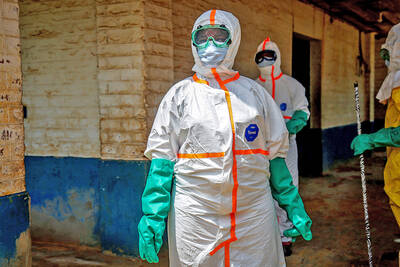
COMMUNITY CONFLICT: Concerns about disease spread from corpses has run up against friends and families’ desire to bury their dead as infection spreads in the area Angry residents of a town at the epicenter of the Ebola outbreak in the Democratic Republic of the Congo (DR Congo) attacked and burned a tent that was part of a health center where people are being treated for the virus, the staff there said Saturday. It was the second such attack in the region in a week. No one was hurt in the attack, according to reports but as patients ran out to escape the fire, 18 people with suspected Ebola infections fled the facility and are unaccounted for, a hospital director said. Angry residents arrived at the clinic in the
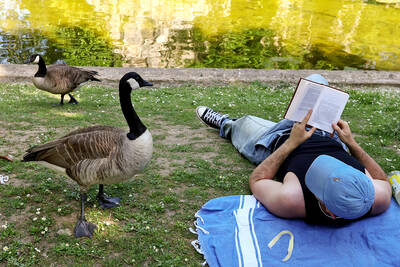
Forecasters in Europe yesterday warned of exceptional heat as record temperatures driven by a “heat dome” push temperatures well above seasonal norms across the continent. The surge follows a record-breaking Monday, with France logging its hottest day in the month of May on record, its weather agency said, and the UK also posting unprecedented highs. A so-called “heat dome” of warm air from northern Africa trapped under a high-pressure system over western Europe is behind the high temperatures not usually seen until high summer. Restrictions on outdoor work were imposed in parts of Italy, beaches in southwest France filled earlier than usual and


 RSS
RSS