


Canada's spy agency has made new allegations against a Montreal man who has been accused of being an al-Qaeda sleeper agent, saying he once discussed commandeering a commercial aircraft and had applied to work for Air Canada.
The Canadian Security Intelligence Service laid the allegations against Moroccan-born Adil Charkaoui late on Friday as the federal government renewed its efforts to deport him and four other men accused of having terrorist links.
Charkaoui's supporters denied the latest accusations against him, calling them unproven fragments of information based on hearsay.
Charkaoui was arrested in Montreal in May 2003 and spent 21 months in jail under Canada's controversial security certificate measure, which allows authorities to hold a detainee indefinitely without charges and lets the government keep any evidence secret. He was released on bail in 2005.
On Friday, the Canadian government leveled new allegations against Charkaoui and the four others who are fighting to remain in the country.
In the newly filed papers, the spy agency claims that convicted terrorist Ahmed Ressam has identified Charkaoui as being present at an al-Qaeda training camp in Afghanistan.
Charkaoui's defenders said that the allegations remain part of the file despite a retraction from Ressam, who was caught trying to smuggle explosives into the US on the eve of the millennium.
"Charkaoui and his lawyers have asked to cross-examine Ressam numerous times. This opportunity has always been denied, and it was finally acknowledged by the government that no sworn testimony existed, and that the information was based on hearsay," a statement said.
The spy agency also said Charkaoui allegedly had a conversation with two others about their apparent desire to take control of a commercial plane for aggressive purposes.
And it said Charkaoui once applied to work in the air traffic control operations at Air Canada, and later had an interest in working in the baggage section of Mirabel airport near Montreal.
The spy service suggests the job search may have been part of the "planning of an attack."
Charkaoui and the four others last year waged a successful challenge to the constitutionality of Canada's federal legislation dealing with the indefinite detention of foreign nationals on the basis of secret suspicions, and under the threat of deportation to countries where they may face torture.
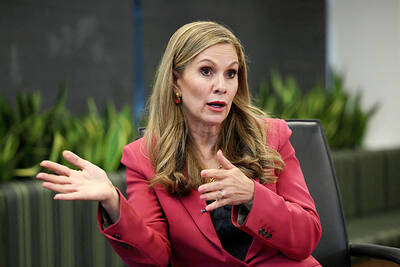
Australians were downloading virtual private networks (VPNs) in droves, while one of the world’s largest porn distributors said it was blocking users from its platforms as the country yesterday rolled out sweeping online age restriction. Australia in December became the first country to impose a nationwide ban on teenagers using social media. A separate law now requires artificial intelligence (AI)-powered chatbot services to keep certain content — including pornography, extreme violence and self-harm and eating disorder material — from minors or face fines of up to A$49.5 million (US$34.6 million). The country also joined Britain, France and dozens of US states requiring
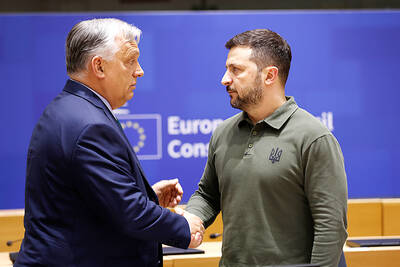
Hungarian authorities temporarily detained seven Ukrainian citizens and seized two armored cars carrying tens of millions of euros in cash across Hungary on suspicion of money laundering, officials said on Friday. The Ukrainians were released on Friday, following their detention on Thursday, but Hungarian officials held onto the cash, prompting Ukraine to accuse Hungary’s Russia-friendly government of illegally seizing the money. “We will not tolerate this state banditism,” Ukrainian Minister of Foreign Affairs Andrii Sybiha said. The seven detained Ukrainians were employees of the Ukrainian state-owned Oschadbank, who were traveling in the two armored cars that were carrying the money between Austria and
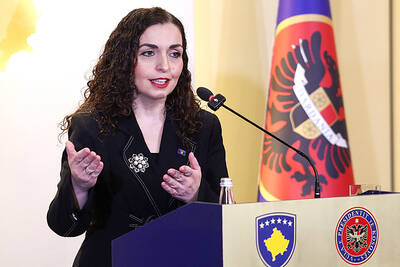
Kosovar President Vjosa Osmani on Friday after dissolving the Kosovar parliament said a snap election should be held as soon as possible to avoid another prolonged political crisis in the Balkan country at a time of global turmoil. Osmani said it is important for Kosovo to wrap up the upcoming election process and form functional institutions for political stability as the war rages in the Middle East. “Precisely because the geopolitical situation is that complex, it is important to finish this electoral process which is coming up,” she said. “It is very hard now to imagine what will happen next.” Kosovo, which declared

MORE BANS: Australia last year required sites to remove accounts held by under-16s, with a few countries pushing for similar action at an EU level and India considering its own ban Indonesia on Friday said it would ban social media access for children under 16, citing threats from online pornography, cyberbullying, online fraud and Internet addiction. “Accounts belonging to children under 16 on high-risk platforms will start to be deactivated, beginning with YouTube, TikTok, Facebook, Instagram, Threads, X, Bigo Live and Roblox,” Indonesian Minister of Communications and Digital Meutya Hafid said. “The government is stepping in so that parents no longer have to fight alone against the giants of the algorithm. Implementation will begin on March 28, 2026,” she said. The social media ban would be introduced in stages “until all platforms fulfill their


 RSS
RSS