


The eight-month closure of Gaza has created "grim and miserable" conditions that deprive Gazans of their basic dignity, the UN's top humanitarian affairs official said during a visit, urging that the territory's borders be reopened.
Meanwhile, medical officials said yesterday that the death toll in a mysterious explosion at a Gaza refugee camp has risen from six to eight. Friday's blast in the house of Ayman Atallah Fayed, a senior Islamic Jihad activist, killed him, his wife, three of his sons and three neighbors, said Moawiya Hassanain, a Health Ministry official. At least 40 people were wounded, 12 of them critically, including one of Fayed's daughters.
Hamas police said the cause was not clear, while Islamic Jihad blamed an Israeli airstrike and threatened revenge attacks.
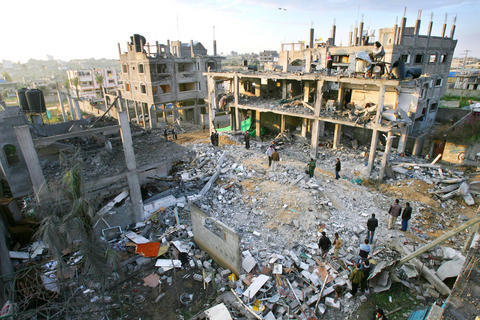
PHOTO: AFP
The Israeli military denied it carried out an airstrike in the Bureij camp.
UN Undersecretary-General for Humanitarian Affairs John Holmes toured Gaza's largest hospital, speaking with dialysis patients and inspecting the neonatal unit, and then visited an industrial zone that once employed 1,800 Palestinians but has been idled by the border closure.
Israel and Egypt severely restricted access to Gaza after the Islamic militants seized the territory by force in June. Since then, only a few dozen trucks carrying food, medicine and other basics have been permitted into Gaza every day, while most exports are banned.
The closure has driven up poverty and unemployment, and the UN says some 80 percent of Gaza's 1.4 million people now get some food aid.
"All this makes for a grim human and humanitarian situation here in Gaza, which means that people are not able to live with the basic dignity to which they are entitled," Holmes told reporters in Gaza.
The extent of suffering in Gaza has been a subject of dispute. Palestinians and human rights groups say hardship is widespread, while Israeli government officials have accused Hamas of trying to manufacture a humanitarian crisis for political gain.
Holmes' four-vehicle convoy, marked by blue UN flags, drove through potholed, muddy streets without a Hamas police escort.
It was Holmes' first visit to Gaza as humanitarian affairs chief, part of a four-day trip that also includes a a stop in the Israeli town of Sderot, hit hard by continued rocket fire from Gaza.
The UN envoy started the day at Gaza City's Shifa Hospital, where administrators told him they were worried about a possible breakdown of overburdened generators and that they needed spare parts for medical machinery, such as dialysis machines.
In recent weeks, rolling blackouts of several hours a day have been the norm in Gaza, a result of reduced fuel shipments by Israel, which says it is trying to pressure Gaza militants to halt rocket fire into Israel. So far, generators have kept hospitals going during power cuts.
"No freedom, no freedom," Zaher Shabat, the wife of dialysis patient Ahmed Shabat, told Holmes after trying to squeeze all her woes into a brief conversation. She told him she has 10 children and that with her husband unemployed, it was tough for him to spend money on trips to the hospital every other day.
"I'll do my best," Holmes told her before being taken to the next patient.
At Gaza's main cargo crossing, closed since June, Holmes was briefed by Wadie al-Masri, general manager of the Karni industrial zone which employed 1,800 before the closure.
Al-Masri told Holmes that Israel must significantly increase the number of truckloads allowed into Gaza, from about 50 to at least 200 a day, just to meet basic needs.

School bullies in Singapore are to face caning under new guidelines, but the education minister on Tuesday said it would be meted out only as a last resort with strict safeguards. Human rights groups regularly criticize Singapore for the use of corporal punishment, which remains part of the school and criminal justice systems, but authorities have defended it as a deterrent to crime and serious misconduct. Caning was discussed in the parliament after legislators asked how it would be used in relation to bullying in schools. The debate followed stricter guidelines on serious student misconduct, including bullying, unveiled by the Singaporean Ministry of

As evening falls in Fiji’s capital, a steady stream of people approaches a makeshift clinic that is a first line of defense against one of the world’s fastest-growing HIV epidemics. In the South Pacific nation — a popular tourist destination of just under a million people — more than 2,000 new HIV cases were recorded last year, a 26 percent increase from 2024. The government has declared an HIV outbreak and described it as a national crisis. “It’s spreading like wildfire,” said Siteri Dinawai, 46, who came to be tested. The Moonlight Clinic, a converted minibus parked in a suburban cul-de-sac in Suva, is

A MESSAGE: Japan’s participation in the Balikatan drills is a clear deterrence signal to China not to attack Taiwan while the US is busy in the Middle East, an analyst said The Japan Self-Defense Forces yesterday fired a Type 88 anti-ship missile during a joint maritime exercise with US, Australian and Philippine forces, hitting a decommissioned Philippine Navy ship in waters facing the disputed South China Sea, in drills that underscore Tokyo’s rising willingness to project military power on China’s doorstep. The drill took place as Manila and Tokyo began talks on a potential defense equipment transfer, made possible by Japan’s decision to scrap restrictions on military exports. The discussions include the possible early transfer of Abukuma-class destroyers and TC-90 aircraft to the Philippines, Japanese Minister of Defense Shinjiro Koizumi said. Philippine Secretary of

‘GROSS NEGLIGENCE?’ Despite a spleen typically being significantly smaller than a liver, the surgeon said he believed Bryan’s spleen was ‘double the size of what is normal’ A Florida surgeon who is facing criminal charges after allegedly removing a patient’s liver instead of his spleen has said he is “forever traumatized” by that person’s death. In a deposition from November last year that was recently obtained by NBC, 44-year-old Thomas Shaknovsky described the death of 70-year-old William Bryan as an “incredibly unfortunate event that I regret deeply.” Bryan died after the botched surgery; and last month, a grand jury in Tallahassee indicted Shaknovsky on a charge of manslaughter. “I’m forever traumatized by it and hurt by it,” Shaknovsky added, also saying that wrong-site surgeries can happen “during


 RSS
RSS